


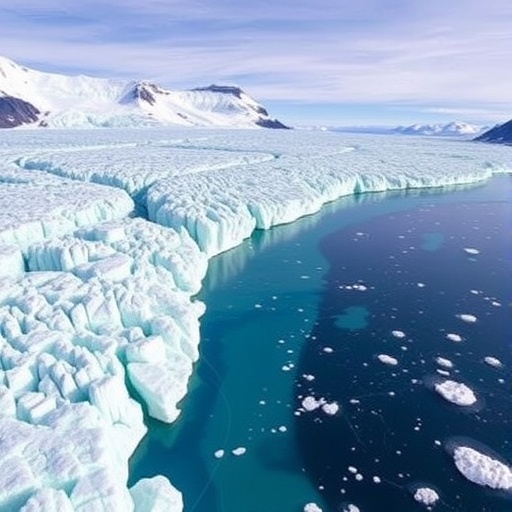
As global temperatures rise and glaciers melt at unprecedented rates, an intriguing question emerges about the fate of the unique microbial communities entrapped in the ice. Recent research led by Liu, K., Liu, Y., Zhang, Z., and colleagues brings new insight into this issue, revealing that microbes released by melting glaciers are seldom found in surrounding coastal ecosystems despite their high diversity and distinctiveness. This discovery challenges existing assumptions regarding microbial dispersal and ecosystem connectivity in the context of climate change.
Glaciers, often perceived as barren ice masses, are in fact complex microbial habitats harboring diverse and specialized microorganisms adapted to extreme cold and low nutrient availability. When glaciers retreat, these microbial populations are liberated into the environment, potentially influencing downstream ecosystems. However, the extent to which glacial microbes colonize or integrate into adjacent marine and terrestrial biomes has remained poorly understood until now.
Utilizing cutting-edge metagenomic sequencing and environmental sampling techniques, the researchers conducted an extensive survey of microbial communities from several retreating glaciers and their corresponding coastal environments. Their results illustrated a stark ecological boundary: while meltwater ecosystems directly downstream exhibited some overlap with glacial microbial assemblages, the microbial signatures detected in nearby coastal ecosystems were largely distinct, indicating minimal microbial transmission.
The study provides comprehensive evidence that most glacial microbes lack the capacity to survive, proliferate, or compete effectively once they enter coastal ecosystems. Factors such as drastic changes in salinity, temperature, nutrient availability, and biotic interactions appear to create strong environmental filters, preventing successful colonization by these cold-adapted glacial microorganisms. This highlights the role of environmental barriers in controlling microbial dispersal despite the physical movement of water and sediments.
Moreover, the findings suggest that the unique microbial biodiversity specialized for cold glacial habitats is at risk with ongoing glacier retreat, as their dispersal does not readily translate into expansion into other biomes. As glacier habitats shrink, these microbes may face local extinction, underscoring the often overlooked biodiversity risks associated with climate-driven ice loss.
The research also advances our understanding of microbial biogeography, showing that dispersal does not necessarily lead to establishment. While microbes are traditionally viewed as having high dispersal potential, this work emphasizes the importance of environmental suitability and niche specificity in microbial distribution patterns. It also challenges the notion that retreating glaciers act as major sources seeding coastal microbial communities with glacial-origin taxa.
Importantly, this study utilized a combination of high-throughput DNA sequencing technologies and sophisticated bioinformatics pipelines to delineate microbial community structure and composition with high resolution. By comparing metagenomes from glacier meltwaters, sediments, and coastal sites, the team detected distinct microbial assemblages shaped by environmental constraints rather than mere geographic proximity.
This research has important implications for understanding how microbial communities respond to environmental change and for predicting ecosystem trajectories in polar and alpine regions. It highlights that microbial ecosystems associated with glaciers are both unique and vulnerable, calling for conservation attention as glaciers continue to disappear.
Furthermore, the study raises questions about the functional roles of glacial microbes once released into downstream ecosystems. If these microbes fail to establish in coastal habitats, the biogeochemical cycles influenced by them may be disrupted. This could impact nutrient fluxes, organic matter turnover, and overall ecosystem functioning in vulnerable polar coastal zones.
The meticulous approach in this study also demonstrates the challenges in detecting and tracking microbial dispersal in complex environmental matrices. Differentiating between transient presence and successful colonization requires combining genetic, ecological, and physiological assessments, a methodological advancement showcased by the authors.
These revelations stress that climate change-driven glacier melting reshapes not only visible landscapes but also microbial ecosystems in nuanced ways that transcend simple dispersal dynamics. The disconnect between microbial release and ecological integration exemplifies the complexity of microbial ecology in changing environments.
By illuminating the fate of microbes from glacier ice, this research enriches our broader understanding of microbial ecology, biogeography, and the resilience and vulnerability of microbial life in an era of rapid environmental transformation. It beckons further interdisciplinary research combining microbiology, glaciology, and ecosystem science to unravel the multifaceted impacts of melting glaciers.
Ultimately, the study by Liu and colleagues fosters a more refined perspective on the microbial consequences of glacier retreat, emphasizing that these hidden microbial communities are not simply passively transported but face stringent ecological hurdles in new habitats. This adds depth to our understanding of microbial dispersal limits and ecosystem specificity under changing planetary conditions.
As glaciers continue to shrink worldwide, the conservation of their unique microbial inhabitants gains significance, especially given their potential roles in ecosystem processes and as reservoirs of genetic diversity adapted to extreme cold. Understanding their ecology is indispensable for predicting future biodiversity patterns and ecosystem responses in polar and alpine environments.
In conclusion, while retreating glaciers act as sources releasing unique microbial assemblages, the propagation of these microbes into coastal ecosystems is exceedingly rare. This discovery underscores the intricacies of microbial distribution driven by environmental filtering rather than dispersal capability alone, offering critical insights into microbial life resilience in a warming world.
Cite Scienmag News
Violet Maxwell. (March 23, 2026). Glacier Microbes Rarely Reach Coastal Ecosystems. Scienmag. https://scienmag.com/glacier-microbes-rarely-reach-coastal-ecosystems/
Violet Maxwell. "Glacier Microbes Rarely Reach Coastal Ecosystems." Scienmag, 23 March 2026, https://scienmag.com/glacier-microbes-rarely-reach-coastal-ecosystems/. Accessed 4 September 2026.
Violet Maxwell. "Glacier Microbes Rarely Reach Coastal Ecosystems." Scienmag. March 23, 2026. https://scienmag.com/glacier-microbes-rarely-reach-coastal-ecosystems/


