

Sunday, May 3, 2026
Science
No Result
View All Result
  • Login
  • HOME
  • SCIENCE NEWS
  • CONTACT US
  • HOME
  • SCIENCE NEWS
  • CONTACT US
No Result
View All Result
Scienmag
No Result
View All Result
Home Science News Space

Giant galactic explosion exposes galaxy pollution in action

April 22, 2024
in Space
Reading Time: 2 mins read
0
A galactic fountain
68
SHARES
618
VIEWS
Share on FacebookShare on Twitter
ADVERTISEMENT

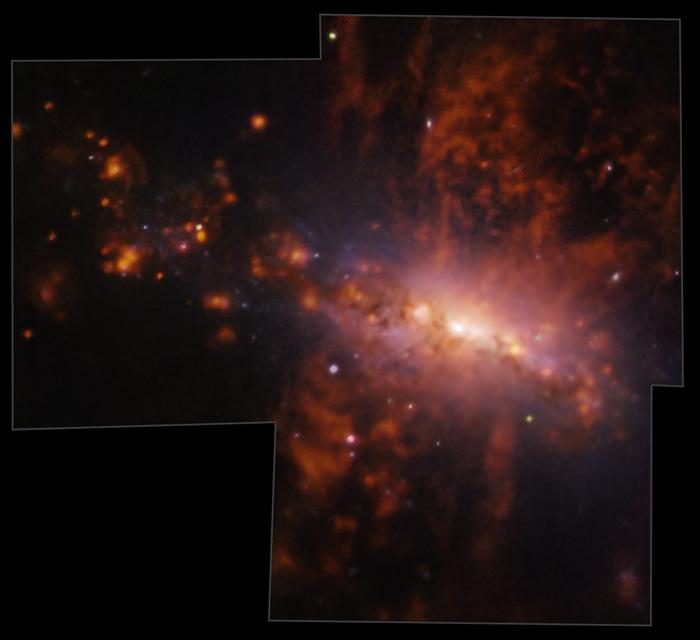
A team of international researchers studied galaxy NGC 4383, in the nearby Virgo cluster, revealing a gas outflow so large that it would take 20,000 years for light to travel from one side to the other.

A galactic fountain

Credit: Credit: ESO/A. Watts et al

A team of international researchers studied galaxy NGC 4383, in the nearby Virgo cluster, revealing a gas outflow so large that it would take 20,000 years for light to travel from one side to the other.

The discovery was published today in the journal Monthly Notices of the Royal Astronomical Society.

Lead author Dr Adam Watts, from The University of Western Australia node at the International Centre for Radio Astronomy Research (ICRAR), said the outflow was the result of powerful stellar explosions in the central regions of the galaxy that could eject enormous amounts of hydrogen and heavier elements.

The mass of gas ejected is equivalent to more than 50 million Suns. 

“Very little is known about the physics of outflows and their properties because outflows are very hard to detect,” Dr Watts said.

“The ejected gas is quite rich in heavy elements giving us a unique view of the complex process of mixing between hydrogen and metals in the outflowing gas.

“In this particular case, we detected oxygen, nitrogen, sulphur and many other chemical elements.”

Gas outflows are crucial to regulate how fast and for how long galaxies can keep forming stars. The gas ejected by these explosions pollutes the space between stars within a galaxy, and even between galaxies, and can float in the intergalactic medium forever.

The high-resolution map was produced with data from the MAUVE survey, co-led by ICRAR researchers Professors Barbara Catinella and Luca Cortese, who were also co-authors of the study.

The survey used the MUSE Integral Field Spectrograph on the European Southern Observatoryʼs Very Large Telescope, located in northern Chile.

“We designed MAUVE to investigate how physical processes such as gas outflows help stop star formation in galaxies,” Professor Catinella said.

“NGC 4383 was our first target, as we suspected something very interesting was happening, but the data exceeded all our expectations.

“We hope that in the future, MAUVE observations reveal the importance of gas outflows in the local Universe with exquisite detail.”


Journal

Monthly Notices of the Royal Astronomical Society

DOI

10.1093/mnras/stae898

Method of Research

Meta-analysis

Article Title

MAUVE: A 6 kpc bipolar outflow launched from NGC4383, one of the most Hi-rich galaxies in the Virgo cluster

Article Publication Date

22-Apr-2024

Share27Tweet17
Previous Post

Everest mountaineer’s letters digitized for the first time

Next Post

First Nations patients leave ED without completing treatment more than comparable non–First Nations patients

Related Posts

Flies Adapt and Recover Under Intense Hypergravity Conditions — Space
Space

Flies Adapt and Recover Under Intense Hypergravity Conditions

May 1, 2026
UBCO Discovery Poised to Revolutionize Future Wireless Networks — Space
Space

UBCO Discovery Poised to Revolutionize Future Wireless Networks

April 30, 2026
Slimmer Silhouette of Giant Planet Revealed — Space
Space

Slimmer Silhouette of Giant Planet Revealed

April 30, 2026
Enhancing Navigation Accuracy: Using Map Coloring to Minimize Visual Drift in GNSS-Denied Environments — Space
Space

Enhancing Navigation Accuracy: Using Map Coloring to Minimize Visual Drift in GNSS-Denied Environments

April 30, 2026
Hidden Cold Traps May Reveal the Secrets of Lunar Ice — Space
Space

Hidden Cold Traps May Reveal the Secrets of Lunar Ice

April 30, 2026
Horizontal Transport Drives Nightside Chemistry on Hot Exoplanet — Space
Space

Horizontal Transport Drives Nightside Chemistry on Hot Exoplanet

April 30, 2026
Next Post
First Nations patients leave ED without completing treatment more than comparable non–First Nations patients

First Nations patients leave ED without completing treatment more than comparable non–First Nations patients

  • Mothers who receive childcare support from maternal grandparents show more parental warmth, finds NTU Singapore study

    Mothers who receive childcare support from maternal grandparents show more parental warmth, finds NTU Singapore study

    27639 shares
    Share 11052 Tweet 6908
  • University of Seville Breaks 120-Year-Old Mystery, Revises a Key Einstein Concept

    1042 shares
    Share 417 Tweet 261
  • Bee body mass, pathogens and local climate influence heat tolerance

    677 shares
    Share 271 Tweet 169
  • Researchers record first-ever images and data of a shark experiencing a boat strike

    540 shares
    Share 216 Tweet 135
  • Groundbreaking Clinical Trial Reveals Lubiprostone Enhances Kidney Function

    527 shares
    Share 211 Tweet 132
Science

Embark on a thrilling journey of discovery with Scienmag.com—your ultimate source for cutting-edge breakthroughs. Immerse yourself in a world where curiosity knows no limits and tomorrow’s possibilities become today’s reality!

RECENT NEWS

  • Family Health Needs of Disabled Elders Explored
  • Mcu Controls Bone Growth Through Mitochondrial Calcium
  • Physical Disorders, ADLs, Cognition, Depression in Nursing Homes
  • Precise Spatiotemporal Cardiac Repair and Regeneration

Categories

  • Agriculture
  • Anthropology
  • Archaeology
  • Athmospheric
  • Biology
  • Biotechnology
  • Blog
  • Bussines
  • Cancer
  • Chemistry
  • Climate
  • Earth Science
  • Editorial Policy
  • Marine
  • Mathematics
  • Medicine
  • Pediatry
  • Policy
  • Psychology & Psychiatry
  • Science Education
  • Social Science
  • Space
  • Technology and Engineering

Subscribe to Blog via Email

Success! An email was just sent to confirm your subscription. Please find the email now and click 'Confirm Follow' to start subscribing.

Join 5,146 other subscribers

© 2025 Scienmag - Science Magazine

Welcome Back!

Login to your account below

Forgotten Password?

Retrieve your password

Please enter your username or email address to reset your password.

Log In
No Result
View All Result
  • HOME
  • SCIENCE NEWS
  • CONTACT US

© 2025 Scienmag - Science Magazine
