


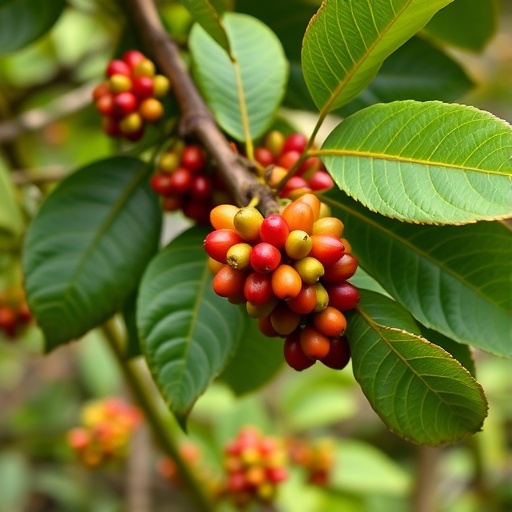
A groundbreaking genomic analysis has recently upended our understanding of Liberica coffee species, shedding new light on their precise geographical distribution and evolutionary relationships. A collaborative research effort led by Davis, Shepherd-Clowes, and Cheek has utilized extensive genomic data in tandem with rigorous field collection records to redefine species boundaries within Liberica coffee, a group essential both ecologically and economically. This reassessment addresses long-standing confusion about the natural habitats and ranges of three closely related but distinctly separate species: Coffea liberica, Coffea klainei, and Coffea dewevrei.
For decades, the classification and distribution of these Coffea species have been mired in ambiguity, with many previous records failing to distinguish between truly wild populations and those that originated from cultivation or spontaneous growth near human settlements. By meticulously filtering out such cultivated and self-sown records, the researchers ensured the robustness of their dataset, focusing solely on indigenous, wild populations. This approach has led to definitive evidence that the indigenous distributions of these species do not overlap, exhibiting allopatric patterns across the African continent.
Coffea liberica has been established as predominantly occupying the upper West African region. This area spans several countries including Sierra Leone, Liberia, Ivory Coast, Ghana, and Nigeria. The species’ range in these territories forms a distinct population cluster, geographically isolated from its congeners. On the other hand, Coffea klainei is localized exclusively in West-Central Africa, specifically encompassing Cameroon, Gabon, the Republic of Congo, and Angola’s Cabinda enclave. The third species, Coffea dewevrei, dominates habitats in a wider swath of Central Africa, found across the Republic of the Congo, Cameroon, the Democratic Republic of Congo, Central African Republic, South Sudan, and Uganda.
An important analytical tool leveraged in this study is Rapoport’s mean propinquity assessment, which measures the spatial coherence and separation between populations. By applying a barrier distance threshold of 500 kilometers, the researchers identified a clear and robust genetic and demographic separation between Coffea liberica and the combined populations of Coffea dewevrei and Coffea klainei. Intriguingly, this barrier was not observed between Coffea dewevrei and Coffea klainei, indicating a closer geographical and possibly evolutionary proximity between these latter two species.
This finding carries significant implications for both evolutionary biology and conservation strategies. It suggests that while Coffea liberica has evolved and persisted largely independent of its central and west-central African relatives, the contact zones or environmental gradients between Coffea klainei and Coffea dewevrei may be more permeable. Such information is critical in understanding the dynamics of gene flow, species adaptation, and ecological niches in these coffee species, many of which are threatened by habitat loss and climate change.
Interestingly, the revised natural range of Coffea liberica parallels that of two other known Coffea species — Coffea humilis and Coffea stenophylla. Both of these species are native to overlapping regions within upper West Africa, sharing similar ecological constraints and possibly analogous environmental drivers. This parallel distribution hints at a broader ecological pattern influencing Coffea species in this subregion, potentially tied to climatic factors, soil composition, or historical biogeographical events shaping species presence and survival.
Elevational preference also distinguishes these species further. Coffea liberica and Coffea klainei predominantly inhabit lowland elevations, with mean altitudes recorded at approximately 386 meters and 273 meters respectively. Meanwhile, Coffea dewevrei favors mid-elevation habitats with a noticeably higher mean altitude around 653 meters. This altitudinal segregation likely contributes to ecological niche differentiation and species isolation, further reinforcing the genetic and geographic boundaries outlined by the study.
The technological foundation underpinning this research is rooted in modern genomic sequencing and intricate population genetic analyses. With advances in next-generation sequencing platforms, researchers were able to unravel the genomic architecture across multiple populations, providing unprecedented resolution in species delimitation. This genomic clarity transcends traditional morphological methods, which often struggle to differentiate closely related or cryptic species, especially in complex rainforest environments where many Coffea species occur.
Moreover, comprehensive herbarium specimen data served as a vital corroborative resource, enabling cross-verification of spatial coordinates, environmental metadata, and collection contexts. The integration of such extensive herbarium records helps circumvent issues related to misidentifications and incorrectly labeled specimens, a frequent problem in botanical taxonomy. The analytical rigor demonstrated by combining field observations, herbarium archives, and high-throughput genomic data exemplifies the power of integrative taxonomy.
From an applied perspective, these refined species delimitations bear direct consequences for coffee crop development and conservation. Liberica coffee (Coffea liberica), although less commercially dominant than Arabica and Robusta, holds significant genetic potential – including desirable traits such as disease resistance, drought tolerance, and unique flavor profiles. Understanding its genuine wild range and genetic distinctiveness enables breeders and agronomists to better identify valuable germplasm for crop improvement programs.
Parallelly, conservation initiatives stand to benefit from the clarified species boundaries and distributions. Recognizing that Coffea liberica, klainei, and dewevrei occupy distinct and sometimes isolated habitats means that conservation priorities can be more accurately targeted. This ensures that the protection of natural populations, critical gene pools, and evolutionary processes receives tailored focus depending on regional ecological parameters, rather than being diffused by taxonomic confusion.
The research also contributes to broader discussions about African rainforest biodiversity and the complex historical biogeography of tropical plant species. The distributional patterns elucidated here offer clues about past climatic fluctuations, riverine barriers, and habitat fragmentation events that have shaped flora across West and Central Africa. These dynamics not only apply to Coffea but likely reflect wider ecosystem-level influences that have structured biodiversity hotspots in these regions.
This work epitomizes the transformative impact of genomic technologies in botanical sciences and highlights the deep interconnectedness between taxonomy, ecology, and applied agriculture. By resolving longstanding ambiguities in Liberica coffee’s taxonomy, the study paves the way for enhanced international collaboration to harness genetic resources sustainably, improve agroforestry systems, and foster resilience against impending climate challenges.
As coffee remains a globally significant commodity and cultural staple, insights into wild genetic diversity underpin both the industry’s future and the ecological integrity of native habitats. This study is poised to stimulate further research into other Coffea species complexes and may inspire analogous methodologies across tropical plant groups where species boundaries remain contentious.
Ultimately, Davis and colleagues’ integrative genomic approach not only refines our map of Liberica coffee but underscores the paramount importance of scientific precision in conserving natural heritage and optimizing crop development strategies. This fusion of state-of-the-art molecular data with robust ecological assessments exemplifies modern botanical research’s capacity to generate knowledge with profound environmental and economic ripples.
The revelations about allopatric differentiation, elevational partitioning, and spatial barriers in these Liberica-related species also raise compelling questions for future studies. For instance, how do these species respond at the genomic and physiological levels to environmental stress? Do hybrid zones exist between Coffea dewevrei and klainei, given their closer spatial proximity? Such inquiries will refine our understanding of speciation, adaptation, and resilience within vital tropical plant lineages.
In an era where global biodiversity faces unprecedented threats, the clarity achieved in defining species boundaries through genomics offers a vital tool to safeguard ecological and agricultural futures. Liberia coffee, once taxonomically murky, now emerges with a sharpened silhouette on Africa’s botanical landscape — setting the stage for innovative conservation and sustainable utilization.
Cite Scienmag News
Juliet Wilcox. (August 8, 2025). Genomic Insights Redefine Liberica Coffee Species Boundaries. Scienmag. https://scienmag.com/genomic-insights-redefine-liberica-coffee-species-boundaries/
Juliet Wilcox. "Genomic Insights Redefine Liberica Coffee Species Boundaries." Scienmag, 8 August 2025, https://scienmag.com/genomic-insights-redefine-liberica-coffee-species-boundaries/. Accessed 3 September 2026.
Juliet Wilcox. "Genomic Insights Redefine Liberica Coffee Species Boundaries." Scienmag. August 8, 2025. https://scienmag.com/genomic-insights-redefine-liberica-coffee-species-boundaries/


