


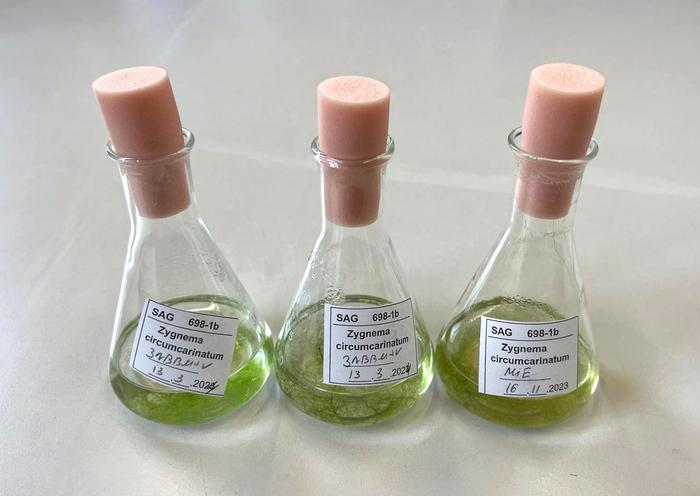
Land plants cover the surface of our planet and often tower over us. They form complex bodies with multiple organs that consist of a broad range of cell types. Developing this morphological complexity is underpinned by intricate networks of genes, whose coordinated action shapes plant bodies through various molecular mechanisms. All of these magnificent forms burst forth from a one-off evolutionary event: when plants conquered Earth’s surface, known as plant terrestrialization. Among those algae most closely related to land plants, diverse body types are found – ranging from single-celled algae to more complex cell filaments. From this group of relatives, an international group of researchers led by the Universities of Göttingen and Nebraska–Lincoln has now generated the first genome data of such complex specimens, on four filamentous “star algae” of the genus Zygnema. Their results were published in Nature Genetics.

Credit: Dr Tatyana Darienko
Land plants cover the surface of our planet and often tower over us. They form complex bodies with multiple organs that consist of a broad range of cell types. Developing this morphological complexity is underpinned by intricate networks of genes, whose coordinated action shapes plant bodies through various molecular mechanisms. All of these magnificent forms burst forth from a one-off evolutionary event: when plants conquered Earth’s surface, known as plant terrestrialization. Among those algae most closely related to land plants, diverse body types are found – ranging from single-celled algae to more complex cell filaments. From this group of relatives, an international group of researchers led by the Universities of Göttingen and Nebraska–Lincoln has now generated the first genome data of such complex specimens, on four filamentous “star algae” of the genus Zygnema. Their results were published in Nature Genetics.
The researchers worked with four algal strains in total, two from a culture collection in the USA and two that have been kept safe in the Algal Culture Collection at Göttingen University (SAG). The research involved more than 50 scientists from nine countries who combined a range of cutting-edge sequencing techniques to elucidate the entire DNA sequence of these algae. The advanced methods enabled them to generate complete genomes for these organisms at the level of whole chromosomes – something that had never been done before on this group of algae. Comparing the genes on the genomes with those of other plants and algae led to the discovery of specific overabundances of signalling genes and environmental response factors. Dr Iker Irisarri, Leibniz Institute for the Analysis of Biodiversity Change, explains: “Many of these genes underpin molecular functions that were important for the emergence of the first multicellular terrestrial plants. It is fascinating that the genetic building blocks, whose origins predate land plants by millions of years, duplicated and diversified in the ancestors of plants and algae and, in doing so, enabled the evolution of more specialized molecular machinery”.
Professor Jan de Vries, University of Göttingen, says: “Not only do we present a valuable, high-quality resource for the entire plant scientific community, who can now explore these genome data, our analyses uncovered intricate connections between environmental responses. This sheds light on one of land plants’ most important features: their ability to adjust their growth and development so that it aligns with the environment in which they dwell – a process known as developmental plasticity.”
Original publication: Feng X et al: “Genomes of multicellular algal sisters to land plants illuminate signaling network evolution”, Nature Genetics 2024. Doi: 10.1038/s41588-024-01737-3
Contact:
Professor Jan de Vries
University of Göttingen
Faculty of Biology and Psychology
Institute of Microbiology and Genetics
Department of Applied Bioinformatics
Goldschmidtstraße 1, 37077 Göttingen, Germany
Tel: +49 (0)551 39-13995
Email: devries.jan@uni-goettingen.de
www.uni-goettingen.de/en/613776.html
Land plants cover the surface of our planet and often tower over us. They form complex bodies with multiple organs that consist of a broad range of cell types. Developing this morphological complexity is underpinned by intricate networks of genes, whose coordinated action shapes plant bodies through various molecular mechanisms. All of these magnificent forms burst forth from a one-off evolutionary event: when plants conquered Earth’s surface, known as plant terrestrialization. Among those algae most closely related to land plants, diverse body types are found – ranging from single-celled algae to more complex cell filaments. From this group of relatives, an international group of researchers led by the Universities of Göttingen and Nebraska–Lincoln has now generated the first genome data of such complex specimens, on four filamentous “star algae” of the genus Zygnema. Their results were published in Nature Genetics.
The researchers worked with four algal strains in total, two from a culture collection in the USA and two that have been kept safe in the Algal Culture Collection at Göttingen University (SAG). The research involved more than 50 scientists from nine countries who combined a range of cutting-edge sequencing techniques to elucidate the entire DNA sequence of these algae. The advanced methods enabled them to generate complete genomes for these organisms at the level of whole chromosomes – something that had never been done before on this group of algae. Comparing the genes on the genomes with those of other plants and algae led to the discovery of specific overabundances of signalling genes and environmental response factors. Dr Iker Irisarri, Leibniz Institute for the Analysis of Biodiversity Change, explains: “Many of these genes underpin molecular functions that were important for the emergence of the first multicellular terrestrial plants. It is fascinating that the genetic building blocks, whose origins predate land plants by millions of years, duplicated and diversified in the ancestors of plants and algae and, in doing so, enabled the evolution of more specialized molecular machinery”.
Professor Jan de Vries, University of Göttingen, says: “Not only do we present a valuable, high-quality resource for the entire plant scientific community, who can now explore these genome data, our analyses uncovered intricate connections between environmental responses. This sheds light on one of land plants’ most important features: their ability to adjust their growth and development so that it aligns with the environment in which they dwell – a process known as developmental plasticity.”
Original publication: Feng X et al: “Genomes of multicellular algal sisters to land plants illuminate signaling network evolution”, Nature Genetics 2024. Doi: 10.1038/s41588-024-01737-3
Contact:
Professor Jan de Vries
University of Göttingen
Faculty of Biology and Psychology
Institute of Microbiology and Genetics
Department of Applied Bioinformatics
Goldschmidtstraße 1, 37077 Göttingen, Germany
Tel: +49 (0)551 39-13995
Email: devries.jan@uni-goettingen.de
www.uni-goettingen.de/en/613776.html
Journal
Nature Genetics
Method of Research
Experimental study
Subject of Research
Not applicable
Article Title
Genomes of multicellular algal sisters to land plants illuminate signaling network evolution
Article Publication Date
1-May-2024
Cite Scienmag News
Drew Townsend. (May 3, 2024). Genomes of “star algae” shed light on origin of plants. Scienmag. https://scienmag.com/genomes-of-star-algae-shed-light-on-origin-of-plants/
Drew Townsend. "Genomes of “star algae” shed light on origin of plants." Scienmag, 3 May 2024, https://scienmag.com/genomes-of-star-algae-shed-light-on-origin-of-plants/. Accessed 4 September 2026.
Drew Townsend. "Genomes of “star algae” shed light on origin of plants." Scienmag. May 3, 2024. https://scienmag.com/genomes-of-star-algae-shed-light-on-origin-of-plants/

