


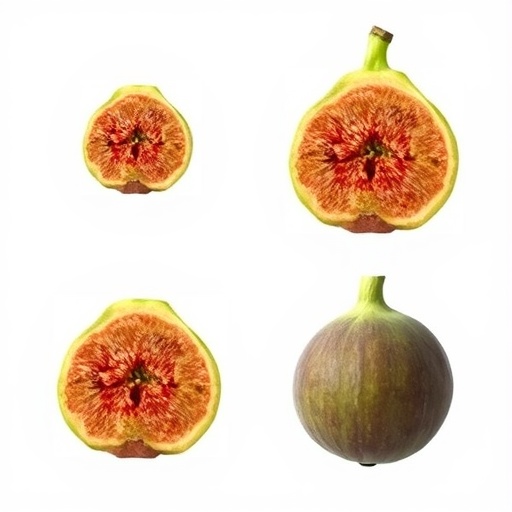
In the transitional hills where the Mediterranean climate of Türkiye’s southern coast gradually yields to the harsher continental conditions of the Anatolian interior, fig trees have quietly persisted for generations, adapting to conditions that their coastal relatives rarely encounter. A new study published in BMC Plant Biology has now brought this overlooked genetic treasure into sharp focus, revealing remarkable diversity among fig genotypes collected from the Konya-Karaman transition zone of southern Türkiye. The research, led by Sabahittin Abay of the Bahri Dağdaş International Agricultural Research Institute together with Ömer Faruk Coşkun, Emel Abay, Adem Dal and Oğuzhan Çalışkan, provides the most detailed characterization to date of fig populations from this underexplored inland region, and it identifies several standout genotypes that could shape the future of fig breeding and conservation.
Türkiye is one of the world’s leading producers of figs, and the crop holds deep cultural and economic significance across the Mediterranean Basin. Yet while fig germplasm from coastal production zones has been relatively well documented, the trees growing in transitional zones, where Mediterranean and continental climates intermingle, have remained largely invisible to science. These environments impose a distinctive set of pressures, including colder winters, greater temperature fluctuations and different patterns of seasonal rainfall, which means that locally adapted fig populations there may carry genetic combinations valuable for breeding programs confronting climate change. The research team set out to close this knowledge gap by surveying sites across the Konya-Karaman transition zone and assembling a targeted collection of female fig genotypes for systematic evaluation.
The scale of the characterization effort was considerable. A total of 47 female fig genotypes were assessed using 46 standardized phenotypic and physicochemical traits, spanning everything from fruit weight, width and length to total soluble solids, acidity and the ratio between them. Morphological descriptors covered tree growth habit, vigor, leaf shape and dimensions, petiole characteristics, shoot internode length, fruit symmetry, skin color, skin cracks, ostiole width, ease of peeling and harvest period, among many others. This comprehensive phenotyping followed internationally recognized descriptor standards, ensuring that the resulting dataset can be compared directly with characterization studies from other fig-growing regions around the world.
The phenotypic results revealed substantial variation across nearly every measured trait. Fruit weight, one of the most economically important characteristics for both fresh and dried fig markets, ranged from a modest 11.22 grams to an impressive 68.17 grams, a more than sixfold difference among genotypes growing within the same survey region. Fruit width varied from 27.49 to 53.85 millimeters and fruit length from 22.85 to 56.09 millimeters, indicating a wide spectrum of fruit shapes and sizes. Perhaps most striking for quality-focused breeding were the sugar and acid measurements: total soluble solids, a key indicator of sweetness, spanned 16.47 to 29.90 percent, while acidity ranged from 0.12 to 1.41 percent. The resulting TSS/acid ratio, which heavily influences perceived flavor, extended from 18.10 to 190.10, an extraordinary range that underscores how much flavor diversity remains untapped in these inland populations.
Applying weighted-ranking criteria to the fruit-quality data, the team identified six genotypes that rose above the rest: 70K10, 42H08, 42H22, 70K12, 70K03 and 70E13. These accessions combined favorable fruit weight, sweetness and flavor-balance profiles with desirable field-observed characteristics, earning them designation as candidate genotypes for further agronomic evaluation. Among these elite six, two accessions in particular, 70K10 and 42H08, stood out because they not only displayed excellent fruit-quality profiles but also possessed distinctly different genetic fingerprints, making them prime candidates for priority testing under uniform orchard conditions in future trials.
Complementing the morphological work, the researchers employed molecular fingerprinting using 20 simple sequence repeat markers, commonly known as SSR markers. SSRs are short, tandemly repeated DNA sequences scattered throughout the genome, and their high mutation rates and co-dominant inheritance make them exceptionally informative tools for assessing genetic diversity within and among plant populations. By amplifying these marker regions across all 47 genotypes and scoring the resulting banding patterns, the team could distinguish accessions that appeared superficially similar in the field and quantify the underlying genetic relationships among the entire collection. The SSR analysis revealed a mean polymorphism rate of 92.69 percent across markers, a very high figure that confirms the surveyed sites harbor genuinely diverse fig material rather than a collection of closely related clones.
To visualize the genetic relationships revealed by the SSR data, the researchers applied three complementary analytical approaches. Unweighted pair group method with arithmetic mean, or UPGMA, a hierarchical clustering technique, grouped genotypes according to overall fingerprint similarity, producing a tree-like diagram of relatedness. Principal coordinate analysis, or PCoA, offered a complementary ordination-based view, positioning genotypes in multidimensional space so that genetic distances could be assessed visually. In addition, an exploratory STRUCTURE visualization was used to depict marker-based grouping patterns and infer underlying population structure within the collection. Together, these multivariate methods provided a robust, internally consistent picture of how the 47 genotypes relate to one another genetically, and they demonstrated that substantial marker-based variation exists among the evaluated materials.
The convergence of phenotypic and molecular evidence carries important implications for conservation. The considerable diversity documented in the collection indicates that the surveyed sites in the Konya-Karaman transition zone contain fig material genuinely worthy of further characterization and protection. Transitional-zone populations are often threatened by agricultural intensification, land-use change and the abandonment of traditional orchards, and without systematic collection and conservation efforts, the unique adaptive alleles they harbor could be lost before their value is ever realized. By providing a traceable, well-documented characterization of this underrepresented inland collection, the study lays the groundwork for future regional germplasm-collection development and gives breeders a vetted shortlist of candidate accessions.
The study was funded by the Scientific and Technological Research Council of Türkiye, TÜBİTAK, under Project No. 124O802, reflecting national investment in the documentation and preservation of Türkiye’s plant genetic resources. The research involved collaboration between the Bahri Dağdaş International Agricultural Research Institute and the Konya Soil, Water and Deserting Control Research Institute, both in Konya, and the Department of Horticulture at Hatay Mustafa Kemal University, combining field-survey expertise, laboratory-based genotyping and horticultural evaluation under a single coordinated program. Corresponding author Ömer Faruk Coşkun of Hatay Mustafa Kemal University led the scientific coordination of the work, which was published as an open-access article, making the full dataset freely available to researchers worldwide.
The authors are careful to note that their findings represent a first, essential step rather than a final verdict on the collection’s agronomic potential. Field-observed trait measurements, however thorough, can be influenced by environmental conditions at the collection sites, and validation under uniform orchard conditions is required to confirm trait stability and true agronomic performance. The six prioritized genotypes, and 70K10 and 42H08 in particular, will therefore need to undergo subsequent multi-year evaluation in common gardens, where fruit quality, yield, pest resistance and adaptation can be assessed without the confounding effects of site-to-site environmental variation. Only then can these candidate accessions be formally considered for release as cultivars or deployment as parents in structured breeding programs.
Beyond its immediate application to fig improvement, the study contributes to a broader scientific conversation about the value of transitional zones as reservoirs of crop genetic diversity. As climate change reshapes agricultural environments worldwide, alleles conferring tolerance to temperature extremes, drought and variable rainfall, precisely the stresses that characterize Mediterranean-continental transition zones, are likely to become increasingly valuable. The Turkish fig collection characterized here demonstrates that such zones can harbor exceptional variation, and it offers a methodological template for other researchers seeking to inventory and conserve crop wild relatives and landrace populations in similarly neglected landscapes. For a crop as ancient and beloved as the fig, the message of this research is clear: some of its most valuable genetic secrets may be hiding far from the famous coastal orchards, on the quiet slopes of the Anatolian interior, waiting to be documented, conserved and eventually brought to tables around the world.
Cite Scienmag News
Juliet Wilcox. (September 8, 2026). Genetic and morphological diversity revealed in Mediterranean fig genotypes. Scienmag. https://scienmag.com/genetic-and-morphological-diversity-revealed-in-mediterranean-fig-genotypes/
Juliet Wilcox. "Genetic and morphological diversity revealed in Mediterranean fig genotypes." Scienmag, 8 September 2026, https://scienmag.com/genetic-and-morphological-diversity-revealed-in-mediterranean-fig-genotypes/. Accessed 8 September 2026.
Juliet Wilcox. "Genetic and morphological diversity revealed in Mediterranean fig genotypes." Scienmag. September 8, 2026. https://scienmag.com/genetic-and-morphological-diversity-revealed-in-mediterranean-fig-genotypes/


