


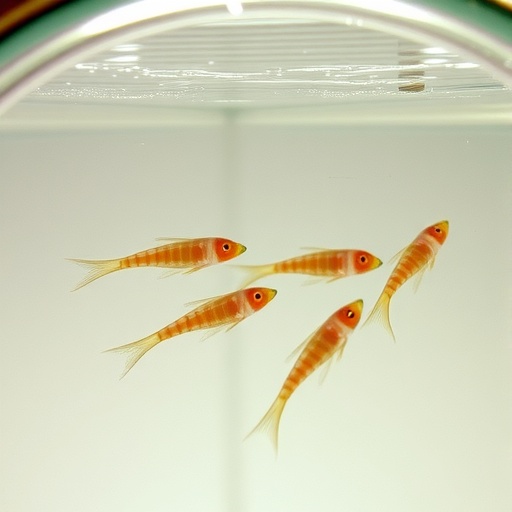
In the world of aquatic toxicology, the water flea Daphnia magna is something of a laboratory legend. For decades, this tiny freshwater crustacean has served as the workhorse of environmental safety testing, its sensitivity to chemical contaminants informing regulatory decisions about pesticides, pharmaceuticals, and industrial compounds worldwide. But a new study from the University of Alberta suggests that one of the most fundamental design choices in daphnid experiments—who lives alone and who lives with roommates—may be quietly reshaping experimental outcomes in ways that persist for generations. The findings, published in the journal Ecotoxicology, reveal that whether Daphnia magna are housed individually or in groups fundamentally alters their survival, reproduction, sexual development, and life history, and that these differences do not simply vanish after a single generation but instead echo across at least five generations of continuous exposure.
The research, conducted by Aaron Boyd and Tamzin A. Blewett of the Department of Biological Sciences at the University of Alberta, was designed to address a deceptively simple question: does the methodological decision to expose test organisms individually or collectively change the results of a toxicity experiment? The question matters because toxicology studies split along these lines depending on their goals. Regulatory protocols, including the Organization for Economic Co-operation and Development’s Test No. 211 for Daphnia magna reproduction, typically prescribe individual housing to eliminate confounding variables. Meanwhile, many exploratory and mechanistic studies house animals in groups to maximize throughput, approximate natural conditions, or simply conserve laboratory space and resources. If these two approaches produce systematically different data, then comparisons across studies—cornerstones of meta-analysis, risk assessment, and reproducibility efforts—may be built on shifting sand.
To probe the issue, the researchers exposed daphnids to organic ultraviolet filters, a class of sunscreen chemicals that has become an emerging concern in aquatic environments. The team worked with avobenzone, octocrylene, and oxybenzone, three of the most widely used organic UV filters, which have been detected in surface waters around the globe and have prompted legislative bans in jurisdictions including Hawaii, Palau, Aruba, and the U.S. Virgin Islands largely due to concerns about coral toxicity. Ultraviolet filters offered an ideal test case for the study because they represent a realistic and environmentally relevant contaminant class, and because prior work from the Blewett laboratory had already characterized their multigenerational effects on daphnids under individual-housing conditions. By repeating the exposure paradigm under group-housing conditions and comparing the two directly, the researchers could isolate the influence of conspecific presence from the influence of the chemicals themselves.
The experimental design followed daphnids across five continuous generations, a demanding undertaking that required careful synchronization of feeding, water changes, and chemical dosing across both housing regimes. Crucially, the study controlled for the most obvious confounding factor: resources. Group-housed and individually housed animals received the same ratio of food and water per organism, meaning that any differences emerging between the two treatments could not be attributed simply to one group having more algae to eat or more space to swim. This resource-matched design distinguishes the new work from earlier density studies, where the effects of crowding and the effects of resource limitation were often inextricably entangled. What remained, after accounting for nutrition and volume, was the biological signal of social environment itself—the physical and chemical presence of other members of the same species.
The results were striking. Baseline mortality among daphnids housed in groups was double that of individually housed counterparts, even in the absence of any toxicant. This elevated death toll in the group-housing scenario was not merely a laboratory artifact of depleted resources, since feeding was matched per animal; rather, it pointed to the subtle but potent stress of living alongside conspecifics. Aquatic organisms constantly exchange chemical cues through the water, releasing metabolites, pheromones, and kairomones that can alter the physiology of their neighbors. Prior research has demonstrated that Daphnia engage in negative interference, with chemical mediation of competition reducing growth and fecundity even when food is abundant. The doubled mortality observed in this study underscores just how consequential these invisible interactions can be for a standard toxicity endpoint as fundamental as survival.
Perhaps the most dramatic finding concerned sex ratios. Daphnia magna are cyclic parthenogens, reproducing clonally for most of the year but switching, under certain environmental cues, to the production of males and resting eggs. Sex determination in this species is widely understood to be environmental rather than genetic, influenced by factors such as population density, food availability, and stress. In the group-housed populations, the proportion of males climbed across successive generations, reaching a maximum of roughly ten percent of the population. Individually housed daphnids, by contrast, showed no comparable shift. Because the resource environment was held constant between treatments, the researchers could attribute this sex-ratio distortion to the presence of conspecifics—a result consistent with previous work showing that Daphnia females adjust sex allocation in response to current population density and sex ratio. The implication for toxicology is unsettling: a chemical treatment that happens to be tested in a group-housing design could appear to have endocrine-disrupting or sex-skewing effects that are actually driven, at least in part, by density-mediated developmental programming.
Reproductive timing and effort also diverged sharply between the two housing regimes. Group-housed daphnids experienced delayed maturation, taking longer to reach reproductive competence than their individually housed counterparts, and they produced broods at a lower frequency. In life-history terms, the crowded animals appeared to adopt a fundamentally different strategy: slowing down, delaying investment in reproduction, and presumably reallocating energy toward maintenance and competition. This pattern echoes classic findings from the 1990s showing that Daphnia magna can shift from a strategy of producing many low-quality offspring to fewer, better-provisioned ones in response to intraspecific interaction. The new study extends that framework into the toxicology context, showing that these life-history shifts emerge even when per-capita resources are equalized, and that they persist across multiple generations rather than resetting between broods.
Critically, the researchers found that these housing-driven differences were largely independent of chemical treatment. Whether daphnids were exposed to avobenzone, octocrylene, oxybenzone, or vehicle controls, the gap between individual and group housing persisted across the measured endpoints. In other words, conspecific presence did not merely modify the toxicity of the ultraviolet filters; it acted as its own independent stressor, reshaping the baseline against which any chemical effect must be measured. This is a subtle but important point. Some previous studies had suggested that intraspecific competition could amplify toxicant effects, as seen in outdoor pond microcosms where crowding increased the impact of pesticides, and in work showing that intraspecific interactions heightened the toxicity of metals to daphnids. The new results indicate that the picture is more complicated: at least for organic UV filters under these conditions, social environment alters organismal physiology across a broad front, but it does not necessarily interact strongly with the chemical stressor itself.
The multigenerational dimension of the study carries particular weight for the field. Toxicology increasingly embraces multigenerational designs as a way to capture delayed effects, transgenerational inheritance, and adaptation. Yet the new findings show that the housing condition itself leaves a multigenerational signature: the elevated mortality, male production, and reproductive delays of group-housed lineages were not transient acclimation responses but stable features that characterized entire lineages across five generations. For any laboratory embarking on a multigenerational exposure study, this means that the housing decision made on day one will shape the entire trajectory of the experiment. A control group housed in groups may exhibit mortality and reproductive profiles so different from an individually housed control in another laboratory that the two “controls” are, in effect, measuring different biological systems.
These results arrive amid a broader reckoning with reproducibility in the life sciences. A widely cited 2016 survey in Nature found that more than 70 percent of researchers had failed to reproduce another scientist’s experiment, and methodological variance—including seemingly trivial husbandry details—has been repeatedly implicated as a hidden driver of irreproducibility. In aquatic toxicology specifically, prior work from the Blewett group had already asked whether group versus individual exposure alters experimental outcomes, and a recent study on temperate fish demonstrated that social isolation alone can influence metabolism, copper accumulation, and thermal tolerance. The new Daphnia study adds a multigenerational, resource-controlled data point to this growing literature, and its message is consistent: the social environment of the test organism is not background noise but a first-order experimental variable.
The authors emphasize that the goal is not to declare one housing method superior to the other. Individual housing remains appropriate when the aim is to minimize uncontrolled variation, and it underpins standardized regulatory tests. Group housing, meanwhile, better reflects the crowded, chemically complex conditions organisms actually face in nature, where density-dependent effects modulate chemical toxicity in real ecosystems. The danger lies in the cross-study comparison of data generated under different regimes without acknowledging the confound. Ecological risk assessments frequently pool toxicity values from many laboratories to derive benchmarks such as species sensitivity distributions; if some of those values came from crowded beakers and others from solitary vessels, the resulting benchmarks may embed a hidden methodological bias. The study’s authors argue that housing density and conspecific presence should be explicitly reported—and ideally explicitly considered—in the interpretation and comparison of toxicity data.
For a field that leans heavily on a handful of model organisms to safeguard aquatic ecosystems, the lesson from this research is a humbling one. The water flea in the crowded beaker and the water flea in the solitary vessel may carry the same species name and the same genome, but over five generations they become, physiologically, different animals. As ultraviolet filters and countless other contaminants continue to flow into the world’s waters, understanding their true risks will require not only better chemistry and longer exposures, but a more honest accounting of the social lives of the organisms doing the telling.
Cite Scienmag News
Sloane Callahan. (September 8, 2026). Transgenerational effects of solitary and grouped rearing persist in Daphnia magna. Scienmag. https://scienmag.com/transgenerational-effects-of-solitary-and-grouped-rearing-persist-in-daphnia-magna/
Sloane Callahan. "Transgenerational effects of solitary and grouped rearing persist in Daphnia magna." Scienmag, 8 September 2026, https://scienmag.com/transgenerational-effects-of-solitary-and-grouped-rearing-persist-in-daphnia-magna/. Accessed 8 September 2026.
Sloane Callahan. "Transgenerational effects of solitary and grouped rearing persist in Daphnia magna." Scienmag. September 8, 2026. https://scienmag.com/transgenerational-effects-of-solitary-and-grouped-rearing-persist-in-daphnia-magna/


