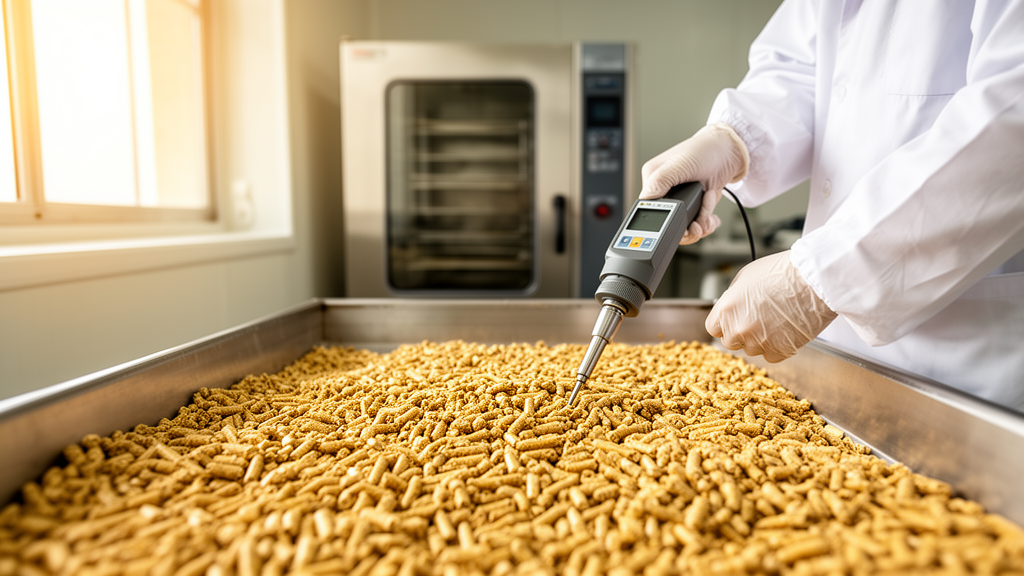
Rice bran, the fine powder left behind when brown rice is milled, has become one of the more valuable byproducts of the grain industry. It carries 18 to 23 percent lipid content along with proteins, gamma-oryzanol and tocopherols, making it a sought-after feedstock for edible oil production. But before that oil can be extracted, the bran must first be pressed into porous pellets and then dried, because excess moisture hinders solvent penetration, raises energy consumption and undermines oil recovery. A new study published in the Journal of Agriculture and Food Research reports a generalized predictive framework for drying those pellets under hot air assisted infrared radiation, and finds that a simple, interpretable equation can hold its own against sophisticated machine learning algorithms.
The pellets arrived with an initial moisture content of 0.18 grams of water per gram of dry matter and were stored refrigerated until use. The drying apparatus combined two 800 W infrared heaters mounted above a cylindrical stainless steel chamber with 4 kW fin heaters and a blower that delivered convective hot air. Infrared intensity, air temperature and air velocity were controlled and monitored continuously throughout each run.
The experimental design was a three-factor full factorial layout: infrared intensity at 5000, 7000 and 9000 watts per square meter; hot air temperature at 40, 60 and 80 degrees Celsius; and air velocity at 1.0, 1.5 and 2.0 meters per second. That produced 27 treatment combinations, each run in duplicate for 54 experimental runs total. Pellets were spread in a single layer and dried to a final moisture content of 0.08 grams per gram of dry matter, the level considered appropriate for subsequent oil extraction, with samples weighed every three minutes.
The drying curves told a consistent story. Moisture ratio declined continuously with time and no constant-rate drying period appeared in any treatment, indicating that moisture removal was governed primarily by internal diffusion rather than surface evaporation. Raising the temperature from 40 to 80 degrees Celsius consistently shortened drying time, and increasing infrared intensity from 5000 to 9000 watts per square meter had a similarly strong effect. At an air velocity of 1 meter per second, drying time fell from 30 to 18 minutes at 40 degrees Celsius and from 15 to 9 minutes at 80 degrees Celsius as infrared intensity climbed. The average drying rate more than tripled, from roughly 0.0027 to 0.0094 grams of water per gram of dry matter per minute, between the mildest and most intensive conditions.
Air velocity, surprisingly, worked against the process. In several cases, increasing airflow from 1 to 2 meters per second actually prolonged drying. At 5000 watts per square meter and 40 degrees Celsius, drying time stretched from 30 to 54 minutes as velocity rose. The authors suggest that higher airflow increased convective heat loss from the pellet surface, partially offsetting the thermal contribution of the infrared radiation, though they caution that because pellet surface temperature was not directly measured, this mechanism remains a plausible interpretation rather than direct experimental evidence.
On the modeling side, nine semi-theoretical drying equations were fitted to each of the 27 treatments individually. The Midilli et al. model, which combines a nonlinear exponential term with a linear correction term, proved best for 24 of the 27 conditions, with coefficients of determination between 0.9994 and 0.9999 and root mean squared errors below 0.0054. The real innovation, however, came next: rather than reporting separate parameters for each condition, the team expressed the Midilli parameters as explicit second-order polynomial functions of infrared intensity, temperature and air velocity. The polynomial form outperformed linear, logarithmic, power and exponential alternatives for every parameter, capturing the nonlinear interactions among the three drying variables.
To test whether this generalized model actually generalized, the researchers held out seven complete drying treatments from model development, using 20 treatments for training and reserving all observations from the seven unseen treatments for external validation. The generalized Midilli model achieved an R-squared of 0.9284 and an RMSE of 0.0520 on the training data, and, notably, slightly better figures of 0.9332 and 0.0493 on the external validation set. Four machine learning regressors, k-nearest neighbors, random forest, support vector regression and extreme gradient boosting, were trained on the same 20 treatments and benchmarked against the same unseen treatments. On external validation, extreme gradient boosting led the field with an R-squared of 0.9201 and RMSE of 0.0539, followed closely by random forest at 0.9168 and 0.0550, while support vector regression and k-nearest neighbors trailed at 0.9000 and 0.8090 respectively.
The comparison carries a methodological point that extends beyond rice bran. Many previous drying studies reporting near-perfect machine learning accuracy relied on random train-test splits, in which observations from the same drying treatment ended up in both datasets, potentially inflating performance estimates. By excluding entire treatments from model development, this study imposed a far more stringent test, and even under those conditions the ensemble tree models remained robust. Yet the interpretable generalized Midilli equation matched and slightly exceeded them on the validation data, suggesting that for this system, moisture ratio evolution can be captured without black-box algorithms, an advantage for process simulation and industrial scale-up.
The team also quantified moisture transport physics. Effective moisture diffusivity, calculated from Fick’s second law assuming a finite cylindrical pellet geometry, ranged from 4.52 to 26.42 times ten to the minus nine square meters per second, increasing with temperature and generally with infrared intensity. Activation energy ranged from 11.37 to 28.08 kilojoules per mole, lower than values reported for long-grain paddy or millet flour pellets, and conditions with higher diffusivity tended to show lower activation energy, consistent with infrared heating lowering the energy barrier for moisture migration. The authors note several simplifying assumptions, including constant pellet dimensions, unmeasured internal temperature and constant diffusivity, so the values should be read as apparent diffusivities.
Quality measurements added industrial nuance. Oil content was significantly affected only by infrared intensity, falling from an average of 21.84 percent at 5000 watts per square meter and 21.52 percent at 7000 to 18.37 percent at 9000, possibly reflecting greater thermal exposure, though the underlying mechanisms were not directly evaluated. All HA-IR treatments nonetheless yielded higher oil content than the factory’s conventional hot-air-dried reference sample at 17.75 percent. Free fatty acid content, by contrast, was driven mainly by air velocity, rising from an average of 1.10 percent to 1.34 percent as oleic acid when airflow increased from 1.0 to 2.0 meters per second, with significant interaction effects between temperature and the other factors. All HA-IR treatments stayed below the industrial reference FFA value of 1.80 percent. The authors emphasize that these are laboratory-scale findings: energy consumption, throughput and storage stability were not evaluated, and pilot and industrial validation, along with techno-economic analysis, remain necessary before the generalized model can guide real-world drying operations.
Subject of Research: Generalized semi-theoretical and machine learning modeling of hot air assisted infrared drying of rice bran pellets, with oil content and free fatty acid evaluation
Article Title: Generalized modeling of rice bran pellets under hot air assisted infrared drying: Semi-theoretical and machine learning approaches with oil content and free fatty acid evaluation
Article References: Pambudi, S., Saechua, W., & Jongyingcharoen, J. S. (2026). Generalized modeling of rice bran pellets under hot air assisted infrared drying: Semi-theoretical and machine learning approaches with oil content and free fatty acid evaluation. Journal of Agriculture and Food Research, 32, Article 103394. https://doi.org/10.1016/j.jafr.2026.103394
Image Credits: AI Generated
DOI: 10.1016/j.jafr.2026.103394
Keywords: rice bran, infrared drying, drying kinetics, Midilli model, machine learning, moisture diffusivity, free fatty acids, oil content, pellets, food processing, Generalized, modeling
Cite Scienmag News
Alan Morgan. (October 29, 2026). Generalized Model Predicts Rice Bran Pellet Drying as Well as Machine Learning. Scienmag. https://scienmag.com/generalized-model-predicts-rice-bran-pellet-drying-as-well-as-machine-learning/
Alan Morgan. "Generalized Model Predicts Rice Bran Pellet Drying as Well as Machine Learning." Scienmag, 29 October 2026, https://scienmag.com/generalized-model-predicts-rice-bran-pellet-drying-as-well-as-machine-learning/. Accessed 1 November 2026.
Alan Morgan. "Generalized Model Predicts Rice Bran Pellet Drying as Well as Machine Learning." Scienmag. October 29, 2026. https://scienmag.com/generalized-model-predicts-rice-bran-pellet-drying-as-well-as-machine-learning/