

Wednesday, October 21, 2026
Science
No Result
View All Result
  • Login
  • HOME
  • SCIENCE NEWS
  • CONTACT US
  • HOME
  • SCIENCE NEWS
  • CONTACT US
No Result
View All Result
Scienmag
No Result
View All Result
Home Science News

Gel-brine study finds selected 2% salt cheeses remain intact

October 21, 2026
in Science News
Morgan Morrow
By Morgan Morrow Scienmag Editorial Profile - Bacteriology
Reading Time: 2 mins read
0
Gel-brine study finds selected 2% salt cheeses remain intact

Gel-brine study finds selected 2% salt cheeses remain intact

65
SHARES
587
VIEWS
Share on FacebookShare on Twitter
ADVERTISEMENT

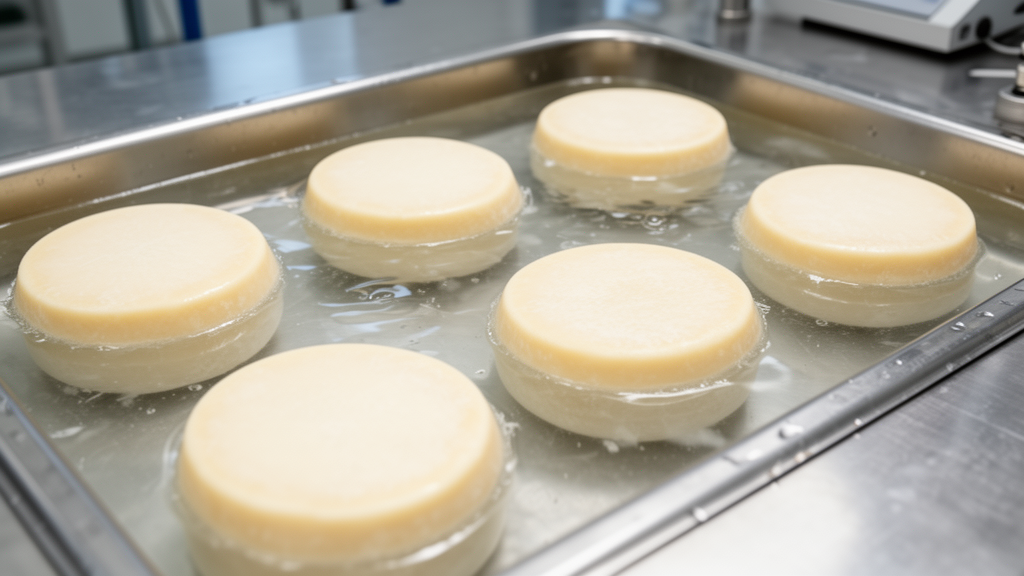
Selected low-salt white cheeses made with gel brine remained intact through 90 days of refrigerated storage, according to a food-production experiment. Two formulations that survived the full storage period contained 2% salt in their brine: one with 3% gelatin and another with 1% carrageenan gum. Researchers also reported that these cheeses were sensorially appreciated.

The study found that some other low-salt samples melted before storage ended, showing that the outcomes depended on the particular formulation rather than on gel brine alone. The researchers prepared brines in gel form by adding thickeners or gelling stabilizers to the salting solution. Xanthan gum and carrageenan gum were tested at 0.5%, 1.0% and 1.5%, while pectin and gelatin were tested at 1.0%, 2.0% and 3.0%.

These stabilizers were combined with salt concentrations of 2.0%, 4.0% or 6.0%. The comparison group consisted of brines without stabilizers at the same three salt levels. The gel-brine technique itself involves increasing the viscosity of cheese-salting brine with selected thickening and gelling stabilizers.

Among cheeses produced with gel brine, dry matter ranged from 28.26% to 44.81%, salt content ranged from 0.79% to 3.45%, and water activity ranged from 0.92 to 0.93. On the L* color scale, the cheeses ranged from 71.82 to 94.59. Total yeast-and-mold counts ranged from 1.0 to 6.7 log cfu/g.

The reported measurements varied across formulations. Because some samples melted during storage, not every cheese could be assessed on days 60 and 90; the cheeses described as remaining intact were the two formulations containing 2% salt, 3% gelatin and 1% carrageenan gum, respectively. Complete melting affected the control samples, preventing their analyses on days 60 and 90.

Some other cheeses also failed to remain intact for the entire storage period, which the researchers associated with the very low salt levels in the gel brines. Despite those failures, the intact samples demonstrated that white cheese with a relatively low-salt brine could retain its form and texture in its packaging under the tested conditions. The scope of the experiment was limited: cheeses were produced in duplicate, stored at one temperature, and tested using a defined set of stabilizer and salt combinations.

The findings therefore establish the result for the reported formulations and storage conditions without determining how the technique would perform across different recipes, packaging systems, temperatures or production scales.

Subject of Research: Physicochemical, color and microbiological evaluation of white cheese produced with gel brines

Article Title: Production of white cheese using the gel brine technique and determination of its physicochemical, color, and microbiological properties using multivariate statistical analyses

Article References: Çavuş, M., Yetim, H., & Cankurt, H. (2026). Production of white cheese using the gel brine technique and determination of its physicochemical, color, and microbiological properties using multivariate statistical analyses. Frontiers in Nutrition, 13, Article 1930095. https://doi.org/10.3389/fnut.2026.1930095

Image Credits: AI Generated

DOI: 10.3389/fnut.2026.1930095

Keywords: gel brine, white cheese, low-salt cheese, food stabilizers, gelatin, carrageenan gum, xanthan gum, pectin, water activity, food microbiology, Production, white

Cite Scienmag News

Morgan Morrow. (October 21, 2026). Gel-brine study finds selected 2% salt cheeses remain intact. Scienmag. https://scienmag.com/gel-brine-study-finds-selected-2-salt-cheeses-remain-intact/

Morgan Morrow. "Gel-brine study finds selected 2% salt cheeses remain intact." Scienmag, 21 October 2026, https://scienmag.com/gel-brine-study-finds-selected-2-salt-cheeses-remain-intact/. Accessed 21 October 2026.

Morgan Morrow. "Gel-brine study finds selected 2% salt cheeses remain intact." Scienmag. October 21, 2026. https://scienmag.com/gel-brine-study-finds-selected-2-salt-cheeses-remain-intact/


Tags: carrageenan gumcomparison of stabilizers in cheese preservationeffects of gelling stabilizers on cheese stabilityfood microbiologyfood stabilizersgel brinegelatinimpact of salt concentration in gel-based cheese brineinfluence of xanthan and pectin on cheese melting and storagelong-term refrigerated storage of low-salt cheeseslow-salt cheeseLow-salt cheese preservation with gel brinepectinproductionrole of gelatin and carrageenan in cheese texturesensory evaluation of low-salt gel-brine cheesesstabilization of cheese structure using gel brine techniqueswater activitywater activity and dry matter contentWhitewhite cheesexanthan gum
Share26Tweet16
Previous Post

Workplace exposure linked to youth employment readiness in Zambia’s health system

Next Post

Model predicts cyclic uplift failure in soft-clay helix anchors

Related Posts

India modeling maps climate-driven shifts in agro-voltaic suitability
Earth Science

India modeling maps climate-driven shifts in agro-voltaic suitability

October 21, 2026
Probiotic blend reduces rivaroxaban-associated colonic bleeding in mice
Medicine

Probiotic blend reduces rivaroxaban-associated colonic bleeding in mice

October 21, 2026
Model predicts cyclic uplift failure in soft-clay helix anchors
Technology and Engineering

Model predicts cyclic uplift failure in soft-clay helix anchors

October 21, 2026
Workplace exposure linked to youth employment readiness in Zambia’s health system
Medicine

Workplace exposure linked to youth employment readiness in Zambia’s health system

October 21, 2026
Olive seed flour improves broiler growth and gut health in 28-day trial
Science News

Olive seed flour improves broiler growth and gut health in 28-day trial

October 21, 2026
China’s data-center shift could cut emissions 27.8% by 2060
Earth Science

China’s data-center shift could cut emissions 27.8% by 2060

October 21, 2026
Next Post
Model predicts cyclic uplift failure in soft-clay helix anchors

Model predicts cyclic uplift failure in soft-clay helix anchors

  • Mothers who receive childcare support from maternal grandparents show more optimized

    Mothers who receive childcare support from maternal grandparents show more parental warmth, finds NTU Singapore study

    27656 shares
    Share 11059 Tweet 6912
  • University of Seville Breaks 120-Year-Old Mystery, Revises a Key Einstein Concept

    1061 shares
    Share 424 Tweet 265
  • Bee body mass, pathogens and local climate influence heat tolerance

    682 shares
    Share 273 Tweet 171
  • Researchers record first-ever images and data of a shark experiencing a boat strike

    546 shares
    Share 218 Tweet 137
  • Groundbreaking Clinical Trial Reveals Lubiprostone Enhances Kidney Function

    531 shares
    Share 212 Tweet 133
Science

Embark on a thrilling journey of discovery with Scienmag.com—your ultimate source for cutting-edge breakthroughs. Immerse yourself in a world where curiosity knows no limits and tomorrow’s possibilities become today’s reality!

RECENT NEWS

  • India modeling maps climate-driven shifts in agro-voltaic suitability
  • Probiotic blend reduces rivaroxaban-associated colonic bleeding in mice
  • Model predicts cyclic uplift failure in soft-clay helix anchors
  • Gel-brine study finds selected 2% salt cheeses remain intact

Categories

  • Agriculture
  • Anthropology
  • Archaeology
  • Athmospheric
  • Biology
  • Biotechnology
  • Blog
  • Bussines
  • Cancer
  • Chemistry
  • Climate
  • Earth Science
  • Editorial Policy
  • Marine
  • Mathematics
  • Medicine
  • Pediatry
  • Policy
  • Psychology & Psychiatry
  • Science Education
  • Science News
  • Social Science
  • Space
  • Technology and Engineering

Subscribe to Blog via Email

Enter your email address to subscribe to this blog and receive notifications of new posts by email.

Join 5,150 other subscribers

© 2025 Scienmag - Science Magazine

Welcome Back!

Login to your account below

Forgotten Password?

Retrieve your password

Please enter your username or email address to reset your password.

Log In
No Result
View All Result
  • HOME
  • SCIENCE NEWS
  • CONTACT US

© 2025 Scienmag - Science Magazine

Discover more from Science

Subscribe now to keep reading and get access to the full archive.

Continue reading