

Wednesday, October 21, 2026
Science
No Result
View All Result
  • Login
  • HOME
  • SCIENCE NEWS
  • CONTACT US
  • HOME
  • SCIENCE NEWS
  • CONTACT US
No Result
View All Result
Scienmag
No Result
View All Result
Home Science News Technology and Engineering

Model predicts cyclic uplift failure in soft-clay helix anchors

October 21, 2026
in Technology and Engineering
Denise Maddox
By Denise Maddox Scienmag Editorial Profile - Mechanical Engineering
Reading Time: 2 mins read
0
Model predicts cyclic uplift failure in soft-clay helix anchors

Model predicts cyclic uplift failure in soft-clay helix anchors

65
SHARES
587
VIEWS
Share on FacebookShare on Twitter
ADVERTISEMENT

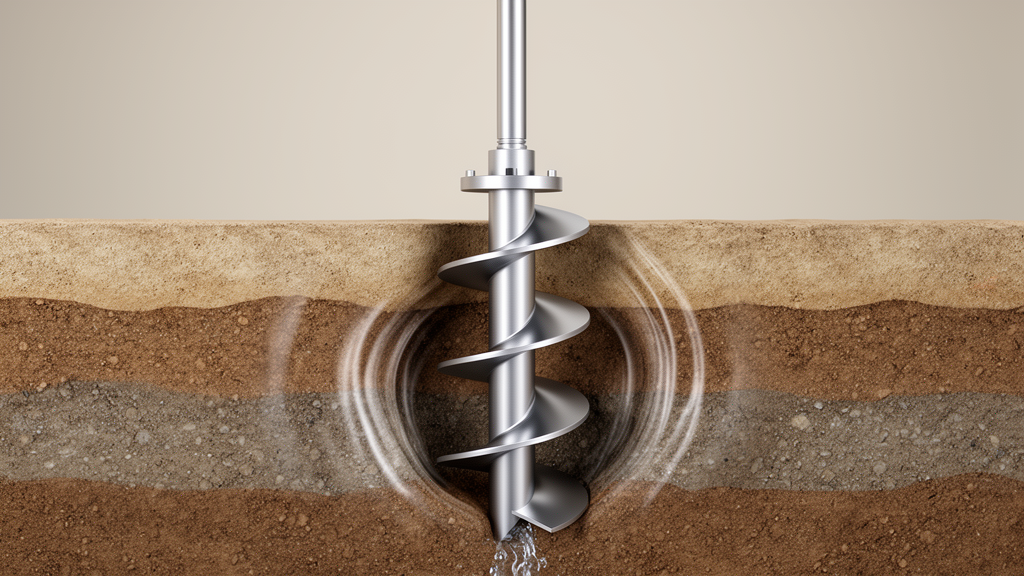
Vertical cyclic loading can reduce the stiffness of a single-helix anchor in soft clay, build excess pore pressure and leave a permanently displaced anchor head, according to a numerical and theoretical study that combined benchmark testing with finite element simulation. The research examined how an installed helical anchor behaves when repeatedly pulled upward, a loading pattern that can shift the soil around the shaft from shallow failure toward deeper local flow around the helix.

The investigators built a two-dimensional axisymmetric finite element model of the anchor–soil system using data from a benchmark cyclic uplift test involving a 26 mm diameter shaft. Its clay formulation included small-strain stiffness, cyclic hardening, plastic displacement accumulation and pore-pressure generation. Against the benchmark test, the model reproduced the observed displacement trend and captured the transition from a shallow wedge of soil moving upward to deeper local flow around the helix. The simulations also showed how excess pore pressure developed in the soil surrounding the helix during repeated uplift.

The researchers also developed a cyclic Q–z model to represent the relationship between load and displacement at the anchor head. This model combined a hyperbolic monotonic backbone with an analytical ultimate-capacity bound, mapping between monotonic and cyclic behavior, a moving projection center and parameters describing cyclic degradation. Together, these components allowed the model to account for path-dependent response, declining stiffness and the accumulation of residual displacement rather than treating each loading cycle as independent.

Calculations with the model examined embedment depth, shaft diameter, mean load and cyclic amplitude. The resulting cyclic interaction diagrams indicated that rapid ratcheting occurred when the maximum cyclic load approached approximately 0.4–0.5 times the ultimate capacity, Qu. This is a modeled threshold, not a universal field limit: the study presents an experimental–finite element–theoretical framework for preliminary assessment of single-helix anchors in soft clay, and the reported behavior depends on the modeled anchor geometry, loading history and soil response.

Subject of Research: Finite element and theoretical modeling of cyclic uplift in single-helix anchors embedded in soft clay

Article Title: Numerical and theoretical analysis of vertical cyclic uplift of single-helix anchors in soft clay

Article References: Shiwei, W., Sihua, L., & Hang, C. (2026). Numerical and theoretical analysis of vertical cyclic uplift of single-helix anchors in soft clay. Scientific Reports. https://doi.org/10.1038/s41598-026-75211-x

Image Credits: AI Generated

DOI: 10.1038/s41598-026-75211-x

Keywords: single-helix anchors, soft clay, cyclic uplift, finite element modeling, pore pressure, residual displacement, stiffness degradation, soil mechanics, anchor ratcheting, Numerical, theoretical, analysis

Cite Scienmag News

Denise Maddox. (October 21, 2026). Model predicts cyclic uplift failure in soft-clay helix anchors. Scienmag. https://scienmag.com/model-predicts-cyclic-uplift-failure-in-soft-clay-helix-anchors/

Denise Maddox. "Model predicts cyclic uplift failure in soft-clay helix anchors." Scienmag, 21 October 2026, https://scienmag.com/model-predicts-cyclic-uplift-failure-in-soft-clay-helix-anchors/. Accessed 21 October 2026.

Denise Maddox. "Model predicts cyclic uplift failure in soft-clay helix anchors." Scienmag. October 21, 2026. https://scienmag.com/model-predicts-cyclic-uplift-failure-in-soft-clay-helix-anchors/


Tags: analysisanchor ratchetingcyclic hardening behavior of soft claycyclic Q–z model for anchor capacitycyclic upliftcyclic uplift loading in soft soilsexcess pore pressure effects on anchor stabilityfinite element modelingfinite element modeling of helical anchorsinfluence of repeated uplift on soft-clay anchorsmodeling of cyclic loading effects on geotechnical anchorsNumericalnumerical simulation of anchor displacementpore pressurepore pressure buildup around anchorsresidual displacementshallow versus deep soil failure mechanismssingle-helix anchorssoft claysoft-clay helix anchor failure predictionsoil mechanicssoil-structure interaction in soft claystiffness degradationtheoretical
Share26Tweet16
Previous Post

Gel-brine study finds selected 2% salt cheeses remain intact

Next Post

Probiotic blend reduces rivaroxaban-associated colonic bleeding in mice

Related Posts

Energy-Aware UAV Planner Cuts Simulated Monitoring Mission Time by Nearly 60%
Technology and Engineering

Energy-Aware UAV Planner Cuts Simulated Monitoring Mission Time by Nearly 60%

October 21, 2026
Experiment maps superconductivity and switchable orbital magnetism in rhombohedral graphene
Technology and Engineering

Experiment maps superconductivity and switchable orbital magnetism in rhombohedral graphene

October 21, 2026
Blockchain-backed IoHT framework reports over 99% accuracy on two attack datasets
Technology and Engineering

Blockchain-backed IoHT framework reports over 99% accuracy on two attack datasets

October 21, 2026
Alkali-Treated Fly Ash Aggregate Lightens and Strengthens Concrete
Science News

Alkali-Treated Fly Ash Aggregate Lightens and Strengthens Concrete

October 21, 2026
LLM study of 67 abstracts finds strong local QA, weak global consistency
Science News

LLM study of 67 abstracts finds strong local QA, weak global consistency

October 21, 2026
Calibration failure and limited-label recalibration of retinal image classifiers under dataset shift
Technology and Engineering

Calibration failure and limited-label recalibration of retinal image classifiers under dataset shift

October 21, 2026
Next Post
Probiotic blend reduces rivaroxaban-associated colonic bleeding in mice

Probiotic blend reduces rivaroxaban-associated colonic bleeding in mice

  • Mothers who receive childcare support from maternal grandparents show more optimized

    Mothers who receive childcare support from maternal grandparents show more parental warmth, finds NTU Singapore study

    27656 shares
    Share 11059 Tweet 6912
  • University of Seville Breaks 120-Year-Old Mystery, Revises a Key Einstein Concept

    1061 shares
    Share 424 Tweet 265
  • Bee body mass, pathogens and local climate influence heat tolerance

    682 shares
    Share 273 Tweet 171
  • Researchers record first-ever images and data of a shark experiencing a boat strike

    546 shares
    Share 218 Tweet 137
  • Groundbreaking Clinical Trial Reveals Lubiprostone Enhances Kidney Function

    531 shares
    Share 212 Tweet 133
Science

Embark on a thrilling journey of discovery with Scienmag.com—your ultimate source for cutting-edge breakthroughs. Immerse yourself in a world where curiosity knows no limits and tomorrow’s possibilities become today’s reality!

RECENT NEWS

  • Probiotic blend reduces rivaroxaban-associated colonic bleeding in mice
  • Model predicts cyclic uplift failure in soft-clay helix anchors
  • Gel-brine study finds selected 2% salt cheeses remain intact
  • Workplace exposure linked to youth employment readiness in Zambia’s health system

Categories

  • Agriculture
  • Anthropology
  • Archaeology
  • Athmospheric
  • Biology
  • Biotechnology
  • Blog
  • Bussines
  • Cancer
  • Chemistry
  • Climate
  • Earth Science
  • Editorial Policy
  • Marine
  • Mathematics
  • Medicine
  • Pediatry
  • Policy
  • Psychology & Psychiatry
  • Science Education
  • Science News
  • Social Science
  • Space
  • Technology and Engineering

Subscribe to Blog via Email

Enter your email address to subscribe to this blog and receive notifications of new posts by email.

Join 5,150 other subscribers

© 2025 Scienmag - Science Magazine

Welcome Back!

Login to your account below

Forgotten Password?

Retrieve your password

Please enter your username or email address to reset your password.

Log In
No Result
View All Result
  • HOME
  • SCIENCE NEWS
  • CONTACT US

© 2025 Scienmag - Science Magazine

Discover more from Science

Subscribe now to keep reading and get access to the full archive.

Continue reading