


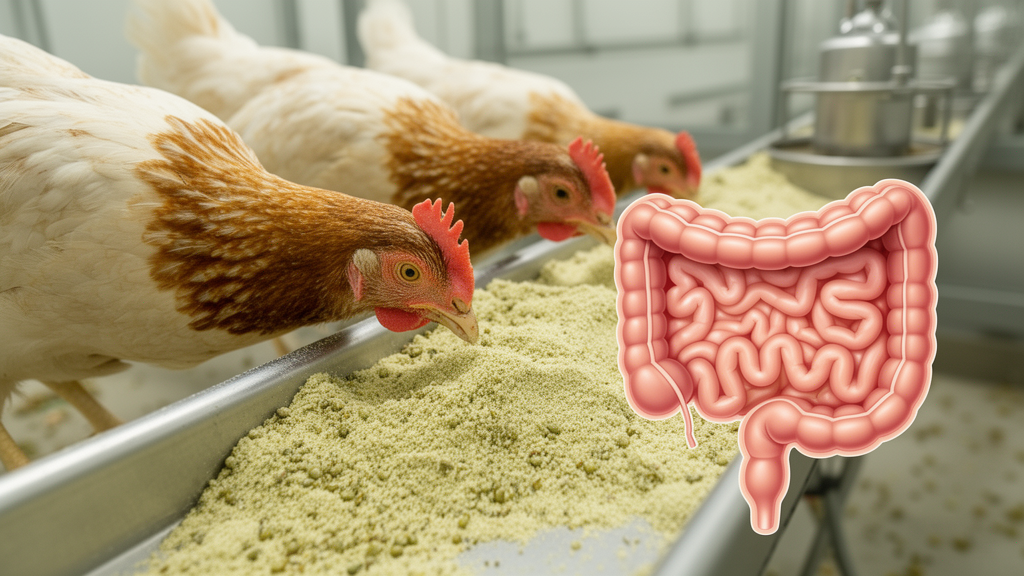
In a controlled feeding trial with 840 male Ross 308 broiler chickens, adding 1–4 grams of defatted olive seed flour per kilogram of feed was associated with better growth, improved feed efficiency and several favorable changes in intestinal and blood measurements. The study, which lasted 28 days and included unchallenged birds under controlled conditions, found that the response varied among outcomes: most growth benefits occurred across all supplementation levels, while higher doses improved carcass yield and 3 grams per kilogram produced the strongest ileal structural and immune-transcription results. No single inclusion rate optimized every measure, but 2–3 grams per kilogram produced the most consistently favorable overall profile.
Researchers randomly assigned the day-old male broilers to five diets, each with 12 replicate floor pens containing 14 birds. One group received a corn–soybean basal diet without supplementation, while four groups received 1, 2, 3 or 4 grams of defatted olive seed flour per kilogram. Body weight, feed use and feed conversion were measured at 14 and 28 days. At slaughter, two birds from each pen were sampled for carcass traits, blood, cecal digesta, ileal tissue and intestinal morphology, and the results from each pen were averaged so that the pen, rather than the individual bird, remained the experimental unit. The study was approved by the King Saud University Research Ethics Committee.
The additive was made from destoned olive seeds by mechanical cold pressing followed by solvent extraction with n-hexane, leaving a material with 7.19% residual fat and 30.00% crude fiber. Previous gas chromatography–mass spectrometry profiling of the tested batch found a matrix dominated by oleic acid, which represented 82.93% of the relative chromatographic area, with smaller proportions of oleuropein, squalene and hydroxytyrosol. These values describe relative peak areas rather than absolute concentrations, and the experiment fed the whole flour rather than isolated compounds. The researchers therefore could not determine whether any effect arose from olive polyphenols, fiber, fatty acids, terpenes or interactions among them.
All four supplemented groups gained more weight and converted feed more efficiently than the control group over the full trial. Average final body weight ranged from 1,696 to 1,724 grams in the supplemented groups, compared with 1,629 grams in controls, while the feed conversion ratio ranged from 1.28 to 1.30 grams of feed per gram of weight gain, against 1.39 in the control group. The European Production Efficiency Index also increased from 417 in controls to 469–479 with supplementation. Feed intake did not differ significantly among groups overall, suggesting that the growth response was not simply the result of birds eating more. No mortality occurred, giving every group 100% livability during the 28-day period.
The dose patterns were not consistently linear. The 1- and 2-gram treatments produced the greatest starter-period gains, while all four supplemented groups performed better during the grower phase and across the full experiment. Carcass weight and dressing yield increased significantly at 3 and 4 grams per kilogram: carcass weight averaged 1,129 and 1,118 grams, respectively, compared with 1,011 grams in controls, while dressing yield reached 68.02% and 66.77% versus 63.53%. Slaughter weight and the proportions of breast and leg cuts did not differ significantly. Relative thymus weight increased with every supplemented dose, and the bursa of Fabricius was heavier at the lowest dose, but organ weight alone does not demonstrate improved immune function. Liver, spleen and intestinal weights were unchanged, as were breast-measurement pH and color characteristics.
Blood measurements showed that supplementation was associated with changes in selected lipid fractions rather than a uniform change in every metabolic marker. At 1 and 2 grams per kilogram, triglycerides were lower and high-density lipoprotein cholesterol higher than in the other groups; low-density lipoprotein cholesterol was also lower at these doses than in controls. Total cholesterol declined linearly with increasing inclusion and was lowest at 4 grams per kilogram, averaging 121.20 milligrams per deciliter compared with 156.39 milligrams per deciliter in controls. Total protein and globulin were higher at 2 grams per kilogram. Aspartate aminotransferase did not differ significantly among groups, while creatinine decreased at the highest dose. Because hepatic pathways, nutrient partitioning and absorption were not measured, the trial cannot identify the mechanisms behind these blood changes or link them causally to better growth.
The clearest systemic oxidative-status pattern appeared at 2–4 grams per kilogram. Birds receiving those diets had higher serum total antioxidant capacity and lower malondialdehyde, a marker of lipid peroxidation, than birds in the control and 1-gram groups. These findings are consistent with reduced lipid peroxidation and stronger measured nonenzymatic antioxidant capacity, but they do not demonstrate activation of a particular intracellular pathway. The researchers did not assay antioxidant enzymes, reactive oxygen species, the nuclear factor erythroid 2-related factor 2 pathway or other proposed molecular targets. They also did not measure nutrient digestibility, so improved feed conversion and intestinal structure cannot be definitively connected to enhanced nutrient absorption. The observed benefits nevertheless remained evident at inclusion rates low enough to avoid a detectable reduction in feed intake.
At 3 grams per kilogram, the ileum had the greatest villus height, averaging 936.19 micrometers, and the largest estimated villus surface area, at 0.29 square millimeters. Villus width also increased at 2–4 grams per kilogram. These are structural measurements that can be associated with absorptive capacity, but the study did not directly test absorption. Crypt depth was greater at 3 and 4 grams per kilogram than at 1 and 2 grams, although it was lower than in controls; the villus-height-to-crypt-depth ratio did not differ significantly among groups. The 3-gram diet also produced the clearest local immune-transcription pattern, with higher interleukin-10 and interferon-gamma messenger RNA and lower interleukin-6 and tumor necrosis factor-alpha transcripts than controls. These measurements represent transcriptional changes, not cytokine proteins or functional immunity, and the simultaneous increase in interferon-gamma prevents the profile from being described as uniformly anti-inflammatory.
Quantitative real-time PCR found more Lactobacillus species DNA in the ceca of every supplemented group and lower DNA targets for Clostridium species, Escherichia coli and Salmonella than in controls. The 3-gram treatment had the lowest Salmonella target abundance, while Bifidobacterium did not differ significantly among diets. These results indicate targeted shifts in five bacterial groups, not a complete account of microbiome health. Copy numbers were derived from genomic DNA and therefore do not distinguish living cells from dead organisms or directly measure bacterial activity. Cecal pH, short-chain fatty acids and microbial metabolites were not measured, leaving the proposed pathway involving fiber fermentation, lactate production and competitive exclusion untested. The findings nevertheless coincided with the improved ileal architecture and growth performance, creating a coherent association among diet, selected bacterial targets, mucosal structure and feed efficiency.
The trial’s scope limits how broadly the results can be applied. It involved only male Ross 308 birds, 60 floor pens and a 28-day period under controlled research conditions, without a disease challenge. The researchers recommend confirmation in other strains, mixed-sex flocks and commercial production settings, as well as broader microbiome analyses using community-level sequencing and viability-based methods. Nutrient digestibility, antioxidant enzyme activity, cytokine proteins, meat quality during storage and economic feasibility also require evaluation. Within those limits, the study presents defatted olive seed flour as a promising low-dose agricultural by-product whose effects differed by endpoint: all tested doses improved growth efficiency, 3–4 grams per kilogram improved carcass yield, and 2–3 grams per kilogram most consistently combined higher antioxidant capacity with favorable intestinal and systemic measures.
Subject of Research: Effects of defatted olive seed flour on growth, oxidative status and intestinal health in broiler chickens
Article Title: Effects of dietary defatted olive seed flour supplementation on growth performance, systemic status, and intestinal health in broiler chickens
Article References: Alhidary, I. A., Alharthi, A. S., Alayedh, Y. A., & Al-Baadani, H. H. (2026). Effects of dietary defatted olive seed flour supplementation on growth performance, systemic status, and intestinal health in broiler chickens. Frontiers in Veterinary Science, 13, Article 2002766. https://doi.org/10.3389/fvets.2026.2002766
Image Credits: AI Generated
DOI: 10.3389/fvets.2026.2002766
Keywords: broiler chickens, olive seed flour, animal nutrition, feed conversion, intestinal health, caecal bacteria, oxidative status, ileal morphology, carcass yield, poultry welfare, Effects, dietary
Cite Scienmag News
Alan Morgan. (October 21, 2026). Olive seed flour improves broiler growth and gut health in 28-day trial. Scienmag. https://scienmag.com/olive-seed-flour-improves-broiler-growth-and-gut-health-in-28-day-trial/
Alan Morgan. "Olive seed flour improves broiler growth and gut health in 28-day trial." Scienmag, 21 October 2026, https://scienmag.com/olive-seed-flour-improves-broiler-growth-and-gut-health-in-28-day-trial/. Accessed 21 October 2026.
Alan Morgan. "Olive seed flour improves broiler growth and gut health in 28-day trial." Scienmag. October 21, 2026. https://scienmag.com/olive-seed-flour-improves-broiler-growth-and-gut-health-in-28-day-trial/


