

Monday, October 26, 2026
Science
No Result
View All Result
  • Login
  • HOME
  • SCIENCE NEWS
  • CONTACT US
  • HOME
  • SCIENCE NEWS
  • CONTACT US
No Result
View All Result
Scienmag
No Result
View All Result
Home Science News Agriculture

GA3 promotes flowering in golden spider lily in experimental plant study

October 26, 2026
in Agriculture
Alan Morgan
By Alan Morgan Scienmag Editorial Profile - Precision Agriculture
Reading Time: 2 mins read
0
GA3 promotes flowering in golden spider lily in experimental plant study

GA3 promotes flowering in golden spider lily in experimental plant study

65
SHARES
587
VIEWS
Share on FacebookShare on Twitter
ADVERTISEMENT

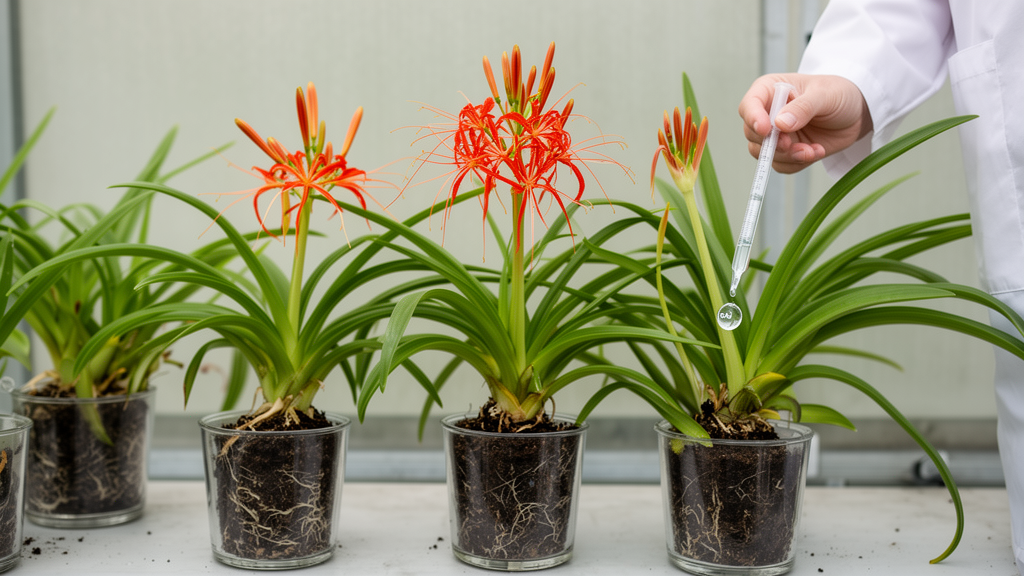
Exogenous GA3 promoted flower-bud differentiation and significantly increased flowering rates in an experimental study of the ornamental plant Lycoris aurea, also known as golden spider lily. The researchers identified 200 mg/L as the optimal GA3 concentration. The study examined the response under experimental conditions and combined histological observations with flowering measurements, hormone and carbohydrate measurements, and integrated transcriptomic and metabolomic analyses to investigate the biological processes associated with the treatment.

L. aurea is characterized by a prolonged vegetative phase and delayed flowering, both of which limit the species’ ornamental and commercial value. The study tested whether applying GA3 could promote flower-bud differentiation and shorten the flowering cycle. Histological analysis showed that GA3 treatment promoted the differentiation of floral primordia, while the flowering rate increased significantly.

The results support a treatment effect in the tested plant system, but the supplied findings do not establish how the treatment performs across field environments or commercial production systems, nor do they establish that every developmental stage of the vegetative phase was shortened. Hormone profiling showed that GA3 treatment was accompanied by dynamic changes in GA3, IAA, ABA and ZR during early flower-bud differentiation. The multi-omics analysis indicated that GA3 activated GA signaling through GID1, increased the expression of SAUR and SnRK2 genes in the IAA and ABA pathways, and suppressed JA-Ile signaling.

These coordinated molecular responses support the conclusion that GA3 affected more than a single signaling pathway. The reported evidence links these changes with promoted flower-bud differentiation, although it does not establish which individual molecular changes are necessary for the flowering response. Carbohydrate measurements also revealed a metabolic shift during early differentiation, with starch, sucrose and SS accumulating as floral primordium development began.

Transcriptomic analysis showed coordinated regulation of genes associated with starch metabolism and sucrose-related processes, including PYG, AMY, HK, SUS and ostA/B. The metabolomic analysis identified sugar-related signals including glucose, trehalose and isomaltose, which the researchers associated with support for flower development. Taken together, the findings suggest that GA3 promoted flower-bud differentiation through crosstalk between hormone signaling and carbohydrate metabolism, while providing evidence for 200 mg/L as the optimal concentration among those tested.

Subject of Research: GA3-mediated flower-bud differentiation and metabolic regulation in Lycoris aurea

Article Title: Exogenous GA3 promotes flower bud differentiation in Lycoris aurea by modulating hormone signaling and carbohydrate metabolism

Article References: Li, Y., Smagghe, G., Hu, Z., Wang, Y., Cernava, T., Zhang, B., Hu, X., & Chen, X. (2026). Exogenous GA3 promotes flower bud differentiation in Lycoris aurea by modulating hormone signaling and carbohydrate metabolism. BMC Plant Biology. https://doi.org/10.1186/s12870-026-09772-4

Image Credits: AI Generated

DOI: 10.1186/s12870-026-09772-4

Keywords: Lycoris aurea, GA3 treatment, flower-bud differentiation, flowering rate, plant hormone signaling, carbohydrate metabolism, floral primordia, transcriptomics, metabolomics, Exogenous, promotes, flower

Cite Scienmag News

Alan Morgan. (October 26, 2026). GA3 promotes flowering in golden spider lily in experimental plant study. Scienmag. https://scienmag.com/ga3-promotes-flowering-in-golden-spider-lily-in-experimental-plant-study/

Alan Morgan. "GA3 promotes flowering in golden spider lily in experimental plant study." Scienmag, 26 October 2026, https://scienmag.com/ga3-promotes-flowering-in-golden-spider-lily-in-experimental-plant-study/. Accessed 26 October 2026.

Alan Morgan. "GA3 promotes flowering in golden spider lily in experimental plant study." Scienmag. October 26, 2026. https://scienmag.com/ga3-promotes-flowering-in-golden-spider-lily-in-experimental-plant-study/


Tags: carbohydrate metabolismExogenousfloral primordiaflowerflower bud differentiationflowering rateGA3 treatmentLycoris aureaMetabolomicsplant hormone signalingPromotesTranscriptomics
Share26Tweet16
Previous Post

HAX1 review highlights context-dependent roles in cancer progression

Next Post

TCGA study links coagulation-associated lncRNAs to prostate cancer prognosis

Related Posts

Genome-wide SSR markers validated in 73 barnyard millet genotypes
Agriculture

Genome-wide SSR markers validated in 73 barnyard millet genotypes

October 25, 2026
Stage-based irrigation raises chickpea yields in arid Türkiye
Agriculture

Stage-based irrigation raises chickpea yields in arid Türkiye

October 25, 2026
Chinese cannabis genomes reveal five regional genetic clusters
Agriculture

Chinese cannabis genomes reveal five regional genetic clusters

October 25, 2026
Ethiopian Homestead Gardens Shelter 45 Woody Species, Most of Them Native
Agriculture

Ethiopian Homestead Gardens Shelter 45 Woody Species, Most of Them Native

October 25, 2026
Multi-omics study links ILA to boosted duckweed growth in laboratory culture
Agriculture

Multi-omics study links ILA to boosted duckweed growth in laboratory culture

October 25, 2026
Silver Nanoparticles Boost Stevia Growth and Sweetener Yield in Lab Cultures
Agriculture

Silver Nanoparticles Boost Stevia Growth and Sweetener Yield in Lab Cultures

October 25, 2026
Next Post
TCGA study links coagulation-associated lncRNAs to prostate cancer prognosis

TCGA study links coagulation-associated lncRNAs to prostate cancer prognosis

  • Mothers who receive childcare support from maternal grandparents show more optimized

    Mothers who receive childcare support from maternal grandparents show more parental warmth, finds NTU Singapore study

    27656 shares
    Share 11059 Tweet 6912
  • University of Seville Breaks 120-Year-Old Mystery, Revises a Key Einstein Concept

    1061 shares
    Share 424 Tweet 265
  • Bee body mass, pathogens and local climate influence heat tolerance

    682 shares
    Share 273 Tweet 171
  • Researchers record first-ever images and data of a shark experiencing a boat strike

    546 shares
    Share 218 Tweet 137
  • Groundbreaking Clinical Trial Reveals Lubiprostone Enhances Kidney Function

    531 shares
    Share 212 Tweet 133
Science

Embark on a thrilling journey of discovery with Scienmag.com—your ultimate source for cutting-edge breakthroughs. Immerse yourself in a world where curiosity knows no limits and tomorrow’s possibilities become today’s reality!

RECENT NEWS

  • TCGA study links coagulation-associated lncRNAs to prostate cancer prognosis
  • GA3 promotes flowering in golden spider lily in experimental plant study
  • HAX1 review highlights context-dependent roles in cancer progression
  • Global review maps serologic exposure among occupationally exposed workers

Categories

  • Agriculture
  • Anthropology
  • Archaeology
  • Athmospheric
  • Biology
  • Biotechnology
  • Blog
  • Bussines
  • Cancer
  • Chemistry
  • Climate
  • Earth Science
  • Editorial Policy
  • Marine
  • Mathematics
  • Medicine
  • Pediatry
  • Policy
  • Psychology & Psychiatry
  • Science Education
  • Science News
  • Social Science
  • Space
  • Technology and Engineering

Subscribe to Blog via Email

Enter your email address to subscribe to this blog and receive notifications of new posts by email.

Join 5,151 other subscribers

© 2025 Scienmag - Science Magazine

Welcome Back!

Login to your account below

Forgotten Password?

Retrieve your password

Please enter your username or email address to reset your password.

Log In
No Result
View All Result
  • HOME
  • SCIENCE NEWS
  • CONTACT US

© 2025 Scienmag - Science Magazine

Discover more from Science

Subscribe now to keep reading and get access to the full archive.

Continue reading