


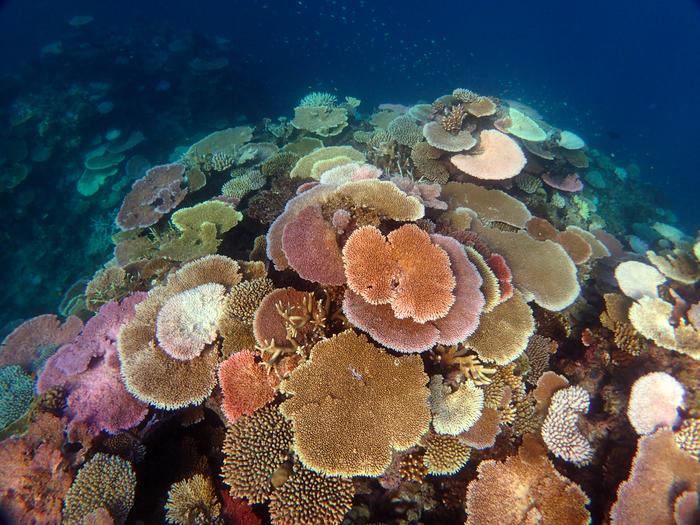
An international team of researchers led by the University of Adelaide has projected future marine heatwaves will cause coral reefs to be at severe risk of bleaching for longer periods than previously seen.

Credit: Neal Cantin, Australian Institute of Marine Science
An international team of researchers led by the University of Adelaide has projected future marine heatwaves will cause coral reefs to be at severe risk of bleaching for longer periods than previously seen.
Through climate modelling and supercomputing, the researchers discovered that extended bleaching events may significantly disrupt coral spawning.
“We found that coral bleaching will start earlier in the year and last longer than previously thought,” said lead author Dr Camille Mellin, from the University of Adelaide’s Environment Institute.
“Our results show that by 2080, coral bleaching will tend to start in spring, rather than late summer, which could potentially threaten coral reproduction success.
“In many regions coral spawning occurs once a year, in spring, and our modelling projects a high risk that coral bleaching will coincide with this reproductive event, which will be devastating for thousands of coral species.”
Marine heatwaves cause corals to become stressed and expel the symbiotic algae living in their tissue, leaving corals white and weakened.
While widespread coral bleaching is a recent phenomenon, four global mass bleaching events have occurred since 1998, the most recent two occurring in this decade.
This recent discovery, published in the journal Science Advances, establishes the severity, timing and duration of severe bleaching risk in the 21st century for Earth’s coral reefs, showing that mass bleaching events are going to continue to become even more frequent in the future.
“Our projections of daily heat stress show that the greatest risk of severe coral bleaching this century will be along the equator, which is also home to the most biodiversity-rich coral reefs,” said Associate Professor Damien Fordham, from the University of Adelaide’s Environment Institute.
“Coral reefs in these equatorial regions, including Indonesia’s Coral Triangle, could face near constant bleaching conditions by the end of the century.
“Unfortunately, marine species in these regions are already living at temperatures near their upper tolerance levels and so are particularly ill-equipped to adapt to accelerated climate change, making them highly vulnerable to extinction.”
Low-latitude coral reef regions support food and nutrition for millions of people worldwide, with local populations relying on coral reef fisheries for income.
These new results, accompanied by an online data portal, will help reef managers identify regions of lower bleaching risk where coral conservation actions can be prioritised and corals best saved.
“Our validated projections of future coral bleaching risk are based on daily marine heatwave forecasts, which represent a critical improvement over past approaches” said Professor Scott Heron, a co-author from James Cook University.
“These next-generation projections will be crucial for developing conservation strategies aimed to protect and restore coral reefs in regions at lesser risk of future climate change. These are areas where conservation success is most likely.”
Article Title
Cumulative risk of future bleaching for the world’s coral reefs
Cite Scienmag News
Violet Maxwell. (June 26, 2024). Future risk of coral bleaching set to intensify globally. Scienmag. https://scienmag.com/future-risk-of-coral-bleaching-set-to-intensify-globally/
Violet Maxwell. "Future risk of coral bleaching set to intensify globally." Scienmag, 26 June 2024, https://scienmag.com/future-risk-of-coral-bleaching-set-to-intensify-globally/. Accessed 5 September 2026.
Violet Maxwell. "Future risk of coral bleaching set to intensify globally." Scienmag. June 26, 2024. https://scienmag.com/future-risk-of-coral-bleaching-set-to-intensify-globally/

