


Updated radiocarbon calibration techniques provide improved date estimates for Greek shipwrecks, according to a study published June 26 in the open-access journal PLOS ONE by Sturt Manning of Cornell University, US, and colleagues.

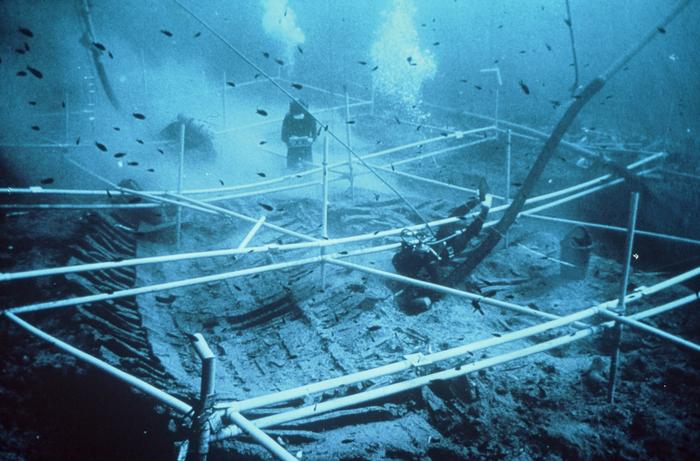
Credit: Image provided to authors by Kyrenia Ship Excavation team for use with this paper, CC-BY 4.0 (
Updated radiocarbon calibration techniques provide improved date estimates for Greek shipwrecks, according to a study published June 26 in the open-access journal PLOS ONE by Sturt Manning of Cornell University, US, and colleagues.
The Kyrenia Ship was found in the 1960s off the coast of Cyprus, and it has become a key vessel in the study of ancient Greek shipbuilding. Archaeological evidence has indicated the age of the ship’s final voyage at around 300 BCE, but previous radiocarbon dating efforts have not lined up with the archaeological evidence. Manning and colleagues suggest that this discrepancy is due to outdated radiocarbon calibration data.
Accurate radiocarbon dating relies on calibration data based on known-age tree-ring dates to correct for error caused by variation in atmospheric carbon over time. As radiocarbon dating techniques have improved, some time periods within the current Northern Hemisphere calibration curve have yet to be updated. In this study, the researchers applied new tree-ring samples and modern dating techniques to revise calibration data for the period between 433-250 BCE.
The authors then applied the updated calibration to newly acquired radiocarbon dates on materials from the Kyrenia Ship (both from the ship and its final cargo). The resulting dates are compatible with existing archaeological data, and they indicate the ship’s last voyage around 280 BCE, slightly later than previous estimates. The authors also applied the new radiocarbon calibration curve to radiocarbon dates from another Greek ship, the Mazotos ship, and estimated an age around 370 BCE for the last voyage, again slightly later than indicated by previous research.
This study emphasizes the importance of continuing revision of radiocarbon calibration data. The authors note that further refinements to this and other time periods will be especially important for archaeological materials which require dating precision on the order of decades.
The authors add: “We are excited to apply scientific techniques to date the famous Kyrenia Ship a little over 2300 years ago. Central to the history of ship technology and maritime trade in the classical Mediterranean, the methods we use to date the ship – and solutions to various technical challenges we had to overcome – will now help date other shipwrecks and better inform the history of ancient seafaring.”
#####
In your coverage please use this URL to provide access to the freely available article in PLOS ONE:
Citation: Manning SW, Lorentzen B, Bridge M, Dee MW, Southon J, Wenger M (2024) A revised radiocarbon calibration curve 350–250 BCE impacts high-precision dating of the Kyrenia Ship. PLoS ONE 19(6): e0302645.
Author Countries: USA, Cypress, UK, The Netherlands
Funding: SWM, New Frontiers Grant, College of Arts & Sciences, Cornell University.
Journal
PLoS ONE
Method of Research
Observational study
Subject of Research
People
Article Title
A revised radiocarbon calibration curve 350–250 BCE impacts high-precision dating of the Kyrenia Ship
Article Publication Date
26-Jun-2024
COI Statement
The authors have declared that no competing interests exist.
Cite Scienmag News
Courtney Benton. (June 26, 2024). Updated radiocarbon dates for the Greek shipwreck Kyrenia. Scienmag. https://scienmag.com/updated-radiocarbon-dates-for-the-greek-shipwreck-kyrenia/
Courtney Benton. "Updated radiocarbon dates for the Greek shipwreck Kyrenia." Scienmag, 26 June 2024, https://scienmag.com/updated-radiocarbon-dates-for-the-greek-shipwreck-kyrenia/. Accessed 5 September 2026.
Courtney Benton. "Updated radiocarbon dates for the Greek shipwreck Kyrenia." Scienmag. June 26, 2024. https://scienmag.com/updated-radiocarbon-dates-for-the-greek-shipwreck-kyrenia/

