


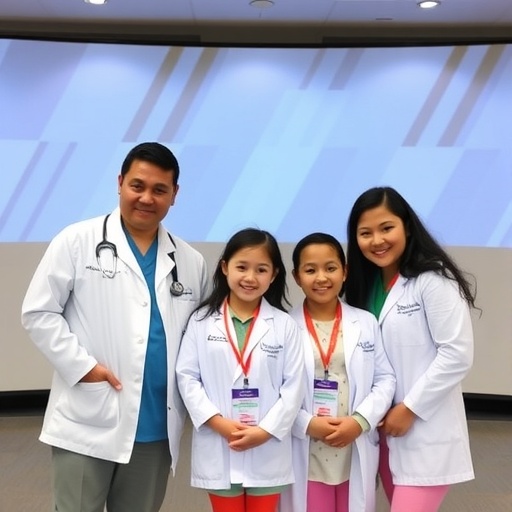
In a powerful demonstration of community solidarity and cutting-edge medical engagement, the 12th edition of Paediatric Brain and Solid Tumour Awareness (PBSTA) Day unfolded in Singapore on May 17, 2026. Far surpassing a mere commemorative or outreach event, PBSTA Day has evolved into a seminal platform for fostering resilience, understanding, and support for children battling brain tumors and other solid malignancies. The event serves as a beacon of hope not only for patients but also for their families and the clinicians dedicated to advancing pediatric oncology.
This year’s PBSTA Day convened 22 pediatric cancer patients along with their families and caregivers in a carefully curated program that emphasized holistic care and community involvement. Spearheaded by 50 dedicated Duke-NUS Medical School student volunteers, the event was further fortified by collaboration with seasoned clinicians from KK Women’s and Children’s Hospital and the National Neuroscience Institute. Together, these stakeholders created a sanctuary of empathy and joy amid the formidable challenges imposed by such illnesses.
Brain tumors remain among the most common solid tumors affecting children worldwide, presenting a formidable challenge due to their aggressive nature and the complex neuroanatomical environments they inhabit. Despite advances in surgical techniques, radiotherapy, and targeted therapies, the prognosis for many pediatric brain tumor subtypes remains guarded. Beyond the biological and clinical dimensions, these tumors impose profound psychosocial, emotional, and economic burdens on affected families, highlighting the necessity for comprehensive care approaches that extend well beyond hospital walls.
Initially conceived as a student-led initiative, PBSTA Day has blossomed into an influential platform for amplifying awareness, fostering solidarity, and encouraging collaborative research efforts in pediatric neuro-oncology. The event intentionally interweaves personal narratives from cancer survivors, caregivers, and healthcare professionals to cultivate a collective understanding of the disease’s multifaceted impact. This participatory model enhances not only community engagement but also informs clinical empathy and patient-centered care strategies.
The 2026 program integrated diverse activities designed to uplift spirits and generate meaningful connections. Among these, the signature luxury car joyride organized by Porsche Club Singapore offered exhilarating moments of reprieve and excitement for the young patients. Complementing these lighthearted experiences were musical performances and interactive carnival games, carefully selected to promote joy while strengthening social bonds.
More significantly, PBSTA’s public outreach was augmented through awareness booths and a panel discussion moderated by Dr. Felicia Chua, Associate Consultant in Neurosurgery at the National Neuroscience Institute. This discourse featured candid dialogue among cancer survivors, caregivers, and medical experts, stressing the ongoing imperative to broaden public understanding of pediatric brain tumors and to dispel misconceptions surrounding these devastating conditions.
Dr. Chua emphasized the critical role that awareness events like PBSTA Day play in bridging the gap between clinical practice and community reality. She remarked on witnessing firsthand the extraordinary resilience demonstrated by children afflicted with brain tumors and the indomitable strength of their families. These narratives underscore a pressing clinical imperative: to meld scientific innovation with humanistic care, ensuring that treatment paradigms honor patient dignity and psychosocial wellbeing alongside biological eradication of disease.
Student project committee member Isabel Crisostomo, part of the Duke-NUS Class of 2028, reflected on the personal growth experienced through participation in PBSTA Day. She noted that while medical education invests deeply in understanding tumor biology at the cellular and molecular levels, community engagement reveals the profound human cost of disease. This dual awareness fosters a compassionate ethos vital for future clinicians who must navigate the intersection between research aspirations and real-world patient support.
Vice Dean of Education at Duke-NUS, Associate Professor Shiva Sarraf-Yazdi, framed PBSTA Day as a manifestation of the institution’s educational mission to cultivate physicians who embody a fusion of scientific rigor and empathetic advocacy. He highlighted that programs such as PBSTA not only facilitate community impact but also enrich medical training by exposing students to the lived experiences of pediatric oncology patients and their families, thus shaping more holistic healthcare providers.
The event poignantly reiterated that medicine transcends technical diagnosis and treatment regimes; it encompasses relational care characterized by presence, attentive listening, and the facilitation of moments of meaningful connection and hope. This model recognizes that long-term survivorship and quality of life hinge equally on psychosocial support networks and ongoing multidisciplinary clinical management.
Moreover, PBSTA Day’s sustained success exemplifies how academic institutions, healthcare providers, community organizations, and patient advocates can coalesce into dynamic alliances that amplify impact on pediatric brain tumor outcomes. The event’s fusion of education, research advocacy, patient support, and public engagement epitomizes an innovative template for addressing complex pediatric diseases in ways that honor scientific progress and human compassion alike.
As pediatric brain tumor incidence remains a critical global health challenge, initiatives like PBSTA spotlight the necessity for expansive strategies that unify education, patient care, and community mobilization. Their integrative approach offers a roadmap not only for enhancing prognosis but also for ameliorating the psychosocial sequelae that keenly affect children and families.
Through such vibrant, inclusive platforms, PBSTA Day continues to forge pathways toward a future where scientific breakthroughs are matched by equally robust frameworks of empathy and support. It stands as a testament to the enduring power of community-driven advocacy to transform the landscape of pediatric oncology.
Cite Scienmag News
Nathaniel Bowman. (May 18, 2026). Future Physicians Unite in Support of Children with Cancer and Their Families at PBSTA Day. Scienmag. https://scienmag.com/future-physicians-unite-in-support-of-children-with-cancer-and-their-families-at-pbsta-day/
Nathaniel Bowman. "Future Physicians Unite in Support of Children with Cancer and Their Families at PBSTA Day." Scienmag, 18 May 2026, https://scienmag.com/future-physicians-unite-in-support-of-children-with-cancer-and-their-families-at-pbsta-day/. Accessed 3 September 2026.
Nathaniel Bowman. "Future Physicians Unite in Support of Children with Cancer and Their Families at PBSTA Day." Scienmag. May 18, 2026. https://scienmag.com/future-physicians-unite-in-support-of-children-with-cancer-and-their-families-at-pbsta-day/


