


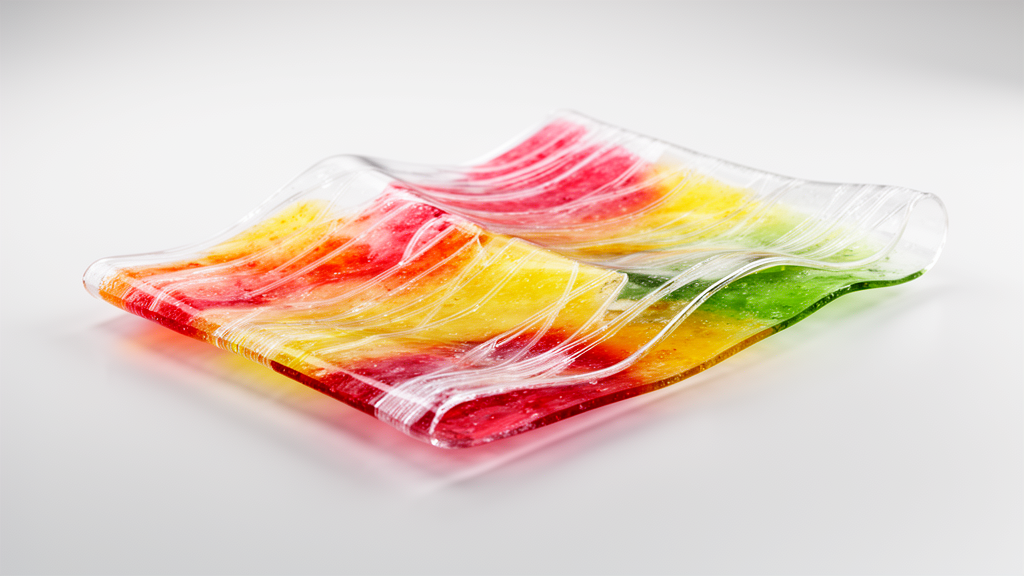
Researchers have blended ordinary polyvinyl alcohol, one of the most widely used water-soluble and biodegradable synthetic polymers, with juice extracts pressed from pomegranate, dragon fruit and black grapes, and then measured in detail how each natural additive reshapes the material’s structure, mechanics and optical behaviour. The study, published in Polymer Bulletin, fabricated films by solution casting, adding pomegranate extract at 0 to 12 v/v%, dragon fruit extract at 0 to 5 v/v% and black grape extract at 0 to 20 v/v%, and then subjected the dried films to X-ray diffraction, infrared spectroscopy, electron microscopy, tensile testing, UV-visible absorption, photoluminescence, quantum yield and time-resolved decay measurements. The goal was to move beyond the usual practice of using plant extracts merely as colour indicators and instead map, side by side, how three different natural chromophore families modify a single polymer host.
The three fruits were chosen because they are inexpensive, food-grade and rich in distinct pigment classes. Pomegranate and black grape are known sources of anthocyanins, the water-soluble pigments behind many red, purple and blue plant colours, while red-fleshed dragon fruit is characterised mainly by betacyanin, with anthocyanins also reported in some studies. The authors are careful to note that published pigment contents for these fruits were not measured for their own extracts and vary with extraction method, so they did not use literature values to explain quantitative differences between the composites. What matters for the polymer is that these molecules carry hydroxyl groups, carbonyls and conjugated aromatic rings, all of which can interact with the hydroxyl-rich backbone of polyvinyl alcohol.
X-ray diffraction revealed the first structural consequence of adding the extracts. Pristine polyvinyl alcohol is semicrystalline, showing a characteristic diffraction peak near a 2-theta value of 20 degrees and a relative crystallinity of about 30%. Once the fruit extracts were incorporated, that crystalline fraction fell dramatically, ranging from 5.1 to 13.2% for the pomegranate series, 9.8 to 23.4% for the dragon fruit series and 8.7 to 16.6% for the black grape series, without changing systematically with concentration in any series. The interplanar spacing of the main reflection stayed nearly constant at about 3.9 angstroms, but the apparent crystallite size shrank with loading in the dragon fruit and black grape films, from ranges of 2.4 to 5.1 nanometres and 1.8 to 4.4 nanometres respectively, consistent with smaller or more disordered crystallites. In the black grape composites, the PVA peak broadened and weakened up to 15 v/v%, but at 20 v/v% a relatively sharp peak reappeared, which the authors attribute to possible phase segregation and localised re-crystallisation during solvent evaporation.
Infrared spectroscopy provided molecular-level evidence for why the crystal packing breaks up. The broad O-H stretching band of pristine PVA sits near 3290 per centimetre, arising from inter- and intramolecular hydrogen bonds. In the composites this band shifted to lower wavenumbers within a 3280 to 3350 per centimetre window and broadened with increasing extract loading, a signature of stronger hydrogen bonding, since a stronger O-H interaction lengthens the bond and lowers its stretching frequency. The shifts indicate that new hydrogen bonds form between PVA hydroxyl groups and the hydroxyl-bearing phenolics and sugars of the extracts. Additional changes appeared across the fingerprint region: carbonyl bands between 1650 and 1740 per centimetre shifted with loading, aromatic carbon-carbon stretching bands developed or strengthened near 1650 to 1580 per centimetre, and the carbon-oxygen and carbon-oxygen-carbon bands varied in ways consistent with sugar-linked extract components. The dragon fruit composites showed the most intense spectral alterations.
Scanning electron microscopy tracked how these molecular interactions translate into surface texture. Pristine PVA films are relatively smooth and homogeneous, but the pomegranate composites developed slight roughening and small granule-like structures with increasing concentration, suggesting aggregation or phase separation of polyphenolic components. Dragon fruit films stayed smooth at low loadings of 1 to 2 v/v% but developed micropores and irregular patches at 3 to 5 v/v%. Black grape composites remained uniform up to 15 v/v%, beyond which agglomeration appeared. Energy-dispersive X-ray spectroscopy added a curious detail: pristine PVA contains only carbon and oxygen, while the composites showed weak signals for sodium in the pomegranate film, sodium and magnesium in the dragon fruit film, and potassium in the black grape film, most likely reflecting the differing mineral content of the juices themselves.
Mechanical testing showed that stiffness and strength respond differently to the additives. Pristine PVA had a tensile strength of 19.12 megapascals and a Young’s modulus of 4.95 megapascals. Only one composition beat the pristine polymer on strength: the pomegranate composite at 4.0 v/v%, which reached 21.55 megapascals. All dragon fruit composites were weaker than pristine PVA, falling from 14.76 megapascals at 1 v/v% to 7.83 megapascals at 5 v/v%, and the black grape films ranged from 2.78 to 10.30 megapascals. Yet most composites were stiffer than the pristine polymer, with maximum moduli of 22.00 megapascals for pomegranate at 4 v/v% and 22.46 megapascals for dragon fruit at 3 v/v%. The authors interpret this combination of higher stiffness with lower strength as evidence that extract-PVA hydrogen bonding restricts chain mobility at small strains without improving resistance to failure at larger strains. Elongation at break rose at moderate loadings, consistent with plasticisation by extract components, and dropped at high loadings where aggregation and microphase separation reduce chain continuity.
The optical results are where the composites become genuinely interesting for applications. Pristine PVA absorbs around 250 nanometres, but the pomegranate and dragon fruit composites showed two distinct absorption bands, near 250 to 300 nanometres and 500 to 600 nanometres, corresponding to pi-pi-star and n-pi-star transitions of the anthocyanin and chromophore pigments, with absorbance intensity climbing as concentration increased. The black grape composites showed a single prominent band at 250 to 300 nanometres that likewise intensified with loading. Using Tauc analysis, the team found that pristine PVA has a direct optical band gap of 4.7 electronvolts, which the extracts narrowed to minima of 1.86 electronvolts for pomegranate, 1.91 for dragon fruit and 3.14 for black grape, while indirect gaps fell to 3.50, 3.90 and 3.99 electronvolts respectively. Optical conductivity rose progressively with extract concentration, and the Urbach energy decreased, indicating a sharpening of the absorption edge, although the authors caution that part of this change may reflect the pigment’s own absorption edge rather than the matrix alone.
Photoluminescence told a more complicated story of competing radiative and non-radiative pathways. Excited at 375 nanometres, the pomegranate composites emitted at 428 and 438 to 440 nanometres with non-monotonic intensity, peaking at 10 v/v%; the dragon fruit films emitted at 455 to 461 nanometres with a slight red shift; and the black grape films showed a monotonic intensity increase with loading. Quantum yield, however, fell sharply in every series: pristine PVA leads at 8.0%, while pomegranate composites dropped to 1.1% at 4 v/v%, dragon fruit to 3.5% at 1 v/v%, and black grape declined continuously to about 0.6% at 20 v/v%. Time-resolved measurements showed lifetimes falling from 5.78 nanoseconds in pristine PVA to minima of 2.50 nanoseconds for pomegranate at 8 v/v%, 2.78 for dragon fruit at 4 v/v% and 3.16 for black grape at 10 v/v%, before partially recovering at the highest loadings. Rate analysis confirmed that the non-radiative decay rate rises to roughly twice to two-and-a-half times the pristine value at moderate loading, consistent with Förster-type energy transfer between closely spaced chromophores and aggregation-induced quenching.
The authors identify optimised compositions that balance mechanical and optical responsiveness: pomegranate at 8 v/v%, dragon fruit at 2 v/v% and black grape at 10 v/v%. Taken together, the solution-cast results demonstrate that extract type and concentration act as tunable levers over crystallinity, stiffness, elongation, band gap and emission quenching in a biodegradable polymer. The combination of strong ultraviolet absorption, narrowed band gaps and suppressed re-emission leads the team to propose the composites as candidate materials for optically active UV-shielding, with possible relevance to optoelectronic and light-harvesting applications. The study offers a detailed concentration-dependent map of how kitchen fruit extracts behave as functional polymer additives rather than simple colorants.
Subject of Research: Photophysical and mechanical properties of fruit juice extract-incorporated PVA biocomposites
Article Title: Photophysical, and mechanical properties of fruit juice extract-incorporated PVA biocomposites
Article References: Nagaraju, M., Norek, M., Sachith, B. M., Kaliszewski, M., Winfred, J. S. R. V., Rajanna, K., & Madhukar, B. S. (2026). Photophysical, and mechanical properties of fruit juice extract-incorporated PVA biocomposites. Polymer Bulletin, 83(12), 692. https://doi.org/10.1007/s00289-026-06748-0
Image Credits: AI Generated
DOI: 10.1007/s00289-026-06748-0
Keywords: PVA, biocomposites, anthocyanins, pomegranate extract, dragon fruit, black grape, photoluminescence, UV shielding, XRD, tensile properties, optical band gap, hydrogen bonding
Cite Scienmag News
Bethany Barker. (October 24, 2026). Fruit Juice Extracts Tune the Light and Strength of PVA Bioplastic Films. Scienmag. https://scienmag.com/fruit-juice-extracts-tune-the-light-and-strength-of-pva-bioplastic-films/
Bethany Barker. "Fruit Juice Extracts Tune the Light and Strength of PVA Bioplastic Films." Scienmag, 24 October 2026, https://scienmag.com/fruit-juice-extracts-tune-the-light-and-strength-of-pva-bioplastic-films/. Accessed 24 October 2026.
Bethany Barker. "Fruit Juice Extracts Tune the Light and Strength of PVA Bioplastic Films." Scienmag. October 24, 2026. https://scienmag.com/fruit-juice-extracts-tune-the-light-and-strength-of-pva-bioplastic-films/


