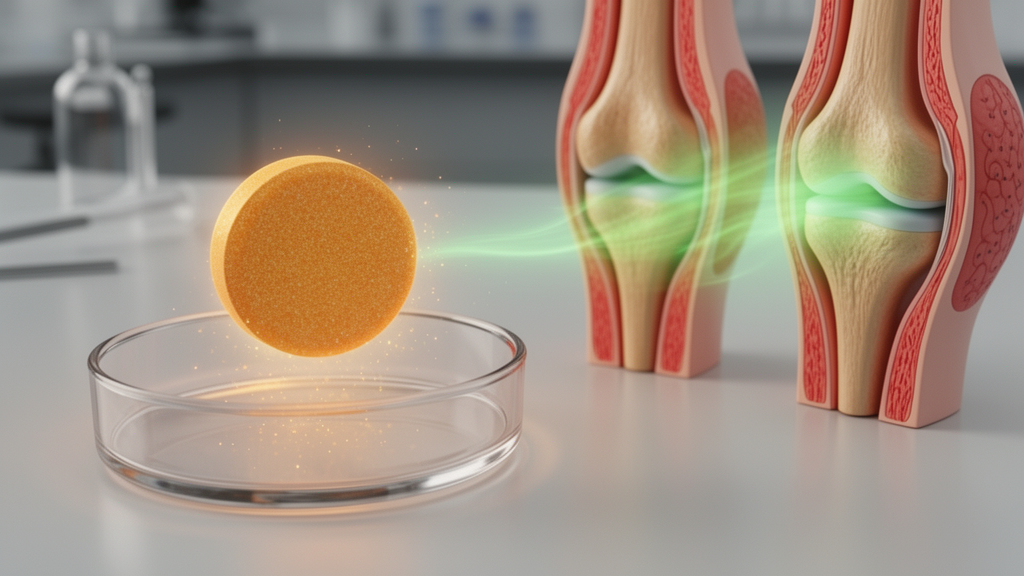
Rheumatoid arthritis is a chronic autoimmune inflammatory disorder, and current therapies often carry adverse effects that prompt researchers to look for alternatives among dietary sources of bioactive compounds. A team led by Sonia Mann and Sagarika Biswas has now reported early laboratory evidence that a chewable nutraceutical tablet formulated from the fruit of Choerospondias axillaris, an underutilized species, may modulate molecular targets linked to RA-related inflammation. The work, published in Molecular Biology Reports, combines formulation chemistry, computational target prediction, cell experiments and an animal model.
The researchers prepared the tablets, referred to as LTs, by direct compression using C. axillaris fruit powder as the principal ingredient. Characterization with Fourier-transform infrared spectroscopy, scanning electron microscopy and energy-dispersive X-ray spectroscopy showed that the formulated tablets contained detectable mineral elements and phytochemical constituents. Antioxidant activity was assessed with the DPPH free-radical scavenging assay, a standard test of a compound’s ability to neutralize radicals in vitro.
To identify which RA-related processes the fruit’s compounds might influence, the team used a network pharmacology approach. Potential RA-associated targets of C. axillaris were predicted with the PharmMapper server, followed by Cytoscape-based network analysis and Gene Ontology and KEGG pathway analyses. This computational screen identified 20 potential targets associated with C. axillaris activity against rheumatoid arthritis.
Molecular docking was then performed to assess how major bioactive compounds from the fruit might interact with selected RA-related proteins. The docking results revealed potential interactions between the selected bioactive compounds and key RA-related proteins, providing a structural rationale for the observed biological effects, although docking predictions alone do not demonstrate activity in living systems.
Using quantitative PCR, the researchers found that in vitro treatment with the tablet preparation reduced the expression of MAPK14, MMP9 and IL2 in these cells.
Treatment with the tablet formulation suppressed inflammatory responses measured in the plasma of the CIA rats. The authors note that these in vivo findings complement the cell culture results, but the model does not reproduce every feature of human rheumatoid arthritis, and plasma inflammatory markers are an indirect readout of disease activity.
Taken together, the authors conclude that C. axillaris bioactive compounds may modulate molecular targets associated with RA-related inflammation and that the findings support further investigation of C. axillaris-derived nutraceutical formulations for RA management. This is deliberately cautious language: the study establishes plausibility and identifies targets, rather than demonstrating a therapeutic benefit in patients.
Several limitations frame the results. The evidence comes entirely from in vitro experiments and an animal model, with no human testing reported. The network pharmacology predictions are computational and require experimental validation for each target. The researchers themselves position the work as a foundation for further investigation rather than a treatment recommendation.
For readers following the search for gentler adjuncts to rheumatoid arthritis therapy, the study is a reminder of how early-stage nutraceutical research proceeds: from fruit chemistry to computational target prediction, then to docking, cell assays and animal models.
Subject of Research: Preclinical evaluation of a Choerospondias axillaris nutraceutical tablet for rheumatoid arthritis
Article Title: Therapeutic modulation of inflammation and oxidative stress in rheumatoid arthritis through Choerospondias axillaris intervention: evidence from in-vitro and in-vivo studies
Article References: Mann, S., Chakraborty, D., Sarkar, A., Sharma, A., Malik, S., Dey, A., Saquib, M., Joshi, L., & Biswas, S. (2026). Therapeutic modulation of inflammation and oxidative stress in rheumatoid arthritis through Choerospondias axillaris intervention: evidence from in-vitro and in-vivo studies. Molecular Biology Reports, 53(1), Article 1771. https://doi.org/10.1007/s11033-026-12893-6
Image Credits: AI Generated
DOI: 10.1007/s11033-026-12893-6
Keywords: rheumatoid arthritis, Choerospondias axillaris, nutraceutical, oxidative stress, inflammation, network pharmacology, molecular docking, collagen-induced arthritis, synovial fibroblasts, antioxidant, Therapeutic, modulation
Cite Scienmag News
Drew Townsend. (October 28, 2026). Fruit-derived nutraceutical tablet shows early anti-inflammatory signals in rheumatoid arthritis models. Scienmag. https://scienmag.com/fruit-derived-nutraceutical-tablet-shows-early-anti-inflammatory-signals-in-rheumatoid-arthritis-models/
Drew Townsend. "Fruit-derived nutraceutical tablet shows early anti-inflammatory signals in rheumatoid arthritis models." Scienmag, 28 October 2026, https://scienmag.com/fruit-derived-nutraceutical-tablet-shows-early-anti-inflammatory-signals-in-rheumatoid-arthritis-models/. Accessed 28 October 2026.
Drew Townsend. "Fruit-derived nutraceutical tablet shows early anti-inflammatory signals in rheumatoid arthritis models." Scienmag. October 28, 2026. https://scienmag.com/fruit-derived-nutraceutical-tablet-shows-early-anti-inflammatory-signals-in-rheumatoid-arthritis-models/