


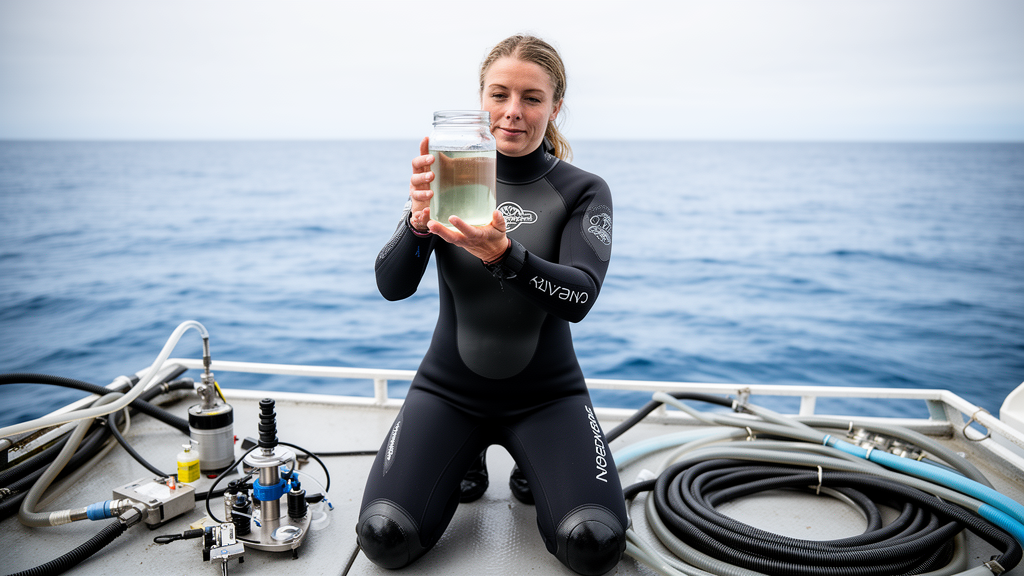
The ocean has long been treated as the planet’s dilution solution, a vast reservoir capable of absorbing whatever industry and agriculture discard into it. A new review published in Environmental Monitoring and Assessment challenges that complacency with a sobering synthesis of more than 100 studies spanning 1993 to 2025, most of them concentrated in the past fifteen years. The analysis, led by Qing Chen and colleagues at Liaoning Normal University in Dalian, China, takes four emblematic classes of emerging pollutants as its focus: endocrine-disrupting compounds, per- and polyfluoroalkyl substances, microplastics, and antibiotics. Together, these contaminants form a chemical cocktail that is quietly rewiring the biology of marine organisms, from the plankton at the base of the food web to the dolphins at its apex.
Endocrine-disrupting compounds, or EDCs, are chemicals that interfere with the hormone systems of living organisms, mimicking or blocking the molecular signals that govern reproduction, development, and metabolism. The review traces the scientific recognition of this threat back to a landmark 1993 paper documenting developmental effects of endocrine-disrupting chemicals in wildlife and humans, and to subsequent studies such as the finding that juvenile alligators in contaminated Florida lakes exhibited gonadal abnormalities and altered sex hormone concentrations. In the marine realm, the evidence is similarly unsettling. Imposex in prosobranch molluscs, disrupted molting in crustaceans exposed to cadmium, and altered oyster microbiomes following atrazine exposure all illustrate how synthetic chemicals can hijack ancient endocrine pathways. Sources are diffuse and insidious: sewage treatment plants discharge steroid hormones and phenols that resist conventional removal, agricultural runoff carries pesticides, and mariculture operations contribute their own hormonal burden, with some studies exploring seaweed-based biosorption as a partial remedy.
The technical challenge posed by EDCs lies partly in their potency at vanishingly low concentrations. Computational studies of estrogen receptor interactions with perfluorinated compounds reveal that even structurally dissimilar molecules can dock onto hormone receptors and trigger downstream gene expression. This means that regulatory frameworks built around traditional dose-response thresholds may underestimate risk, particularly for chronic, low-level exposures that accumulate across generations. The review emphasizes that bioconcentration in fish bile and surface waters of heavily industrialized deltas, such as the Pearl River Delta in southern China, demonstrates that these compounds are not merely passing through coastal ecosystems but lodging within them.
Per- and polyfluoroalkyl substances, better known as PFAS, represent perhaps the most chemically stubborn of the four pollutant classes. These synthetic molecules owe their utility to carbon-fluorine bonds, among the strongest in organic chemistry, which render them resistant to hydrolysis, photolysis, and microbial degradation. That same stability has earned them the colloquial name forever chemicals. The Madrid Statement of 2015, signed by dozens of scientists, formalized concerns about their persistence and toxicity. In marine environments, PFAS arrive through wastewater effluent, atmospheric transport on aerosol particles, and industrial discharges, and they bioaccumulate in the tissues of top predators. Studies of mass-stranded common dolphins in New Zealand have documented substantial PFAS burdens alongside trace elements, raising questions about immune suppression and developmental toxicity documented in laboratory mammals.
Mitigation of PFAS remains an engineering frontier. The review highlights emerging destruction technologies, including plasma treatment that exploits structural differences among PFAS compounds to break their recalcitrant bonds, as well as sorptive removal using activated carbon and anion exchangers in drinking water treatment. Yet these interventions operate downstream of the problem. The sheer diversity of the PFAS universe, numbering thousands of distinct structures according to OECD terminology guidance, means that analytical detection lags behind the introduction of new variants, and short-chain replacements often prove nearly as persistent as the long-chain compounds they replaced.
Microplastics, defined as plastic particles smaller than five millimeters, have become the most visually iconic marine pollutant of the Anthropocene. The review synthesizes three decades of research showing that plastic debris fragments into ever-smaller particles that permeate every ocean compartment, from subtropical gyres where floating plastics accumulate to hadal trenches described as the ocean’s ultimate trashcan. Atmospheric deposition carries microplastics to remote seas such as the northwestern South China Sea, while coastal blue carbon ecosystems, including seagrass meadows and mangrove forests, trap particles in their sediments. The biological consequences are wide-ranging: zebrafish exposed to polystyrene microplastics suffer liver toxicity and gut microbiota dysbiosis, marine jacopever show altered behavior and depleted energy reserves, and oysters exposed to polystyrene exhibit impaired reproduction, a finding with direct implications for aquaculture economies.
What elevates microplastics from nuisance to systemic threat is their role as chemical vectors and microbial platforms. Laboratory and field studies show that plastics sorb organic contaminants, including antibiotics, from seawater, potentially delivering concentrated doses to organisms that ingest them. Simultaneously, plastic surfaces host distinct bacterial communities compared with ambient water and sediment, and recent work has documented microplastic-mediated transfer of tetracycline resistance genes via mussels, positioning these particles as oceanic hitchhikers for antimicrobial-resistant bacteria. Combined exposure studies reveal further complexity: nanoplastics and polycyclic aromatic hydrocarbons jointly reshape seawater microbial communities, and microplastics paired with tetracycline harm coral holobionts at environmentally relevant concentrations, compounding stress on ecosystems already pushed to their thermal limits.
Antibiotics complete the quartet, and their story is one of unintended evolutionary consequences. Pharmaceutical manufacturing effluent, hospital wastewater, veterinary use in aquaculture and livestock, and agricultural runoff all funnel active compounds into coastal waters. Once there, antibiotics exert selective pressure on microbial communities, promoting the proliferation and horizontal transfer of antibiotic resistance genes, a phenomenon documented in water environments since the early 2000s. The ecological damage extends beyond resistance: erythromycin and tetracycline inhibit the growth of cyanobacteria and aquatic plants, antibiotic disturbance alters aquatic microbial community composition and food web interactions, and planktonic ecosystems show cascading responses from individual cells to whole communities. European monitoring of wastewater treatment plant effluents confirms that antibiotic residues routinely survive conventional treatment, prompting calls for regulatory guidelines specifically targeting antibiotic resistance in treated discharges.
The review’s governance analysis reveals a patchwork of responses that varies dramatically by pollutant and jurisdiction. Single-use plastics prohibitions, such as Canada’s 2023 regulations, and European Union life-cycle regulations on plastic bags represent binding legislative action, while marine protected areas offer spatial refuges whose ecological coherence depends on network design, as Baltic Sea studies demonstrate. PFAS governance has progressed from the Madrid Statement’s scientific consensus to national phase-outs, though enforcement remains uneven across the thousands of chemical variants. For EDCs, the scientific complexity of endocrine mechanisms has slowed regulatory momentum, and commentary within the European Union highlights ongoing debates over how to assess endocrine effects in invertebrates, which constitute the majority of marine species yet lack standardized testing frameworks. Antibiotics governance intersects with human health policy through the One Health framework, which recognizes that environmental, animal, and human resistance reservoirs are interconnected.
The authors argue that no single intervention suffices, and their evidence-based recommendations converge on several fronts: upstream source reduction through greener chemistry and restrictions on persistent substances; improved wastewater treatment capable of intercepting hormones, PFAS, microplastics, and antibiotic residues before discharge; bioremediation approaches ranging from plastic-degrading microbes and algae to PET-degrading enzymes discovered in environmental metagenomes; and harmonized international monitoring that treats the four pollutant classes as interacting stressors rather than isolated problems. The review, supported by the Latitudinal Project, arrives as the UN Ocean Decade pushes toward its 2030 vision of understanding and beating marine pollution. Its central message is stark: the ocean’s capacity to absorb humanity’s chemical output is not infinite, and the window for evidence-based intervention is narrowing. What happens to the hormone signals of an oyster, the immune system of a dolphin, the microbial balance of a coral reef, and the resistance genes of a biofilm on a floating fragment of polyethylene will ultimately trace back to choices made in laboratories, factories, farms, and parliaments far from the shoreline.
Subject of Research: Sources, ecological risks, and governance of emerging marine pollutants including EDCs, PFAS, microplastics, and antibiotics
Article Title: Review on emerging marine pollutants: sources, risks, and governance of EDCs, PFAS, microplastics, and antibiotics
Article References: Chen, Q., Yu, G., Wang, C., Wang, X., Deng, Y., & Gong, Z. (2026). Review on emerging marine pollutants: sources, risks, and governance of EDCs, PFAS, microplastics, and antibiotics. Environmental Monitoring and Assessment, 198(9), Article 1034. https://doi.org/10.1007/s10661-026-15829-6
Image Credits: AI Generated
DOI: 10.1007/s10661-026-15829-6
Keywords: emerging pollutants, marine pollution, endocrine-disrupting compounds, PFAS, microplastics, antibiotics, antimicrobial resistance, ecotoxicology, wastewater treatment, marine governance, ocean health, One Health
Cite Scienmag News
Violet Maxwell. (October 15, 2026). From Hormone Mimics to Forever Chemicals: A Global Audit of the Ocean’s Emerging Pollutants. Scienmag. https://scienmag.com/from-hormone-mimics-to-forever-chemicals-a-global-audit-of-the-oceans-emerging-pollutants/
Violet Maxwell. "From Hormone Mimics to Forever Chemicals: A Global Audit of the Ocean’s Emerging Pollutants." Scienmag, 15 October 2026, https://scienmag.com/from-hormone-mimics-to-forever-chemicals-a-global-audit-of-the-oceans-emerging-pollutants/. Accessed 15 October 2026.
Violet Maxwell. "From Hormone Mimics to Forever Chemicals: A Global Audit of the Ocean’s Emerging Pollutants." Scienmag. October 15, 2026. https://scienmag.com/from-hormone-mimics-to-forever-chemicals-a-global-audit-of-the-oceans-emerging-pollutants/


