


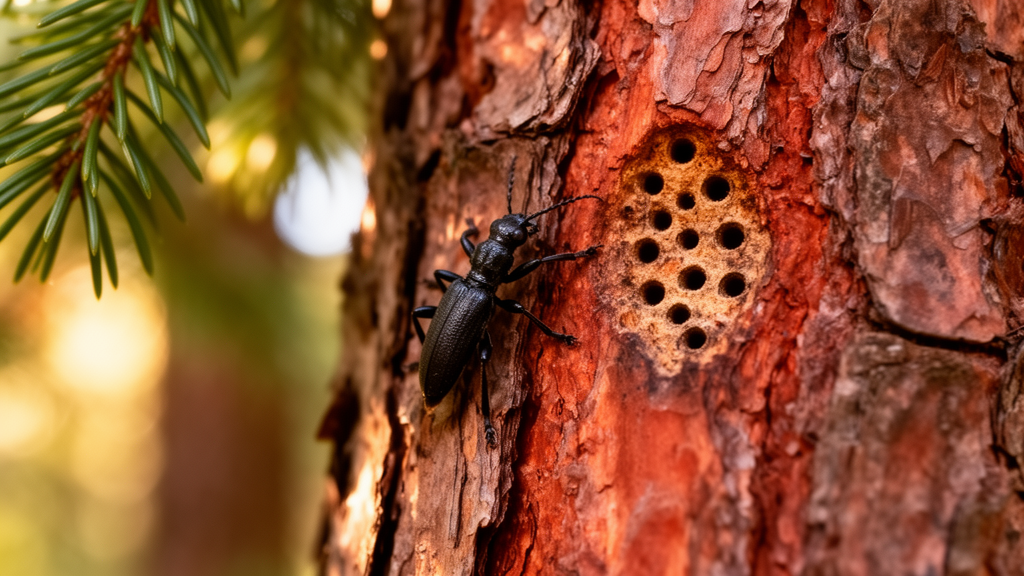
Bark beetles are among the most destructive forest pests on Earth, and foresters have almost never been able to stop them with living weapons. The mountain pine beetle killed roughly 731 million cubic metres of pine across 18 million hectares of British Columbia between 1999 and 2015, while the eight-toothed spruce bark beetle destroyed 35 million cubic metres of spruce in the Czech Republic in just two years. Against this grim backdrop, a new review in the journal NeoBiota documents something extraordinary: the only recorded case in history of a bark-beetle pest fully and stably controlled by classical biological control. The hero of the story is Rhizophagus grandis, a mahogany-coloured predator about the size of a rice grain, and its prey is Dendroctonus micans, the great spruce bark beetle. Over more than six decades, four countries—Georgia, France, Great Britain and Türkiye—mass-produced and released millions of these predators, and in every treated site the pest subsided within four to eight years.
The great spruce bark beetle is an atypical member of its subfamily. Phylogeographic analyses indicate that it is native to the Russian Far East, and its closest relative is the North American Dendroctonus punctatus, on the far side of the Bering Strait. From its Siberian origins the species has spread westward and is now established in most of the spruce forests of Eurasia. Unlike tree-killing bark beetles that mass-attack and overwhelm their hosts, D. micans behaves almost like a parasite: each mated female, 90 percent of which have already mated with their brothers under the bark before emergence, bores a solitary egg gallery into a living tree. The beetle tolerates the resin and chemical defences that repel other species, so it does not need to kill its host. Each female lays up to 250 eggs, often in a single batch, and the larvae feed gregariously along a feeding front in the phloem, packing their frass behind them. Development is slow, taking one to three years depending on climate, which means the insect’s brood chambers remain embedded in living trees for long periods.
That slow, cryptic, living-host lifestyle is precisely what made the pest vulnerable to a very particular enemy. Rhizophagus grandis, a beetle of the family Monotomidae measuring 4.5 to 5.5 millimetres, has followed D. micans across its territorial expansion, though with temporal and spatial lags caused by long-distance passive transport of the pest with timber trade and by habitat fragmentation. More than a hundred species of insects, mites and nematodes have been found in the brood systems of D. micans, but almost all are inquilines, mycetophages or saprophages; only R. grandis is consistently associated with the pest. The predator’s adults and larvae consume the eggs, larvae, pupae and young adults of their prey, and both life stages show high resistance to the host tree’s monoterpenes. This tolerance grants them access to a rewarding niche with ample resources and virtually no interspecific competitors.
The predator’s prey-finding mechanism is extraordinarily efficient. Adults locate their prey’s galleries by means of specific chemical cues, or kairomones, primarily oxygenated monoterpenes derived from the larval frass of D. micans. In Belgium, where brood chamber densities can be as low as one to four per hectare, more than 90 percent of the chambers are gradually colonised by R. grandis. Once inside a brood chamber, the adults feed on the prey’s immature stages and lay 50 to 100 eggs under laboratory conditions. Females assess the availability of prey for their offspring through oviposition-stimulating cues present in the larval frass and can apportion their egg load accordingly. The predator larvae are voracious and display a coordinated aggregative behaviour mediated by chemical signals, consuming the equivalent of one fully grown D. micans larva during their entire development. At the end of the larval phase, the pre-pupae leave the bark and pupate in the litter at the base of the tree.
The historical record shows how the pest outran its enemy. Digitised old literature reveals that D. micans was already present, as a rare endemic species, in central European mountain ranges by the end of the eighteenth century, with early records from the Bohemian Massif and the Harz Mountains, and scattered finds in Sweden, the Italian Alps, Norway and Lapland. From the mid-nineteenth century onward, large outbreaks occurred and the pest spread progressively across Europe, reaching the Vosges in France by 1862, Belgium, the Carpathians and the Dinaric Alps. The invasion finally reached the Atlantic when the beetle arrived in Brittany in 2009 and moved to the western tip of Finistère in 2010. In newly colonised territories, where R. grandis had not followed, the pest became notably harmful. Georgia first detected it in 1955 in the Borjomi gorge, where the number of infested oriental spruce trees grew from about 200 to 700 within a single year, and by the late 1960s the infestation spanned a radius of over 300 kilometres. Türkiye recorded its first attacks in 1966 near the Georgian border, and by 2011 the beetle occupied the entire 452,693-hectare oriental spruce area of the Turkish Black Sea Region. Great Britain, an island with a relatively impoverished forest fauna, found the pest breeding in Sitka spruce in 1982, and dendrochronological analysis of occluded galleries showed that the initial attacks dated from 1973 or earlier, near a sawmill at Ludlow in Shropshire that imported wood from the continent.
The biocontrol campaigns began in Georgia in 1963, when the entomologist A.L. Kobakhidze released 23 adults and 36 larvae obtained from Czechoslovakia into infested trees near Tsagveri. Subsequent introductions from Czechoslovakia, the Latvian SSR and multiple Soviet republics progressively increased the founder stock, and the diversity of this original genetic material is thought to have enhanced acclimatisation. Seventeen small production laboratories were established at state forestry enterprises across the republic, using log-rearing: living prey larvae or mature females are introduced into fresh spruce logs, pairs of predators are inserted through slits in the bark where a hollow noise indicates a brood chamber beneath, and the pre-pupae emerging from the logs are collected in moist sand. Over the lifetime of the programme, approximately four million R. grandis were bred and released into Georgian forests. France followed in 1978, Great Britain in 1983 and Türkiye in 1985, ultimately releasing 800,000, 250,000 and 10,880,000 predators respectively.
Production technology evolved considerably. Log-rearing was labour-intensive, spatially demanding, produced unpredictable yields of 23 to 80 pre-pupae per female, under-exploited the available prey, and was prone to devastating epizootics caused by the entomopathogenic fungus Beauveria bassiana, which could destroy 80 to 100 percent of production. From 1984 onwards, a semi-artificial method was devised and progressively refined, operating at a constant temperature of 19 to 23 degrees Celsius. Spruce bolts are infested with prey females, and after about 55 days the fourth- or fifth-instar larvae are collected. Small flat polystyrene boxes are prepared with alternating layers of re-moistened spruce bark powder and fresh bark, into which 20 to 25 prey larvae and one pair of predators are introduced. Average yields of 50 to 100 eggs and young larvae per box can be obtained, with an overall average of approximately 44 young adults per female. A key advantage is that Beauveria mycelium can be seen through the transparent containers, allowing preventative destruction of infected boxes and rigorous prophylaxis between rearing cycles. An artificial diet based on blue bottle fly larvae and cat food croquettes has even been developed for Türkiye’s massive programme.
Release strategies were refined in parallel. In France, predators were introduced as a priority at the leading edge of the pest’s expanding range, in stands undergoing incipient infestation at low prey density, on the rationale that even limited introductions could establish an effective biocontrol zone ahead of the advancing front—forestalling by 15 to 20 years the natural arrival of the predator and sparing considerable timber volumes. The alternative approach bridged the demographic gap in long-established outbreak areas, requiring large numbers from the centralised mass-rearing facility. In Great Britain, low-density inoculative releases treated as many infested locations as possible, with sites receiving 10 to 50 pairs depending on the number of attacked trees recorded during intensive surveys. Mark-release-recapture experiments with 2,500 fluorescent-dusted adults in an isolated spruce block showed that predators reached infested trees up to 200 metres from a central release point, and that the attack rate by R. grandis scaled linearly with the number of prey immature stages present—evidence that the predator can detect how much prey is available and adjust its response accordingly.
The impact was measured with a simple but elegant technique. Because most attacked trees remain alive, identified cohorts of trees can be monitored for years along calibrated
Subject of Research: Classical biological control of the great spruce bark beetle Dendroctonus micans using the specific predator Rhizophagus grandis in Georgia, France, Great Britain and Türkiye
Article Title: Successful bark-beetle biocontrol. A review of the only case in history Releasing Rhizophagus grandis in Georgia, France, Britain and Türkiye against Dendroctonus micans
Article References: Grégoire, J.-C., Alkan Akıncı, H., Burjanadze, M., Evans, H. F., Fielding, N., & Mayer, F. (2026). Successful bark-beetle biocontrol. A review of the only case in history Releasing Rhizophagus grandis in Georgia, France, Britain and Türkiye against Dendroctonus micans. NeoBiota, 109, 271-313. https://doi.org/10.3897/neobiota.109.205672
Image Credits: AI Generated
DOI: 10.3897/neobiota.109.205672
Keywords: bark beetles, biological control, Rhizophagus grandis, Dendroctonus micans, forest pests, invasive species, Successful, bark-beetle, biocontrol, review, only, case
Cite Scienmag News
Patricia Pace. (October 15, 2026). The Only Bark-Beetle Biocontrol Success: How a Tiny Predator Beat a Global Spruce Pest. Scienmag. https://scienmag.com/the-only-bark-beetle-biocontrol-success-how-a-tiny-predator-beat-a-global-spruce-pest/
Patricia Pace. "The Only Bark-Beetle Biocontrol Success: How a Tiny Predator Beat a Global Spruce Pest." Scienmag, 15 October 2026, https://scienmag.com/the-only-bark-beetle-biocontrol-success-how-a-tiny-predator-beat-a-global-spruce-pest/. Accessed 15 October 2026.
Patricia Pace. "The Only Bark-Beetle Biocontrol Success: How a Tiny Predator Beat a Global Spruce Pest." Scienmag. October 15, 2026. https://scienmag.com/the-only-bark-beetle-biocontrol-success-how-a-tiny-predator-beat-a-global-spruce-pest/


