


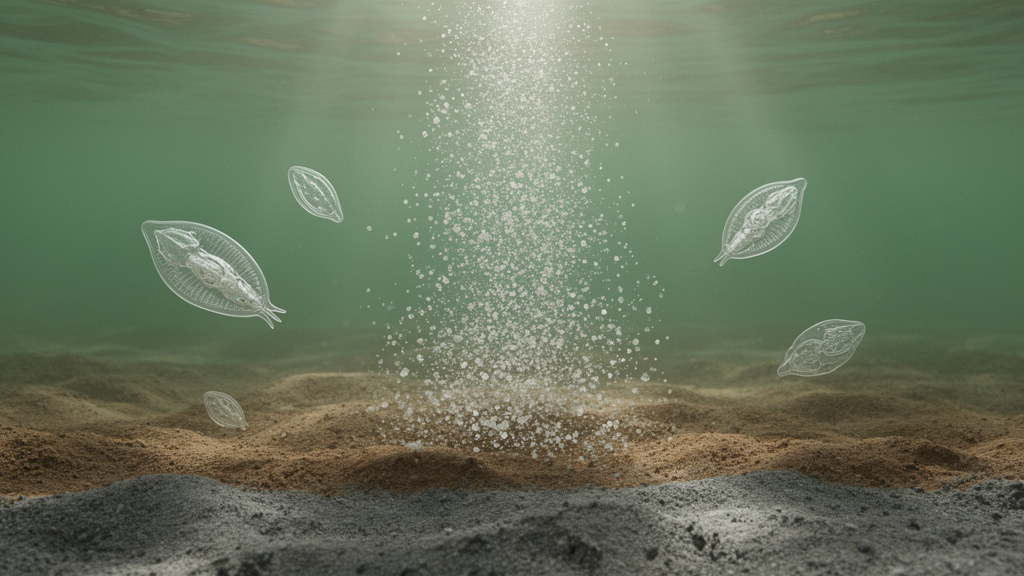
For decades, scientists tracking the chemistry of the Baltic Sea assumed they had a reasonable handle on where its silicon comes from. Rivers deliver dissolved silicate, diatoms take it up, sediments recycle some of it back. A new study, published in the journal Biogeosciences, upends that tidy picture. By compiling 305 direct measurements of silicate fluxes from seafloor sediments across the entire Baltic Sea, a team of Swedish researchers has calculated that the sediments release roughly 8520 metric kilotonnes of dissolved silicate per year — about ten times more than all rivers combined deliver, and about three times more than the Baltic’s diatoms can produce and export out of the sunlit zone. The inescapable conclusion is that a vast, previously unaccounted pool of reactive silicon, most likely of terrestrial and freshwater origin, is quietly feeding the Baltic’s silicon cycle.
Dissolved silicate, predominantly silicic acid, is the essential macronutrient for diatoms, the single-celled algae with glassy silica shells that dominate primary productivity in temperate coastal seas. When diatoms die and sink, their silica debris settles on the seafloor, where it dissolves and re-enters the water column. This benthic recycling is fundamental to coastal ecology, yet direct rate measurements of silicate mobilisation from sediments remain surprisingly scarce worldwide — and the Baltic Sea was no exception, with data largely confined to regional reports from the Gulf of Finland and the Gdansk Basin.
The research team, led by Nils Ekeroth and Per Hall of the University of Gothenburg, together with colleagues from Stockholm University, spent two decades — from 2001 to 2021 — deploying benthic chamber landers and conducting core incubations across the Baltic Proper, the Gulf of Bothnia and the Gulf of Finland. The landers, described in detail by Kononets and colleagues in 2021, are open-bottomed chambers that penetrate roughly 15 centimetres into the sediment, enclosing about eight litres of overlying water. Ten syringes per chamber withdraw water samples at pre-set intervals; one syringe first injects a known volume of de-ionized water, and the resulting salinity drop, recorded by conductivity sensors, allows precise calculation of the incubated water volume. The samples were filtered and analysed spectrophotometrically for dissolved silicate, and fluxes were derived from least-squares regression of concentration change against time.
The measurements spanned all months of the annual cycle except March and December, and covered muddy, mixed, and sandy sediments in both coastal archipelago zones and open sea areas. Station-averaged fluxes ranged from 0.3 to 9.3 millimoles of silicate per square metre per day, with an overall Baltic average of 3.7 — squarely within the range reported for other brackish systems such as the Black Sea, Chesapeake Bay and San Francisco Bay. The highest fluxes, exceeding 7 millimoles per square metre per day, occurred in the deep muddy basins of the Eastern and Western Gotland Basins and in the coastal Kanholmsfjärden basin. Notably, all but one of the 305 fluxes were directed out of the sediment, confirming the seafloor as an overwhelming net source of silicate to the water column.
The real power of the study lies in the upscaling. Using QGIS software and the EMODnet seabed substrate map at 1:1,000,000 scale, the team calculated the areal extent of five seabed substrate classes within each of the Baltic’s HELCOM-defined sub-basins, further splitting Swedish and Finnish coastal zones from open sea areas. Sub-section-specific average fluxes, weighted by the number of measurements per station and supplemented with literature values from comparable incubation studies, were then multiplied by the mapped areas. The result: an integrated annual benthic release of 8520 kilotonnes of dissolved silicate for the entire Baltic Sea. Mud and muddy sand dominate the load in most sub-basins, though in the Gulf of Bothnia mixed sediment contributes more, reflecting its unusually large 58 per cent coverage of that seafloor.
Set against existing budgets, the number is staggering. The benthic release is equivalent to 78 per cent of the entire dissolved silicate standing stock in the Baltic water column, which holds about 10970 kilotonnes. It is roughly a factor of ten higher than the annual riverine dissolved silicate input of 822 kilotonnes per year. In practical terms, benthic recycling could renew the water column’s silicate stock in under two years — a dramatic contrast with previous residence-time estimates of 7 to 11 years, which were based on net losses between inflows and outflows rather than internal recirculation.
Here is where the mass balance breaks — and the study becomes truly provocative. Assuming steady state, the total reactive silicon deposition needed on the Baltic seafloor equals the benthic dissolved silicate release plus the reported biogenic silica burial rate of about 610 kilotonnes per year, giving 9130 kilotonnes per year. But the team’s own estimate of diatom export production — derived from remote-sensing primary production of roughly 266 milligrams of carbon per square metre per day, an assumed one-third export ratio, diatoms responsible for 75 per cent of that export, and a carbon-to-silicon weight ratio of 3.3 — yields only about 2740 kilotonnes of biogenic silica per year. That is just 30 per cent of the required deposition. Some 6390 kilotonnes per year of reactive silicon is unaccounted for by marine production alone.
Where could this missing silicon come from? The authors point to river and groundwater delivery of reactive particulate silicon — dissolvable amorphous silica and, crucially, lithogenic silicon from weathered rock fragments. For years, particle-associated silicon was dismissed as ecologically negligible because it was assumed to dissolve too slowly to matter. That view is now under revision. Recent studies show that up to 5 per cent of the silicon in rock fragments transported to sea can dissolve readily in seawater, and in the Barents Sea, stable silicon isotopes revealed that 60 to 98 per cent of porewater silicate was sourced from lithogenic dissolution. In the Baltic, Lehtimäki and colleagues estimated that up to 40 per cent of reactive silicon delivered by rivers arrives as biogenic silica, including phytoliths and freshwater diatoms — forms entirely absent from existing dissolved silicate budgets.
The study also offers an explanation for a long-running monitoring puzzle. Swedish national marine monitoring has recorded an increasing trend in the winter dissolved silicate standing stock in nearly all Baltic basins from 1994 through 2023, with the largest rise in the Bothnian Sea. The team’s findings suggest that this enrichment is driven by the ‘excess’ benthic silicate release — silicon of terrestrial origin that dissolves, settles, and is recycled in sediments faster than diatoms can consume it. Some of the surplus may also be exported to the Kattegat, where the current net export estimate of 225 kilotonnes per year is at least 17 years old and likely outdated.
The authors are candid about uncertainties. Confidence intervals on the annual fluxes sum to about 25 per cent of the total load, and the Gulf of Bothnia estimate rests on only three open-sea stations, with the mixed-sediment flux based on a single site. Substituting the lowest literature value for that sediment type would cut the total to 6870 kilotonnes — a maximum error of roughly 40 per cent. Yet even with such a reduction, diatom export alone cannot fuel the required reactive silicon deposition, so the central conclusion stands. A parallel radium-isotope study estimated benthic release at 23000 to 35000 kilotonnes per year, three to four times higher, though its vertical transport coefficients spanned three orders of magnitude in the strongly stratified Baltic. What is now clear is that the Baltic’s silicon cycle is far more heavily shaped by reactive silicon of land and freshwater origin than anyone previously acknowledged — a finding that should stimulate a wholesale revision of silicon budgets for this and other coastal seas worldwide.
Subject of Research: Baltic Sea benthic silicate fluxes reveal a major land-derived reactive silicon source
Article Title: The integrated benthic silicate flux in the Baltic Sea suggests a major land- or freshwater-derived reactive silicon source
Article References: The integrated benthic silicate flux in the Baltic Sea suggests a major land- or freshwater-derived reactive silicon source. (n.d.). https://doi.org/10.5194/bg-23-7203-2026
Image Credits: AI Generated
Keywords: integrated, benthic, silicate, flux, Baltic, suggests, major, land-, freshwater-derived, reactive, silicon, source
Cite Scienmag News
Violet Maxwell. (October 15, 2026). Baltic Sea sediments release far more silicon than diatoms can cycle, pointing to a hidden land-derived source. Scienmag. https://scienmag.com/baltic-sea-sediments-release-far-more-silicon-than-diatoms-can-cycle-pointing-to-a-hidden-land-derived-source/
Violet Maxwell. "Baltic Sea sediments release far more silicon than diatoms can cycle, pointing to a hidden land-derived source." Scienmag, 15 October 2026, https://scienmag.com/baltic-sea-sediments-release-far-more-silicon-than-diatoms-can-cycle-pointing-to-a-hidden-land-derived-source/. Accessed 15 October 2026.
Violet Maxwell. "Baltic Sea sediments release far more silicon than diatoms can cycle, pointing to a hidden land-derived source." Scienmag. October 15, 2026. https://scienmag.com/baltic-sea-sediments-release-far-more-silicon-than-diatoms-can-cycle-pointing-to-a-hidden-land-derived-source/


