


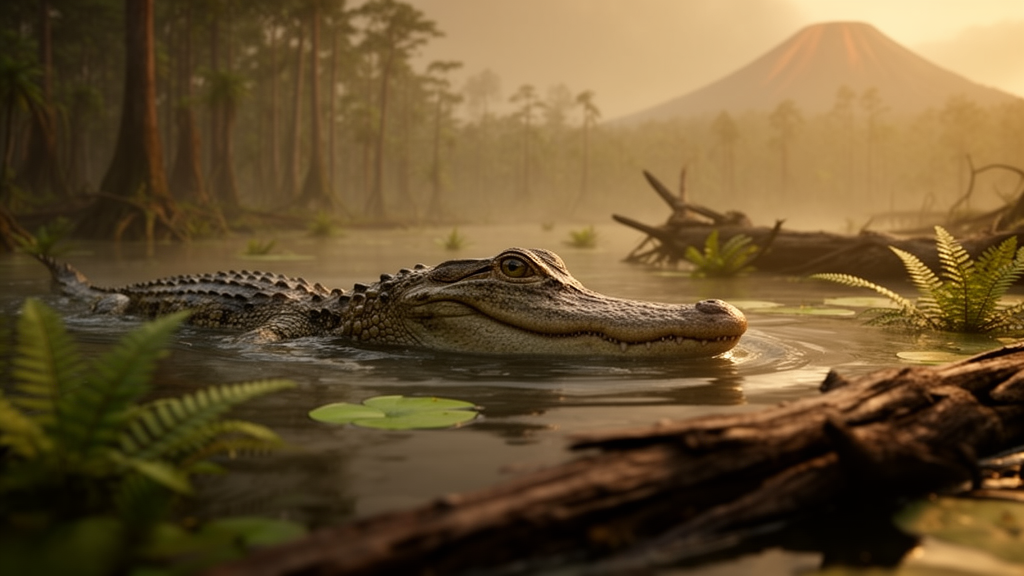
A descriptive palaeontological study identifies UCMP 164865, a 6.3-centimetre fragment of a lower jaw from central Oregon, as an alligatoroid, but the researchers could not assign it securely to Alligatorinae, Caimaninae, Orientalosuchina or another branch of the clade. The specimen comes from the middle Eocene Hancock Mammal Quarry in the uppermost Clarno Formation, within the John Day Fossil Beds, and is the first described alligatoroid from central Oregon.
The study treats UCMP 164865 as the anterior portion of a reconstructed left dentary. Its mandibular symphysis measures 2.4 centimetres and extends posteriorly to the fourth dentary alveolus. The dentary curves deeply between the fourth and twelfth alveoli, with a noticeable dorsal rise between the eleventh and twelfth. Although the splenial bone itself is absent, a preserved scar on the lingual surface indicates that it formed the medial wall of the anterior mandibular ramus and participated in the jaw symphysis.
Seven teeth are partly or wholly preserved in the specimen, together with evidence from the alveoli. The teeth project dorsally or anterodorsally, are unserrated and bear anterior and posterior carinae. They also show varying degrees of labiolingual compression, while the twelfth tooth is distinctly globidontan. Deeply furrowed basiapical striations occur on the lingual surfaces of the teeth. The authors note that these dental striations are particularly evident in several Eocene orientalosuchins, including Krabisuchus, Orientalosuchus and Dongnanosuchus, although the Oregon specimen itself is not established as an orientalosuchin.
No individual observed or inferred character establishes membership in Alligatoroidea by itself. The assignment instead rests on a combination of features, including a short dentary symphysis, deep dentary curvature, a splenial that participates in the mandibular symphysis, smooth tooth carinae and the globidontan posterior tooth. Comparisons with contemporaneous North American alligatoroids found distinctions that separate the specimen from late Eocene Alligator, Allognathosuchus, Procaimanoidea, Ceratosuchus burdoshi, Ahdeskatanka russlanddeutsche and Chrysochampsa mlynarskii.
The jaw is dated within a constrained interval of 42.7 to 39.677 million years ago by radiometric ages associated with the quarry strata. This range places the site in the latest Uintan or Duchesnean North American Land Mammal Age, described in the study as late Lutetian or Bartonian. The quarry contains a concentration of disarticulated large mammal skeletons that was probably deposited in a point bar of a meandering river channel. It is the only published vertebrate quarry deposit in the John Day Basin and preserves mammals, plants, fish, amphibians and reptiles.
UCMP 164865 shares a particular combination of three characters with Dongnanosuchus hsui and Alligator olseni: a short dentary symphysis, a deeply curved dentary and a splenial participating in the symphysis. Its lingual dental striations further resemble those of several Eocene orientalosuchins. These similarities make membership in Orientalosuchina possible, but the limited anatomy of the specimen prevents a more exclusive taxonomic assignment. The authors therefore retain alligatorines, caimanines, orientalosuchins and other alligatoroid branches as possible placements.
The geographic setting also raises questions about the specimen’s affinities. Eocene alligatoroids are common east and south of the Rocky Mountains but are virtually absent farther west, apart from this Oregon occurrence. The uplift of the Rockies during the Laramide Orogeny may have restricted crocodylian dispersal by the Uintan. In contrast, the authors note repeated faunal exchange between East Asia and North America through Beringia, providing a possible route for an orientalosuchin to reach western North America.
Other fossils from the Hancock Mammal Quarry show Asian connections. Five of the 14 mammalian genera represented there—Harpagolestes, Teletaceras, Eubrontotherium, Plesiocolopirus and Zaisanamynodon—also occur in parts of Asia during the middle Eocene. The tortoise Hadrianus from the slightly older Clarno Nut Beds is likewise known from the early Eocene of Asia. Approximately 40% of the genera in the Nut Beds flora occur in Eocene floras of Europe and Asia, a pattern interpreted as evidence for a connected mid-latitude Northern Hemisphere forest.
The report also figures UCMP 164866, a 10.5-centimetre right humerus from the upper Clarno Formation. It is presented as representative eusuchian postcranial material and is not assumed to belong to the same taxon or individual as the dentary, although their relative sizes do not rule out that possibility. Overall, the partial jaw adds a distinct and geographically unusual alligatoroid to the known record of Eocene North America, but its precise placement and any relationship to Asian orientalosuchins remain unresolved.
Subject of Research: Description and classification of a middle Eocene alligatoroid jaw from Oregon
Article Title: Small, enigmatic alligatoroid from the Middle Eocene Clarno Formation, John Day Fossil Beds, Oregon
Article References: Stout, J. B., Massonne, T., Samuels, J. X., & Schubert, B. W. (2025). Small, enigmatic alligatoroid from the Middle Eocene Clarno Formation, John Day Fossil Beds, Oregon. Fossil Record, 28(2), 309-319. https://doi.org/10.3897/fr.28.169148
Image Credits: AI Generated
DOI: 10.3897/fr.28.169148
Keywords: Alligatoroidea, Eocene, Clarno Formation, John Day Fossil Beds, Hancock Mammal Quarry, palaeontology, crocodylian, lower jaw, Oregon, Orientalosuchina, Small, enigmatic
Cite Scienmag News
Gavin Prescott. (October 20, 2026). Fragmentary Eocene jaw from Oregon identified as an alligatoroid. Scienmag. https://scienmag.com/fragmentary-eocene-jaw-from-oregon-identified-as-an-alligatoroid/
Gavin Prescott. "Fragmentary Eocene jaw from Oregon identified as an alligatoroid." Scienmag, 20 October 2026, https://scienmag.com/fragmentary-eocene-jaw-from-oregon-identified-as-an-alligatoroid/. Accessed 20 October 2026.
Gavin Prescott. "Fragmentary Eocene jaw from Oregon identified as an alligatoroid." Scienmag. October 20, 2026. https://scienmag.com/fragmentary-eocene-jaw-from-oregon-identified-as-an-alligatoroid/


