


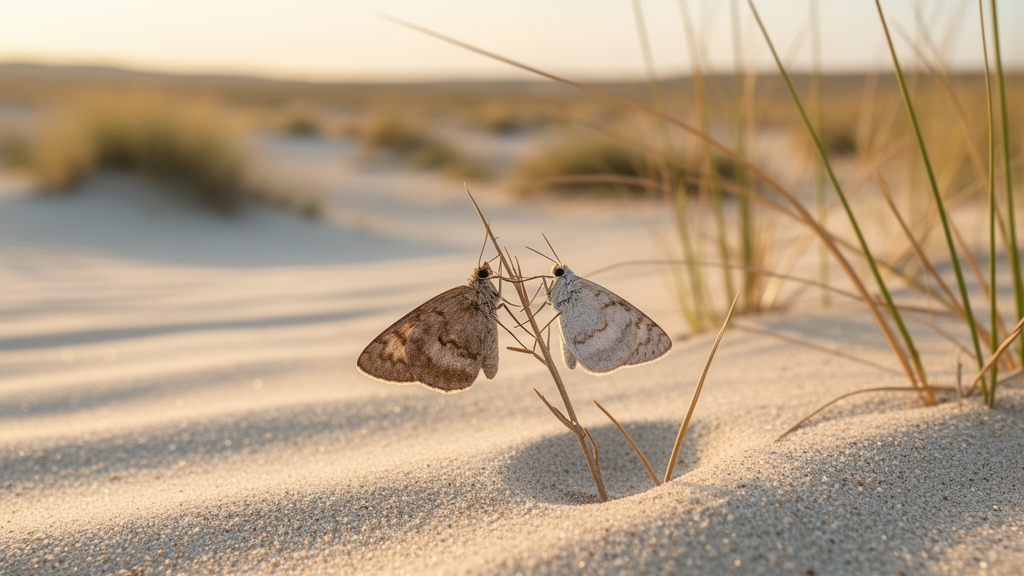
A morphological and molecular taxonomic study described two new species of the gelechiid moth genus Scrobipalpa from Ukraine’s Kherson region: Scrobipalpa arenicola and Scrobipalpa burkutica . The study used adult external morphology, dissected male and female genitalia and, for S. arenicola , DNA barcodes. It was a formal species-description study based on museum specimens, not a population or ecological investigation.
Both species were recorded in the Lower Dnipro Sands, where adults were observed in late April and late June in dunes and sandy steppe. The specimens came from two collecting events: Eugeny Rutjan collected material in the Tchernomorsky Nature Reserve in 1999, and Oleksiy Bidzilya collected additional specimens near Burkuty village in 2017. The two species were collected sympatrically, with S. arenicola also represented by additional males from another locality in the same biotope.
The description of S. arenicola followed an earlier observation of a Ukrainian male that resembled S. hyoscyamella in genital structure but differed in forewing colour and markings. Its identity was then considered uncertain. DNA barcoding of the later specimens confirmed that they represented an undescribed Scrobipalpa species.
The second new species, S. burkutica , was distinguished from other members of the genus through a combination of external characters and male and female genital anatomy. For the molecular analysis, researchers prepared tissue from three S. arenicola specimens and sequenced a 658-base-pair segment of the mitochondrial cytochrome c oxidase subunit 1 gene, or COI. The material was processed at the Canadian Centre for DNA Barcoding using a standard high-throughput protocol.
Three sequences from the two closest species in the Barcode of Life Data Systems were also included. Barcode Index Numbers, described as algorithm-based operational taxonomic units and proxies for species-level identification, assigned the S. arenicola sequences to BOLD:ACT3383. Genetic distances were calculated with the Kimura two-parameter model in BOLD Systems version 4.0, and a neighbor-joining tree was constructed with the same model in MEGA7.
The three S. arenicola specimens had an average intraspecific barcode distance of 0.12%. Their minimum distance from the nearest sampled neighbour, S. inexplictata , was 5.77% under p-distance. No DNA barcode was available for S. burkutica , whose recognition therefore rested on external appearance and male and female genital characters.
Scrobipalpa arenicola has a wingspan of 9.7–10.0 mm. Its narrow forewings have a less distinct black pattern than those of several superficially similar species and include a pair of black spots in the middle of the cell. Diagnostic male genital features include a trapezoidal uncus with a straight or weakly emarginated posterior margin, a short valva, a sacculus extending almost halfway along the valva and a slender saccus.
Female genitalia could not be described because the available slide was broken. Scrobipalpa burkutica was described from a female holotype and one male and one female paratype. It has a wingspan of 10–12 mm and a comparatively uniform greyish-brown forewing with an ochreous suffusion.
It differs from S. vasconiella in lacking a contrasting black forewing pattern and from S. amseli in lacking black spots in the cell. Its male genitalia differ from those of S. arenicola in features including a rounded posterior margin of the uncus, a broader valva, a more distinctly narrowed sacculus and a basally broader saccus. Female genitalia were available for S. burkutica .
They include papillae anales that are subrectangular in the basal half, a sclerotised anterior edge on sternum VIII and rounded lobes of the ventromedial depression covered with a dense reticulate network of sclerotised ridges. The specific name arenicola combines the Latin words for “sand” and “to inhabit,” referring to the species’ association with sandy habitats. The name burkutica derives from Burkuty village, its type locality.
Type and other examined material is held principally in the Zoological Museum of Taras Shevchenko National University in Kyiv, with some paratypes deposited at the Tiroler Landesmuseum Ferdinandeum in Austria and the Zoological Museum, Natural History Museum of Denmark, in Copenhagen. The documented distribution of both species in the study is Ukraine’s Kherson region.
Subject of Research: Taxonomic description of two new Scrobipalpa moth species from Ukraine’s Kherson region
Article Title: Two new species of the genus Scrobipalpa Janse, 1951 ( Lepidoptera , Gelechiidae ) from Ukraine
Article References: Bidzilya, O. V. (2023). Two new species of the genus Scrobipalpa Janse, 1951 (Lepidoptera, Gelechiidae) from Ukraine. Nota Lepidopterologica, 46, 125-134. https://doi.org/10.3897/nl.46.103595
Image Credits: AI Generated
DOI: 10.3897/nl.46.103595
Keywords: Scrobipalpa, Gelechiidae, Lepidoptera, new species, Ukraine, Kherson region, taxonomy, DNA barcoding, sandy habitats, moth genitalia, species, genus
Cite Scienmag News
Margaret Porter. (October 20, 2026). Taxonomic study describes two new Scrobipalpa moth species from Ukraine’s Kherson region. Scienmag. https://scienmag.com/taxonomic-study-describes-two-new-scrobipalpa-moth-species-from-ukraines-kherson-region/
Margaret Porter. "Taxonomic study describes two new Scrobipalpa moth species from Ukraine’s Kherson region." Scienmag, 20 October 2026, https://scienmag.com/taxonomic-study-describes-two-new-scrobipalpa-moth-species-from-ukraines-kherson-region/. Accessed 20 October 2026.
Margaret Porter. "Taxonomic study describes two new Scrobipalpa moth species from Ukraine’s Kherson region." Scienmag. October 20, 2026. https://scienmag.com/taxonomic-study-describes-two-new-scrobipalpa-moth-species-from-ukraines-kherson-region/


