


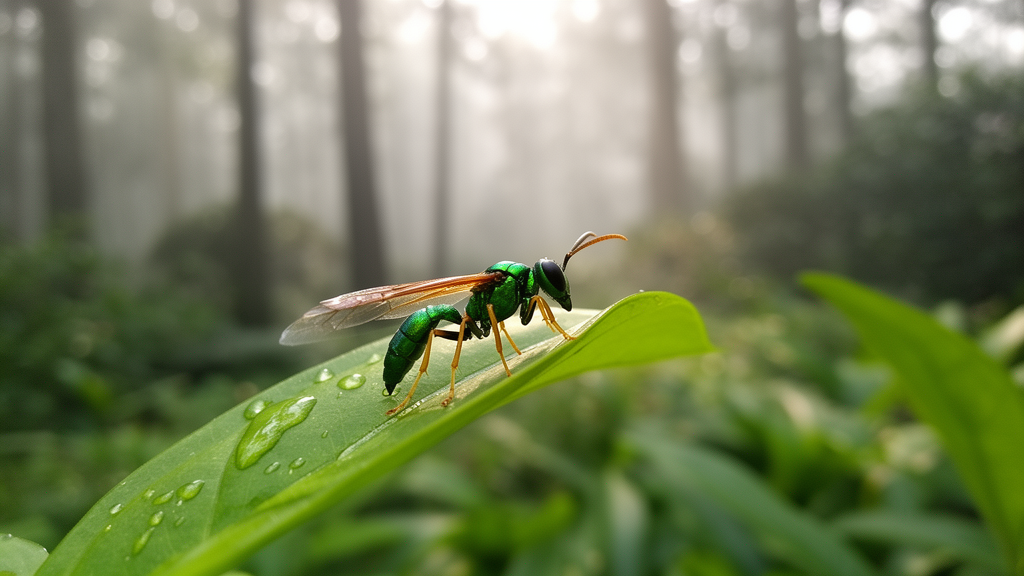
A specimen-based taxonomic study described six new species of the predatory wasp genus Nitela from China, documented three species as new records for the country and published a key for identifying the genus’s Oriental species. The new species are Nitela carinifrons, N. noncrenulata, N. punctidorsalis, N. transcarinata, N. tumidiscuta and N. vecarinata.
The researchers examined specimens collected in Yunnan, Guangdong and Hainan provinces. The material was deposited in the Insect Collection of Yunnan Agricultural University in Kunming, China. Specimens were observed and illustrated with an Olympus SZ-series stereomicroscope equipped with an ocular micrometer, and photographs were taken with a VHX-5000.
The assessment focused on external anatomical characters used in taxonomy, including the clypeus, frons, pronotal collar, mesoscutum, mesoscutellum, mesopleuron, propodeum, wings and metasoma. Measurements included postocellar distance, ocellocular distance and the longest diameter of a lateral ocellus. The study compared the new taxa with previously recognized species and supplied diagnoses, descriptions, type-material lists, distributional records and illustrations.
N. carinifrons was described from Guangdong. Females measured 3.2–3.6 mm and were characterized in part by a conspicuous median longitudinal carina on the frons that reached the anterior ocellus. The species resembles N. bifida but differs in the clypeal margin, the absence of lamellate projections along the lateral margin of the propodeal posterior surface, mesoscutal sculpture and the color of the pronotal lobe. Males were unknown.
N. noncrenulata was described from Yunnan, where females measured 5.3–6.3 mm. It was compared with N. collaris and distinguished by transverse striations on the gena, transverse ridges on the vertex, a non-crenulate anterior margin of the mesoscutellum, the absence of conspicuous oblique carinae on the ventral half of the mesopleuron and a distinctive reticulate pattern on the propodeal posterior surface. Its name refers to the non-crenulate mesoscutellar margin. Males were unknown.
N. punctidorsalis was reported from Guangdong and Hainan, with females measuring 4.3–4.9 mm. The authors compared it with N. ohgushii, noting differences involving dense punctation on the frons and mesonotum, a densely punctate mesoscutellum and the extension of the clypeal median carina to the lower frontal tubercle. The species name refers to the densely punctate mesoscutellum. Males were unknown.
N. transcarinata was recorded from Guangdong, Hainan and Yunnan. Females measured 5.4–5.9 mm. The species resembles N. collaris but was distinguished by features including the pronotal collar and its transverse groove, highly polished areas between mesoscutal ridges, absence of the scutal lateral sulcus, parallel oblique mesopleural ridges and straight longitudinal propodeal ridges. Its name refers to transverse carinae on the mesoscutum. No males were reported.
N. tumidiscuta was known from Yunnan in the study, and its females measured 3.6–3.9 mm. It was compared with N. feltoni, with diagnostic differences including the absence of ridges on the ventral half of the mesopleuron, an impunctate frons, contrasting punctation on the mesoscutum and mesosternum, and the shape of the clypeal anterior margin. The name refers to the conspicuously convex mesonotum. N. vecarinata was recorded from Yunnan and Guangdong, with females measuring 3.9–4.3 mm. It differed from N. yasumatsui taiwana in its reticulate propodeal dorsal surface, relative lengths of the wing cells and conspicuous longitudinal mesoscutellar carinae. Males were unknown for both species.
The study also documented Nitela domestica, N. rugosa and N. williamsi as new records for China. Specimens of N. domestica came from Hainan, specimens of N. rugosa from Hainan and Yunnan, and specimens of N. williamsi from Guangdong, Hainan and Yunnan. The authors further concluded that descriptions labeled N. domestica in two Chinese works aligned with N. collaris and recommended correcting those identifications to N. collaris.
The accompanying identification key distinguishes Oriental Nitela species using coloration and characters of the thorax, propodeum, punctation, carinae and wing venation. It explicitly notes cases in which males or females were unknown, including several newly described species. Because this was a specimen-based taxonomic assessment rather than an ecological experiment, it did not measure abundance, behavior or population trends. The results expand the documented Chinese species list and supply diagnostic material for identification, but the evidence does not establish population sizes, geographic abundance or conservation status.
Subject of Research: Taxonomic description of six new species and three new Chinese records in the predatory wasp genus Nitela
Article Title: Six new species of the genus Nitela Latreille ( Hymenoptera , Crabronidae ) from China, with a key to the Oriental species
Article References: Li, C., Li, Q., & Ma, L. (2025). Six new species of the genus Nitela Latreille (Hymenoptera, Crabronidae) from China, with a key to the Oriental species. Journal of Hymenoptera Research, 98, 871-896. https://doi.org/10.3897/jhr.98.172249
Image Credits: AI Generated
Keywords: Nitela, taxonomy, new species, Hymenoptera, Crabronidae, China, Oriental species, identification key, morphology, species, genus, Latreille
Cite Scienmag News
Gavin Prescott. (October 20, 2026). Taxonomic study describes six new Nitela wasp species from China. Scienmag. https://scienmag.com/taxonomic-study-describes-six-new-nitela-wasp-species-from-china/
Gavin Prescott. "Taxonomic study describes six new Nitela wasp species from China." Scienmag, 20 October 2026, https://scienmag.com/taxonomic-study-describes-six-new-nitela-wasp-species-from-china/. Accessed 20 October 2026.
Gavin Prescott. "Taxonomic study describes six new Nitela wasp species from China." Scienmag. October 20, 2026. https://scienmag.com/taxonomic-study-describes-six-new-nitela-wasp-species-from-china/


