


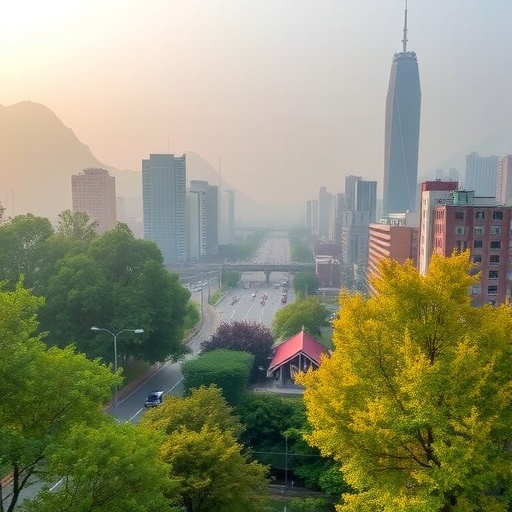
In the age of rapid urbanization and industrial growth, air quality remains one of the most pressing environmental concerns worldwide. Particularly in densely populated and industrially active regions, particulate matter (PM) pollution poses severe health risks and environmental challenges that demand innovative and reliable forecasting methods. A recent groundbreaking study conducted by Hasnain and colleagues delves into this precise issue, harnessing the power of advanced machine learning techniques to predict particulate matter concentrations in Zhejiang Province, China—a region grappling with persistent air quality issues.
The study capitalizes on the strengths of long short-term memory (LSTM) networks, a specialized form of recurrent neural networks (RNNs), to capture the temporal dependencies inherent in air pollution data. Unlike traditional statistical models that often struggle with nonlinear and complex relationships, LSTM models are designed to handle time series data effectively, making them particularly suitable for environmental predictions where past values influence future outcomes in intricate ways. By training the model on historical air quality datasets, the researchers developed a powerful tool capable of forecasting PM levels with increased accuracy.
Zhejiang Province represents a microcosm of China’s broader environmental challenges. As a coastal province with booming industrial activity and rapid urban expansion, the region experiences episodes of heightened particulate matter pollution, primarily PM2.5 and PM10. These particles, due to their minute size, penetrate deep into the human respiratory system, posing severe health hazards including respiratory and cardiovascular diseases. Therefore, accurate pollution forecasting in such locales is indispensable not only for policy formulation but also for public health advisories and mitigation strategies.
The researchers collected an extensive dataset encompassing various air pollutant metrics alongside meteorological parameters such as temperature, humidity, wind speed, and atmospheric pressure. Integrating these variables was crucial as they intricately influence particulate matter concentration levels. The LSTM model was meticulously trained using this multivariate data, enabling it to recognize patterns and dependencies that simpler predictive models could overlook. This approach reflects a broader movement within environmental science toward leveraging big data and artificial intelligence for enhanced predictive capabilities.
One of the key achievements highlighted in the study is the model’s superior performance compared to conventional methods such as autoregressive integrated moving average (ARIMA) models and support vector machines (SVM). The LSTM model consistently produced lower error rates and exhibited greater robustness when dealing with fluctuating pollution levels. This distinction underscores the transformative potential of deep learning frameworks in environmental forecasting, where capturing subtle temporal trends can significantly elevate prediction quality.
The methodological framework adopted involved dividing the dataset into training and testing subsets to rigorously evaluate the model’s generalization ability. Through a series of hyperparameter optimizations, including tuning the number of LSTM layers, neuron counts, and learning rates, the team refined the network’s architecture to maximize predictive accuracy. Notably, the study also addressed overfitting concerns by incorporating dropout regularization techniques, ensuring that the model maintains strong performance when exposed to unseen data.
Beyond the immediate implications for Zhejiang Province, this research holds considerable promise for broader applications. As many urban centers worldwide wrestle with air pollution, tailored LSTM-based prediction models could empower local governments and environmental agencies to make informed decisions about issuing health warnings and implementing traffic or industrial restrictions preemptively. This proactive stance could mitigate the adverse consequences of pollution spikes, safeguarding public health more effectively than reactive measures.
The study also opens avenues for integrating real-time sensor data streams into the predictive framework, potentially enabling dynamic, continuously updated pollution forecasts. Such capabilities align with the smart city’s vision, where Internet of Things (IoT) devices provide granular environmental monitoring data. Coupled with robust predictive models, these systems could revolutionize how communities respond to air quality issues, fostering healthier, more resilient urban environments.
Moreover, by revealing the complex interplay between various meteorological factors and pollution dynamics, the findings reinforce the necessity for multidisciplinary approaches in environmental management. The LSTM model’s ability to synergize diverse data types into coherent predictive outputs exemplifies this integrative trend, merging atmospheric science, data analytics, and machine learning to tackle a consequential global challenge.
An equally important facet of the study is its emphasis on transparency and reproducibility. The authors have made efforts to detail the model architecture and data preprocessing steps, enabling other researchers and practitioners to replicate or build upon their work. This openness is vital in the nascent field of AI-driven environmental modeling, where collaborative progress will accelerate the development of even more sophisticated and reliable predictive tools.
While the performance gains are notable, the authors acknowledge certain limitations. For instance, the model’s reliance on historical data means that unprecedented pollution events—such as those caused by sudden industrial accidents or atypical weather patterns—may not be accurately captured. Future research might therefore explore ensemble methods or hybrid models that blend deep learning with mechanistic atmospheric simulations to further bolster forecasting resilience.
In conclusion, the investigation conducted by Hasnain et al. marks a significant stride in the quest to harness artificial intelligence for environmental health. By deploying LSTM networks to predict particulate matter pollution in one of China’s critical industrial hubs, the study demonstrates that data-driven approaches can substantially improve air quality forecasting. This breakthrough has far-reaching implications for environmental policy, public health, and urban planning—not only within Zhejiang Province but across similarly affected regions spanning the globe.
As the world continues grappling with pollution and climate-related crises, innovative computational tools like those presented in this study offer a beacon of hope. They exemplify how the fusion of technology and environmental science can yield tangible benefits, enabling societies to anticipate and mitigate pollution hazards more effectively. The integration of LSTM models into routine air quality monitoring protocols could be a vital step towards cleaner, healthier urban futures.
It is imperative that such research continues to evolve, incorporating ever larger and more diverse datasets, refining model architectures, and expanding to different geographic and climatic contexts. Initiatives encouraging the deployment of AI-driven pollution prediction systems, alongside enhanced environmental regulations and public awareness campaigns, hold the key to mitigating the adverse impacts of particulate matter exposure worldwide.
Ultimately, this research underscores an essential truth: the solutions to complex environmental challenges are increasingly found at the intersection of advanced data science and classical environmental health paradigms. Harnessing this synergy will be crucial as humanity navigates the intertwined imperatives of economic development and ecological stewardship in the decades ahead.
Cite Scienmag News
Russell Cooper. (August 11, 2025). Forecasting Zhejiang’s Particulate Pollution with LSTM. Scienmag. https://scienmag.com/forecasting-zhejiangs-particulate-pollution-with-lstm/
Russell Cooper. "Forecasting Zhejiang’s Particulate Pollution with LSTM." Scienmag, 11 August 2025, https://scienmag.com/forecasting-zhejiangs-particulate-pollution-with-lstm/. Accessed 3 September 2026.
Russell Cooper. "Forecasting Zhejiang’s Particulate Pollution with LSTM." Scienmag. August 11, 2025. https://scienmag.com/forecasting-zhejiangs-particulate-pollution-with-lstm/


