


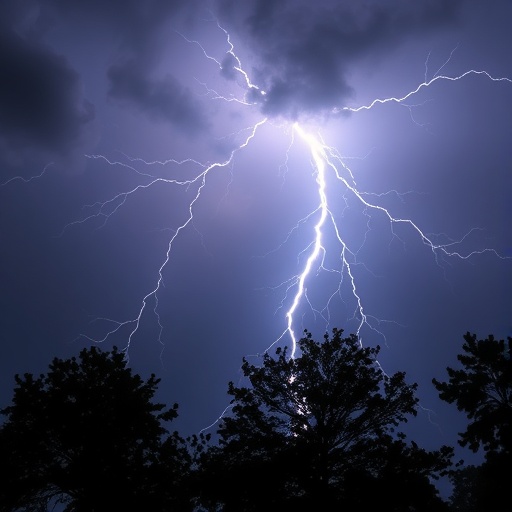
For the first time in the annals of atmospheric research, scientists have successfully detected and quantified corona discharges emanating from the foliage of trees during thunderstorms. These subtle yet fascinating electrical phenomena manifest as faint blue sparkles—imperceptible to the unaided human eye—dancing along the edges of leaves and branches. This groundbreaking observation emerged from an extensive field study conducted along the U.S. East Coast during the summer months of 2024, unveiling a previously unknown interaction between thunderstorms and forest canopies.
Corona discharges represent weak electrical emissions created when atmospheric electrical fields intensify near sharp points, like leaf tips, and ionize surrounding air molecules. Though well-studied in laboratory settings, capturing their presence on living trees outdoors has long eluded researchers due to their tenuous glow and the challenge of isolating them from ambient light conditions during storms. The research, now published in Geophysical Research Letters, overturns century-old scientific assumptions by documenting such discharges under natural thunderstorm conditions for the first time.
The genesis of these woody coronae lies in the interplay between the thunderstorm’s overhead electrical charge and the induced countercharge in the earth below. Thunderstorms often accumulate significant charge within their cloud bases, creating strong electrostatic fields extending toward the ground. This field induces an opposing charge in terrestrial surfaces—especially at elevated points such as tree canopies—leading to an accumulation of electrical charge on leaf tips. When this charge concentration reaches a critical threshold, it causes a discharge of electricity into the surrounding air, ionizing it and creating characteristic corona emissions.
One of the study’s pioneers, Patrick McFarland, a meteorologist based at Pennsylvania State University, recalls how reproducing these coronae in controlled laboratory environments provided a crucial glimpse into their nature. By placing leaves beneath charged plates in near-total darkness, his team observed the faint ultraviolet blue glows characteristic of corona discharges. These displays are typically masked in natural environments by the general brightness of daylight or even twilight, highlighting the challenge faced in detecting them in the wild.
Further experiments revealed that the intensity of UV radiation emitted by coronae correlates closely with the electrical current passing through tree tissues. This finding not only confirms the electrical nature of these discharges but also suggests a possible avenue to non-invasively monitor electrical currents within trees during storms. Past research dating back to the mid-20th century had already flagged such currents as potentially damaging to plants, given that electrical flow can disrupt cellular membranes and degrade chloroplasts responsible for photosynthesis.
To break through the obstacles of field observation, the researchers leveraged an innovative approach: outfitting a 2013 Toyota Sienna minivan with an array of sensitive instruments. This includes an electric field detector, a laser rangefinder, and notably, a roof-mounted periscope channeling light into an ultraviolet-sensitive camera. By catching UV emissions otherwise invisible to human eyes and ordinary cameras, this mobile lab enabled the team to chase thunderstorms and systematically scan treetops for corona activity.
Daily expeditions involved braving intense storms while carefully aiming cameras at specific tree branches—such as those of sweetgum and loblolly pine—across various sites stretching from Florida northward to Pennsylvania. The data accrued demonstrated not sporadic, but rather prolific corona generation. Over 90 minutes of storm monitoring in one instance revealed at least 41 distinct corona discharges flickering intermittently on leaf tips, each lasting up to several seconds and sometimes racing from leaf to leaf in near choreographed patterns.
The ubiquity of corona discharges during thunderstorms is striking. McFarland hypothesizes that these discharges likely illuminate every treetop beneath storm cells, collectively creating a vast, albeit faint, spectacle of blue UV light reminiscent of swarms of bioluminescent insects. Yet, this electrical light show is more than just atmospheric artistry—it carries important biological implications. The repetitive bombardment of coronae can physically scorch leaf tips, evidenced by visible burn marks after only seconds of exposure.
Such damage might go beyond superficial burns. The researchers speculate that corona-induced electrical stress could degrade the cuticle, the protective waxy barrier shielding leaves from UV damage and dehydration. Since trees endure countless thunderstorms annually, the cumulative impact could influence leaf longevity and overall canopy health. This opens intriguing questions about whether trees have evolved structural or physiological traits in response to persistent corona damage to minimize harm over evolutionary time scales.
Looking ahead, McFarland envisions multidisciplinary collaboration to deepen understanding of coronae’s ecological role. Partnerships with forest ecologists and botanists could unravel how these electrical phenomena affect plant physiology, growth patterns, and forest ecosystem dynamics. Assessing whether certain species exhibit adaptations to withstand or mitigate corona effects is another promising frontier.
This paradigm-shifting discovery underscores the complex and intimate connections between atmospheric electricity and terrestrial ecosystems. It illuminates a hidden layer of interaction where thunderstorms not only deliver rain and lightning but also subtly electrify forest canopies in a dazzling yet imperceptible display. As detection technologies advance, researchers anticipate new insights into the electrical life pulsing through forests during storms, with potential ramifications for climatology, plant biology, and forestry management.
Ultimately, this first-ever field documentation of tree corona discharges opens a new chapter in understanding how natural electrical phenomena shape our planet’s biosphere. The faint sparkles of UV coronae serve as a reminder that even the mightiest forces of nature express themselves in subtle, unseen ways—transforming our perception of the stormy mingling between sky and forest.
Cite Scienmag News
Russell Cooper. (February 24, 2026). For the first time, thunderstorms create eerie coronae atop treetops, observed outdoors—news from the latest science magazine. Scienmag. https://scienmag.com/for-the-first-time-thunderstorms-create-eerie-coronae-atop-treetops-observed-outdoors-news-from-the-latest-science-magazine/
Russell Cooper. "For the first time, thunderstorms create eerie coronae atop treetops, observed outdoors—news from the latest science magazine." Scienmag, 24 February 2026, https://scienmag.com/for-the-first-time-thunderstorms-create-eerie-coronae-atop-treetops-observed-outdoors-news-from-the-latest-science-magazine/. Accessed 3 September 2026.
Russell Cooper. "For the first time, thunderstorms create eerie coronae atop treetops, observed outdoors—news from the latest science magazine." Scienmag. February 24, 2026. https://scienmag.com/for-the-first-time-thunderstorms-create-eerie-coronae-atop-treetops-observed-outdoors-news-from-the-latest-science-magazine/


