


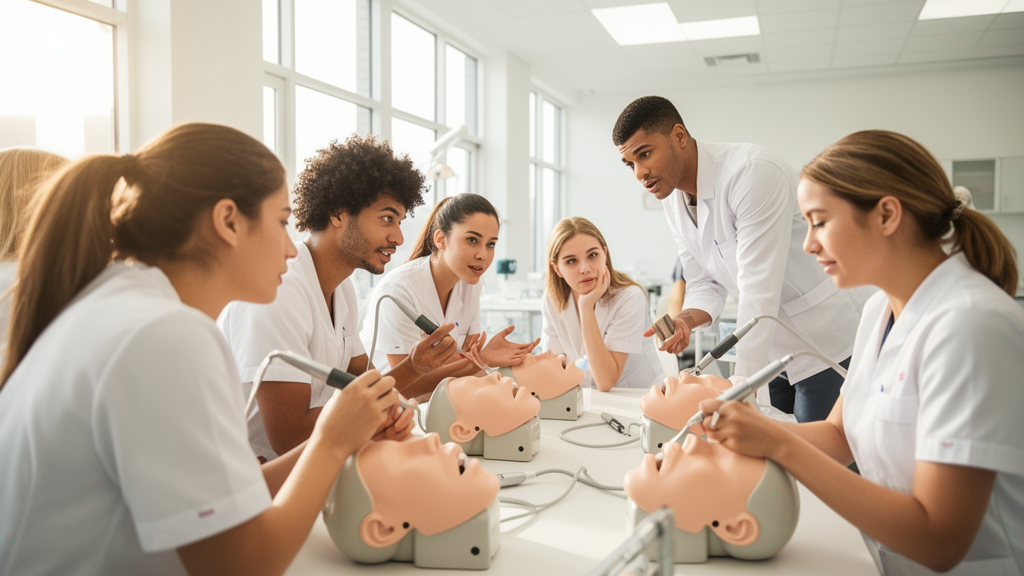
Dental schools around the world still rely heavily on the traditional lecture: an instructor stands at the front of a room, delivers a dense body of factual material, and students take notes in the hope of reproducing it later in an examination. Educational researchers have long argued that this passive format offers limited opportunity for engagement, active recall, and the application of knowledge to clinical problems. A new quasi-experimental study from the College of Dentistry at the University of Sulaimani in Iraq, published in BMC Medical Education, put a modern alternative to the test among second-year undergraduate dental students, combining flipped pre-class materials, problem-based discussion, and microteaching into a single blended active-learning model.
The intervention was deliberately multicomponent. Before class, students in the intervention arm received a package of video, audio, and text materials along with training questions designed to prepare them for the session ahead. In class, the usual lecture was replaced by question-based, problem-based-learning-oriented discussion, in which students worked through clinical and conceptual problems rather than listening to a monologue. Targeted microteaching sessions were also woven in, giving students short, focused teaching experiences intended to reinforce specific skills and concepts. The comparison group, meanwhile, continued with the traditional lecture model, allowing the researchers to contrast the two approaches under real academic conditions rather than in an artificial laboratory setting.
The study design was a non-randomized, cluster-allocated quasi-experimental trial. Six pre-existing academic subgroups of second-year dental students served as the units of allocation: subgroups A through C received the traditional lecture model, while subgroups D through F received the blended active-learning model. Because intact groups rather than individual students were assigned to the teaching conditions, the researchers treated subgroup-level comparison as the principal basis for inferential interpretation, while student-level analyses were described as descriptive or exploratory. This distinction matters enormously for how the findings should be read, and the authors were unusually candid about its consequences.
Knowledge was assessed one week after the teaching intervention using a five-question multiple-choice quiz randomly drawn from a reviewed and piloted 15-item question bank, with questions selected at a comparable intended difficulty level. Importantly, all students completed the course quiz irrespective of whether they took part in the research, because the quiz formed part of routine academic assessment. Research participation status played no role in calculating final course grades; consent governed only whether individual assessment data could be used in the study. This separation of routine assessment from research participation was designed to minimize assessment bias and to protect students from any academic consequence of joining or leaving the study.
A total of 194 valid post-test scores were available, evenly split at 97 students per teaching model. In the principal subgroup-level analysis, the mean of the three blended subgroup means was 4.47 out of 5, compared with 3.73 for the three traditional subgroup means, a difference of 0.74 points. However, the statistical test associated with this comparison, a Welch t-test, yielded a value of 1.55 with 2.27 degrees of freedom and a p-value of 0.247, with an approximate 95 percent confidence interval stretching from -1.10 to 2.58. With only three clusters per arm, the estimate was highly imprecise and, as the authors state plainly, not statistically conclusive.
Student-level descriptive analyses told a more encouraging story. The blended group showed a higher mean score than the traditional group, 4.47 plus or minus 0.68 versus 3.70 plus or minus 1.57 out of 5. The narrower spread of scores in the blended arm is itself noteworthy, suggesting that the active-learning model may have lifted weaker students in particular, since the traditional group’s standard deviation of 1.57 was more than double that of the intervention group. But the authors are careful to note that these student-level observations did not account for the subgroup-level allocation, and therefore cannot by themselves establish a causal effect of the teaching model.
Perceptions collected from the intervention group added a third layer of evidence. Among 88 respondents who completed the piloted perception questionnaire, 90.9 percent considered the blended model useful, 86.4 percent reported better engagement, and 78.4 percent preferred the question-based model over the lecture format. These are strikingly high approval figures for an educational intervention, and they align with a broader international literature suggesting that students respond positively to flipped classrooms and problem-based approaches when those approaches are well structured and supported with quality pre-class materials.
The authors are refreshingly honest about the limitations of their work. Because only six intact subgroups were included, the effective sample size at the cluster level was tiny, which is why the confidence interval around the principal estimate was so wide. Baseline knowledge was not measured, meaning the researchers could not confirm that the two arms started from equivalent levels of understanding, a critical weakness in any non-randomized comparison. The intervention itself was multicomponent, combining flipped materials, discussion, and microteaching, so even a confirmed effect could not be attributed to any single ingredient. For these reasons, the authors conclude that the findings do not establish a causal effect, and they call for further studies with more clusters, baseline assessment, and longer follow-up.
Why does this matter beyond one dental school in Iraq? Medical and dental education worldwide is undergoing a slow but persistent transformation away from passive lecturing toward active learning, and institutions considering such reforms need evidence about what works, for whom, and at what cost. This study used only routinely available educational resources, including Google Classroom, Google Forms, Microsoft Excel, IBM SPSS Statistics, and instructor-prepared video, audio, and PowerPoint teaching materials, receiving no specific grant from any funding agency. That low-cost, low-tech profile makes the model potentially replicable in resource-constrained settings, where expensive simulation laboratories and dedicated educational technologists are simply not available.
The study also offers a methodological lesson for educational researchers. Cluster-allocated designs are often unavoidable in schools, where students are already organized into fixed groups and randomizing individuals would contaminate the comparison. But with so few clusters, statistical power collapses, and even seemingly large differences in mean scores can be compatible with chance. The Sulaimani team’s decision to foreground the subgroup-level analysis, rather than leaning on the more flattering student-level numbers, is an example of statistical transparency that other education researchers would do well to emulate. It would have been easy to headline the 0.74-point advantage and the 90.9 percent approval rating; instead, the paper’s conclusion emphasizes imprecision and the absence of causal proof.
The ethical architecture of the study was also carefully constructed. Approval was granted by the Ethics Committee of the College of Dentistry, University of Sulaimani, and the research was conducted in accordance with the Declaration of Helsinki. All research procedures, from recruitment and written informed consent through post-test data collection and questionnaire administration, occurred after ethical approval, between June 30 and August 14, 2026. The investigators acknowledged that they had teaching or assessment roles in relation to the participating students when consent was obtained, and they took steps to firewall research participation from grading decisions. Faculty investigators did not have access to students’ detailed course-grade records, formal grading remained with the course instructors, and research data were coded and reported only in aggregate form.
For dental educators watching this space, the practical takeaway is one of cautious optimism. The blended model was popular with students, produced descriptively better and more consistent quiz performance, and can be implemented with everyday digital tools. But the definitive question, whether such a model genuinely causes improved learning when compared fairly with traditional lectures at scale, remains open. Larger trials with more clusters, baseline knowledge measurement, and longer-term follow-up, ideally tracking students into their clinical years, are the logical next step. Until then, the Sulaimani study stands as a promising, honestly reported data point in the ongoing effort to make dental education as active, engaging, and effective as the profession it serves demands.
Subject of Research: Blended active-learning models in undergraduate dental education
Article Title: Quasi-experimental trial of flipped classroom with microteaching and PBL-oriented discussion in dental education: student outcomes and perceptions
Article References: Quasi-experimental trial of flipped classroom with microteaching and PBL-oriented discussion in dental education: student outcomes and perceptions. (n.d.). https://doi.org/10.1186/s12909-026-10620-0
Image Credits: AI Generated
DOI: 10.1186/s12909-026-10620-0
Keywords: dental education, flipped classroom, problem-based learning, microteaching, active learning, quasi-experimental study, undergraduate dental students, medical education, oral histology, student perceptions, blended learning, cluster allocation
Cite Scienmag News
Courtney Benton. (October 15, 2026). Flipped Classroom Boosts Dental Student Engagement, but Evidence Remains Inconclusive. Scienmag. https://scienmag.com/flipped-classroom-boosts-dental-student-engagement-but-evidence-remains-inconclusive/
Courtney Benton. "Flipped Classroom Boosts Dental Student Engagement, but Evidence Remains Inconclusive." Scienmag, 15 October 2026, https://scienmag.com/flipped-classroom-boosts-dental-student-engagement-but-evidence-remains-inconclusive/. Accessed 15 October 2026.
Courtney Benton. "Flipped Classroom Boosts Dental Student Engagement, but Evidence Remains Inconclusive." Scienmag. October 15, 2026. https://scienmag.com/flipped-classroom-boosts-dental-student-engagement-but-evidence-remains-inconclusive/


