


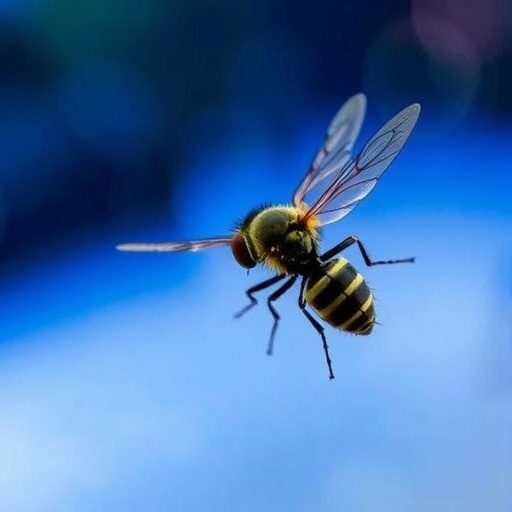
Scientists from the University of California, Riverside, have unveiled groundbreaking insights into how living organisms adapt to environments with extreme gravitational forces, a phenomenon known as hypergravity. Their study, published in the Journal of Experimental Biology, challenges long-held assumptions that exposure to intense physical stress inevitably leads to physiological breakdown. Instead, their research on fruit flies reveals remarkable resilience and adaptability, opening new avenues for understanding the influence of gravity on biological systems.
The researchers employed a custom-built centrifuge to simulate elevated gravitational forces far beyond Earth’s normal gravity. By spinning fruit flies at varying levels—ranging from four times Earth’s gravity (4G) to as high as thirteen times (13G)—they meticulously documented behavioral and physiological responses over different time scales, from a single 24-hour exposure to sustained, multi-generational experiments. This comprehensive approach allowed them to probe not only immediate effects but also long-term adaptations to hypergravity.
Initial findings were startling. At 4G for 24 hours, fruit flies exhibited hyperactivity, moving more vigorously than under normal gravity. However, as the gravitational force increased further to 7G, 10G, and 13G, activity levels dropped significantly. The flies became less mobile and displayed diminished climbing behaviors, an instinctive upward movement known as negative geotaxis. This inversion of response underscores a complex relationship between gravity and organismal activity tied to energy expenditure optimization in stressful conditions.
Behavioral alterations were not fleeting. Following hypergravity exposure, flies in the 4G group maintained heightened activity for approximately seven weeks—most of their lifespan—before gradually normalizing. Flies subjected to more intense gravitational forces showed an immediate reduction in activity but similarly returned to typical movement patterns over time. This dynamic recovery process suggests a sophisticated neural and metabolic plasticity that governs energy management and movement decisions based on external physical demands.
The research team postulates that these behavioral patterns represent energy trade-offs controlled by the brain’s assessment of environmental conditions. Moderate increases in gravity appear to stimulate increased movement, potentially as a compensatory mechanism to meet heightened biomechanical demands. Conversely, at extreme gravity levels, the metabolic cost of movement becomes prohibitive, prompting an intrinsic conservation strategy that suppresses unnecessary activity to preserve energy reserves.
Corroborating this hypothesis, physiological measurements revealed parallel shifts in fat storage and metabolism closely linked to behavioral states. Initially, fat accumulation rose soon after hypergravity exposure, possibly reflecting an adaptive energy stockpiling mechanism. Subsequent elevated activity at moderate gravity levels led to a reduction in stored fat as energy consumption increased. These findings indicate a tightly coupled regulatory circuit where gravity influences metabolism and activity in concert.
What distinguishes this investigation is its longitudinal and multi-generational scope. By exposing flies to continuous hypergravity throughout their entire lifespan and across ten successive generations, researchers evaluated the capacity for inherited adaptation and physiological robustness. Contrary to expectations that sustained stress would cause cumulative damage, the flies demonstrated enduring survivability, reproduction, and activity, highlighting the evolutionary potential for coping with harsh gravitational environments.
The implications of these results extend far beyond entomology. Humans routinely experience fluctuating gravitational forces—fighter pilots face transient hypergravity during maneuvers, while astronauts endure significant shifts during launch and reentry phases. Yet, scientific understanding of how such stresses impact human physiology remains incomplete. This study’s revelation of gravity as an active modulator of neural energy budgeting and movement offers a vital perspective for aerospace medicine and astronaut health management.
Unlike prior research focused primarily on microgravity’s effects in space, this work reverses the lens to explore heightened gravitational forces. By doing so, it addresses a critical knowledge gap in gravitational biology, positioning gravity not as a static background force but as a dynamic environmental cue integral to life’s fundamental processes. This paradigm shift could recalibrate how scientists model organismal responses to spaceflight and terrestrial extreme environments alike.
Future space exploration missions, including NASA’s Artemis II endeavor planned for lunar travel, stand to benefit from these insights. As humans embark on longer and more physically demanding journeys beyond Earth, understanding how gravitational extremes influence energy metabolism, motor control, and recovery mechanisms becomes essential for optimizing astronaut performance and safety. Preventative strategies informed by such research could mitigate health risks associated with hypergravity exposure.
The researchers emphasize the timeliness of their work amid the expanding frontier of commercial and governmental spaceflight. With more frequent and prolonged missions, hypergravity effects are poised to become a pervasive challenge in human space endeavors. This study paves the way for integrative research that unites biology, neuroscience, and physics to devise comprehensive countermeasures that can sustain human life under exceptional gravitational stress.
In essence, this research redefines gravity as a biological signal with profound influence over how organisms allocate energy, coordinate movement, and endure environmental stress. By leveraging a simple model organism and innovative methodology, the study illuminates the resilient and adaptable nature of life under physical extremes. As space travel ushers in unprecedented challenges, grasping the interplay between gravity and physiology may prove pivotal in safeguarding the explorers of tomorrow.
News Publication Date: 23-Apr-2026
Web References:
- https://journals.biologists.com/jeb/article/229/8/jeb251327/371426/Hypergravity-exposure-leads-to-persistent-effects
- http://dx.doi.org/10.1242/jeb.251327
Keywords
Hypergravity, gravity biology, Drosophila melanogaster, energy metabolism, movement behavior, neural plasticity, aerospace physiology, spaceflight adaptation, centrifuge simulation, multi-generational study, negative geotaxis, Artemis II mission
Cite Scienmag News
Grant Pearson. (May 1, 2026). Flies Adapt and Recover Under Intense Hypergravity Conditions. Scienmag. https://scienmag.com/flies-adapt-and-recover-under-intense-hypergravity-conditions/
Grant Pearson. "Flies Adapt and Recover Under Intense Hypergravity Conditions." Scienmag, 1 May 2026, https://scienmag.com/flies-adapt-and-recover-under-intense-hypergravity-conditions/. Accessed 6 September 2026.
Grant Pearson. "Flies Adapt and Recover Under Intense Hypergravity Conditions." Scienmag. May 1, 2026. https://scienmag.com/flies-adapt-and-recover-under-intense-hypergravity-conditions/


