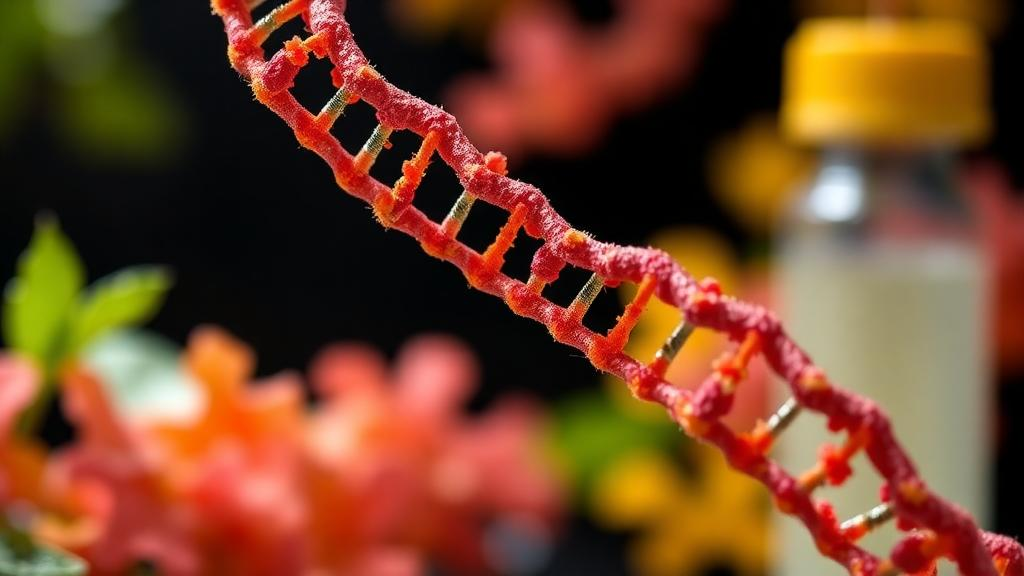
The compounds, licoricidin and isoliquiritigenin, were shown to bind directly to DNA and to reduce the formation of two specific methylated DNA adducts produced by N-methyl-N-nitrosourea, or MNU. The work, published in the journal Genes and Environment, was conducted entirely in bacterial and cell-free laboratory systems, so the findings do not yet translate into evidence of protection in humans.
MNU belongs to the N-nitrosamine family, a group of environmental contaminants found in food, water, drugs, cosmetics, and tobacco products. Human exposure also occurs internally, when amines in the body undergo nitrosation through acid- or bacteria-catalyzed reactions with nitrite, or through reactions with nitric oxide products generated during inflammation or infection. Many N-nitroso compounds are mutagenic and carcinogenic in all animal species tested, and they are suspected to be carcinogenic to humans. MNU itself can be formed in the body and acts as a direct-acting alkylating agent, meaning it needs no metabolic activation to attack DNA.
When MNU methylates DNA, it produces a range of adducts, two of which were central to the new study. O6-methylguanine, which sits in the major groove of B-form DNA, can cause miscoding errors during replication, leading to GC-to-AT transition mutations. N3-methyladenine, located in the minor groove, is not considered a serious promutagenic lesion based on studies in bacterial and yeast systems. Because the two lesions occupy different grooves of the double helix, molecules that bind to DNA in a groove-specific fashion might be expected to shield one adduct more than the other, a prediction the researchers set out to test directly.
The team, led by Chisato Matsuoka and colleagues including Keiko Inami, built on earlier Ames assay results showing that licoricidin, an isoflavan, and isoliquiritigenin, a chalcone, could block MNU-induced mutations in Salmonella typhimurium strain TA1535. In the new experiments, the researchers used calf thymus DNA and ultraviolet-visible spectrophotometry to characterize noncovalent binding of the flavonoids, alongside two well-characterized control compounds: the intercalator ethidium bromide and the minor-groove binder Hoechst 33258. Two compounds that lack antimutagenic activity against MNU, 4′,6,7-trihydroxyisoflavone and glycyrrhetinic acid, served as negative controls.
The spectroscopic data revealed clear evidence of compound-DNA complex formation, with isosbestic points appearing in the absorption spectra as DNA concentration increased. Binding constants at 298 kelvin ranked Hoechst 33258 highest at 3.78 x 10^5 per molar, followed by licoricidin at 1.19 x 10^5, isoliquiritigenin at 0.83 x 10^5, and ethidium bromide at 0.81 x 10^5. Thermodynamic analysis of the binding pointed to distinct modes: negative enthalpy and entropy changes for Hoechst 33258 and licoricidin implied minor-groove interaction, while isoliquiritigenin showed an enthalpy change near zero with positive entropy, consistent with electrostatic interaction with the DNA phosphate backbone. All Gibbs free energy values were negative, indicating spontaneous binding. The negative-control compounds showed no detectable DNA interaction.
In the Ames assay with MNU at 1.5 micromoles per plate, licoricidin, isoliquiritigenin, and Hoechst 33258 all suppressed MNU-induced mutagenicity in a concentration-dependent manner, without cytotoxicity against the bacteria. The half-maximal inhibitory concentrations were 0.15 micromoles per plate for licoricidin, 0.8 for isoliquiritigenin, 1.0 for ethidium bromide, and 1.9 for Hoechst 33258. Ethidium bromide showed an unusual biphasic pattern, enhancing mutagenicity at lower concentrations of 0.25 to 0.5 micromoles per plate before suppressing it at higher doses. Trihydroxyisoflavone, at 1.0 to 8.0 micromoles per plate, had no effect on MNU mutagenicity.
The key mechanistic experiment quantified the DNA adducts themselves. Using liquid chromatography-tandem mass spectrometry on calf thymus DNA treated with MNU in the presence of each compound, the researchers found that adduct levels fell as compound concentrations rose. Licoricidin preferentially reduced N3-methyladenine at all tested concentrations, consistent with its minor-groove binding mode; at 4 millimolar, O6-methylguanine and N3-methyladenine levels were reduced to 79 and 57 percent of controls, respectively. Isoliquiritigenin produced comparable reductions in both adducts, in line with its backbone interaction, reaching 40 and 35 percent of control levels at 8 millimolar. Hoechst 33258 was more effective at reducing N3-methyladenine at low concentrations, while at 8 millimolar it inhibited both adducts to a similar extent.
A crucial set of control experiments ruled out a simpler explanation: direct chemical scavenging of MNU or its reactive intermediates. The half-life of MNU was similar in the presence and absence of licoricidin, isoliquiritigenin, and Hoechst 33258. Over 24 hours of incubation, the amounts of licoricidin and isoliquiritigenin in the reaction mixture did not change, and no new products were detected, demonstrating that the flavonoids did not react directly with MNU or intercept the methyldiazonium ions it generates. This positions the compounds as antimutagens, which prevent mutation by protecting DNA, rather than desmutagens, which inactivate the mutagen itself. Interestingly, trihydroxyisoflavone and ethidium bromide did shorten MNU’s half-life, indicating they decomposed the alkylating agent, and trihydroxyisoflavone’s strong reduction of both adducts was attributed to this decomposition at concentrations roughly 19-fold higher than MNU.
The picture that emerges is not entirely tidy, and the authors acknowledge this openly. Because MNU-induced mutagenesis in S. typhimurium TA1535 is mainly attributed to O6-methylguanine, and because isoliquiritigenin reduced that adduct more strongly than licoricidin did, DNA binding alone cannot fully explain the antimutagenic activity. Licoricidin showed greater antimutagenic potency and DNA-binding capacity, yet its effects were likely attributable to mechanisms independent of O6-methylguanine reduction. The researchers suggest that flavonoid-DNA interactions may modulate gene expression or alter enzyme activity, potentially promoting accurate replication of damaged bases, error-free DNA repair pathways, or suppression of error-prone enzymes. They also note that flavonoids’ radical-scavenging and metal-chelating properties might contribute, since MNU treatment may be associated with increased intracellular reactive oxygen species, though these possibilities remain speculative in this study.
The study’s limitations are clearly stated. The experiments used bacterial and in vitro DNA systems, which may not fully represent mammalian cellular environments, including chromatin structure, DNA repair capacity, and metabolic processes. Solubility constraints limited the concentrations that could be tested, and sequence-specific DNA binding preferences were not investigated, leaving the genomic selectivity of flavonoid-DNA interactions unclear. The authors call for further work in cell-based systems to fully elucidate the mechanisms, identify preferential DNA sequences, and clarify the structural basis of antimutagenic activity. For now, the study stands as a careful mechanistic demonstration that two plant flavonoids can physically occupy DNA and measurably reduce the chemical lesions left by a mutagen, while pointing to additional, still-unidentified layers of protection.
Subject of Research: Mechanisms by which the flavonoids licoricidin and isoliquiritigenin inhibit MNU-induced mutagenicity through noncovalent DNA binding
Article Title: Mechanistic investigation of flavonoid-mediated inhibition of N-methyl-N-nitrosourea-induced mutagenicity via noncovalent DNA binding
Article References: Matsuoka, C., Takatama, N., Muraoka, T., & Inami, K. (2026). Mechanistic investigation of flavonoid-mediated inhibition of N-methyl-N-nitrosourea-induced mutagenicity via noncovalent DNA binding. Genes and Environment, 48(1), Article 13. https://doi.org/10.1186/s41021-026-00361-3
Image Credits: AI Generated
DOI: 10.1186/s41021-026-00361-3
Keywords: flavonoids, licoricidin, isoliquiritigenin, N-methyl-N-nitrosourea, DNA adducts, antimutagenicity, DNA binding, Ames assay, O6-methylguanine, N3-methyladenine, Genes and Environment, chemoprevention
Cite Scienmag News
Drew Townsend. (October 28, 2026). Flavonoids that bind DNA block a mutagen’s chemical fingerprints in lab tests. Scienmag. https://scienmag.com/flavonoids-that-bind-dna-block-a-mutagens-chemical-fingerprints-in-lab-tests/
Drew Townsend. "Flavonoids that bind DNA block a mutagen’s chemical fingerprints in lab tests." Scienmag, 28 October 2026, https://scienmag.com/flavonoids-that-bind-dna-block-a-mutagens-chemical-fingerprints-in-lab-tests/. Accessed 28 October 2026.
Drew Townsend. "Flavonoids that bind DNA block a mutagen’s chemical fingerprints in lab tests." Scienmag. October 28, 2026. https://scienmag.com/flavonoids-that-bind-dna-block-a-mutagens-chemical-fingerprints-in-lab-tests/