


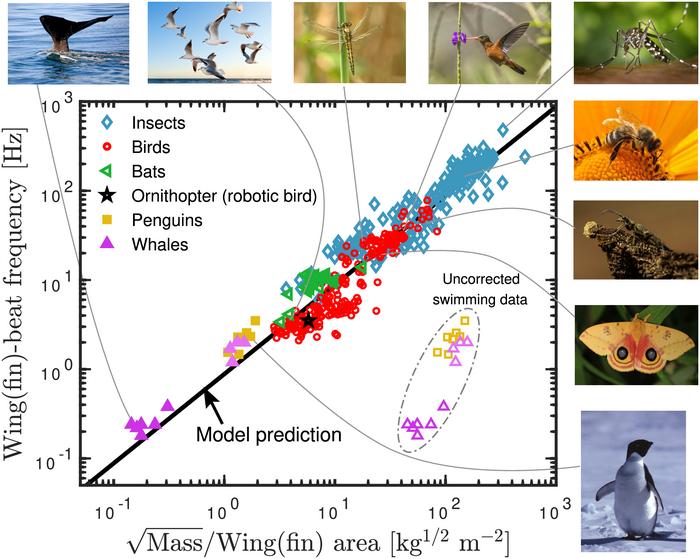
A single universal equation can closely approximate the frequency of wingbeats and fin strokes made by birds, insects, bats and whales, despite their different body sizes and wing shapes, Jens Højgaard Jensen and colleagues from Roskilde University in Denmark report in a new study in the open-access journal PLOS ONE, publishing June 5.

Credit: Jensen et al., 2024, PLOS ONE, CC-BY 4.0 (
A single universal equation can closely approximate the frequency of wingbeats and fin strokes made by birds, insects, bats and whales, despite their different body sizes and wing shapes, Jens Højgaard Jensen and colleagues from Roskilde University in Denmark report in a new study in the open-access journal PLOS ONE, publishing June 5.
The ability to fly has evolved independently in many different animal groups. To minimize the energy required to fly, biologists expect that the frequency that animals flap their wings should be determined by the natural resonance frequency of the wing. However, finding a universal mathematical description of flapping flight has proved difficult. Researchers used dimensional analysis to calculate an equation that describes the frequency of wingbeats of flying birds, insects and bats, and the fin strokes of diving animals, including penguins and whales.
They found that flying and diving animals beat their wings or fins at a frequency that is proportional to the square root of their body mass, divided by their wing area. They tested the accuracy of the equation by plotting its predictions against published data on wingbeat frequencies for bees, moths, dragonflies, beetles, mosquitos, bats, and birds ranging in size from hummingbirds to swans.
The researchers also compared the equation’s predictions against published data on fin stroke frequencies for penguins and several species of whale, including humpbacks and northern bottlenose whales. The relationship between body mass, wing area and wingbeat frequency shows little variation across flying and diving animals, despite huge differences in their body size, wing shape and evolutionary history, they found. Finally, they estimated that an extinct pterosaur (Quetzalcoatlus northropi) — the largest known flying animal — beat its 10 meter-square wings at a frequency of 0.7 hertz.
The study shows that despite huge physical differences, animals as distinct as butterflies and bats have evolved a relatively constant relationship between body mass, wing area and wingbeat frequency. The researchers note that for swimming animals they didn’t find publications with all the required information; data from different publications was pieced together to make comparisons, and in some cases animal density was estimated based on other information. Furthermore, extremely small animals — smaller than any yet discovered — would likely not fit the equation, because the physics of fluid dynamics changes at such a small scale. This could have implications in the future for flying nanobots. The authors say that the equation is the simplest mathematical explanation that accurately describes wingbeats and fin strokes across the animal kingdom.
The authors add: “Differing almost a factor 10000 in wing/fin-beat frequency, data for 414 animals from the blue whale to mosquitoes fall on the same line. As physicists, we were surprised to see how well our simple prediction of the wing-beat formula works for such a diverse collection of animals.”
#####
In your coverage please use this URL to provide access to the freely available article in PLOS ONE:
Citation: Jensen JH, Dyre JC, Hecksher T (2024) Universal wing- and fin-beat frequency scaling. PLoS ONE 19(6): e0303834.
Author Countries: Denmark
Funding: The work was supported by the VILLUM Foundation’s Matter grant VIL16515. The funders had no role in study design, data collection and analysis, decision to publish, or preparation of the manuscript.
Journal
PLoS ONE
Method of Research
Observational study
Subject of Research
Animals
Article Title
Universal wing- and fin-beat frequency scaling
Article Publication Date
5-Jun-2024
COI Statement
The authors have declared that no competing interests exist.
Cite Scienmag News
Gavin Prescott. (June 5, 2024). Flapping frequency of birds, insects, bats and whales described by universal equation. Scienmag. https://scienmag.com/flapping-frequency-of-birds-insects-bats-and-whales-described-by-universal-equation/
Gavin Prescott. "Flapping frequency of birds, insects, bats and whales described by universal equation." Scienmag, 5 June 2024, https://scienmag.com/flapping-frequency-of-birds-insects-bats-and-whales-described-by-universal-equation/. Accessed 4 September 2026.
Gavin Prescott. "Flapping frequency of birds, insects, bats and whales described by universal equation." Scienmag. June 5, 2024. https://scienmag.com/flapping-frequency-of-birds-insects-bats-and-whales-described-by-universal-equation/

