


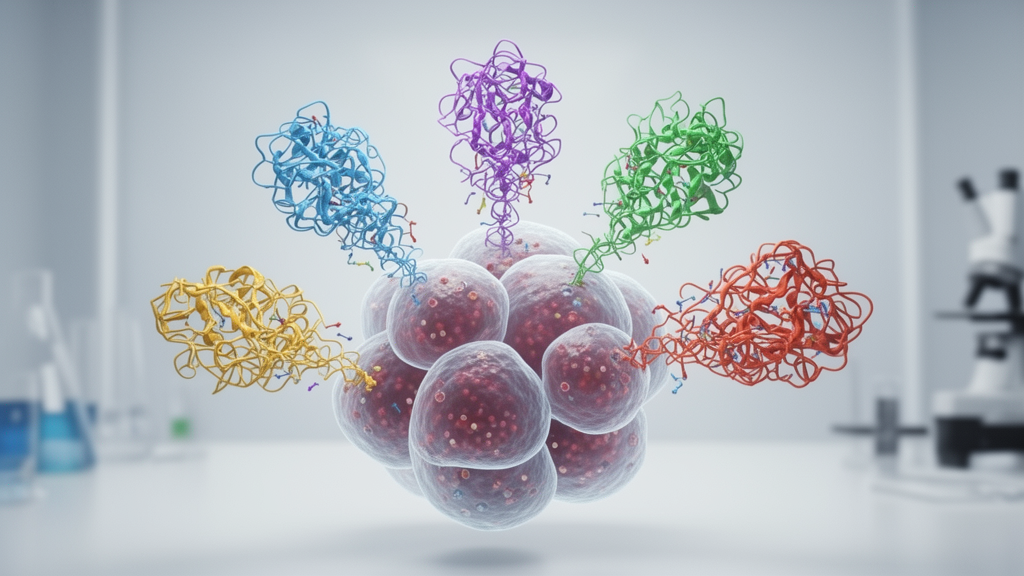
A five-member panel of synthetic aptamers reduced the viability, proliferation, migration and colony-forming activity of triple-negative breast cancer cells in laboratory experiments, according to a study that also exposed substantial variation among tumor models. The AptaBreast panel, comprising AptaB1 through AptaB5, showed different activity profiles depending on the assay and cell line: AptaB2 was particularly potent against migration and in one viability assay, AptaB4 strongly suppressed colony formation, and the combined treatment produced substantial effects in several experiments. Most measurements in MCF10A cells, a non-tumoral mammary epithelial line used as a control, showed no significant change.
Triple-negative breast cancer, or TNBC, lacks detectable expression of the estrogen receptor, progesterone receptor and human epidermal growth factor receptor 2. These characteristics exclude hormone-directed and HER2-targeted treatment options, while the disease is associated with a poor prognosis, limited therapeutic choices, high recurrence rates and pronounced molecular heterogeneity. Recognized intrinsic groups include basal-like 1, basal-like 2, mesenchymal, immunomodulatory, mesenchymal stem-like and luminal androgen receptor. Researchers at the Oswaldo Cruz Institute in Brazil investigated whether aptamers previously selected by cell-SELEX could exert direct effects against TNBC cells. Aptamers are synthetic single-stranded DNA or RNA molecules that fold into three-dimensional structures and bind molecular targets with selectivity and high affinity.
The experiments used four established TNBC cell lines chosen to represent distinct intrinsic settings. MDA-MB-231 represents the mesenchymal subtype, MDA-MB-468 and HCC-1937 represent basal-like 1, and HCC-70 represents basal-like 2. MDA-MB-231 was also used for the migration and colony-formation assays because it has an invasive, stem-like phenotype and greater migratory capacity. Each aptamer was applied at 400 nanomolar, the highest concentration among 25, 50, 100, 200 and 400 nanomolar tested in previous cellular-binding work by the group. The combination contained 400 nanomolar of each member, producing a total aptamer concentration of 2 micromolar. Viability and proliferation were assessed at 24, 48 and 72 hours, with three independent assays performed in triplicate under most conditions.
Direct counts of viable and non-viable MDA-MB-231 cells showed that individual aptamers caused death in 40% to 57% of treated cells after 24 hours, compared with 12% in medium-only controls and 10% with a random-sequence aptamer library. The five-aptamer mixture produced approximately 70% cell death at that point. After 48 hours, AptaB2 was associated with a 36% reduction in viability and AptaB4 with a 64% reduction, while the combination reached 76% cell death. At 72 hours, individual aptamers were associated with roughly 60% cell death and the combination with 84%. A separate resazurin-based viability assay showed somewhat different magnitudes: after 24 hours, individual aptamers lowered MDA-MB-231 viability by 27% to 37% and the combination by 43%.
Responses also differed among the other tumor models. In MDA-MB-468 cells, the combination reduced measured viability by 58% after 24 hours, 51% after 48 hours and 41% after 72 hours. In HCC-70 cells, individual and combined treatments produced reductions of 20% to 32% after 24 hours; at 48 hours, individual aptamers caused a 25% reduction and the combination a 35% reduction. At 72 hours, AptaB2 generated a 93% reduction in measured HCC-70 viability, while the full combination reduced viability by 46%. HCC-1937 was comparatively resistant: no significant effect was detected after 24 or 48 hours from either individual or combined treatments, although AptaB2 and AptaB3 each lowered viability by about 30% at 72 hours.
The contrast between MDA-MB-468 and HCC-1937 is important because both were classified as basal-like 1. Their divergent responses show that a broad intrinsic label alone may not predict aptamer activity. The molecular targets recognized by the AptaBreast aptamers remain unknown, so the study could not determine whether differences in target abundance, accessibility or molecular context contributed to the pattern. It also did not establish that the two cell lines were equivalent in every biological respect. This heterogeneity is not merely an experimental complication: it illustrates why responses seen in one laboratory model may not transfer uniformly to the wider TNBC population.
The panel also reduced DNA-associated proliferation indices in the tumor models. In MDA-MB-231 cells, individual aptamers lowered the proliferation index by 11% to 32% after 24 hours, while the combination reduced it by 33%, with reductions sustained through 72 hours. In MDA-MB-468 cells, individual treatments produced reductions of 21% to 34% at 24 hours and the combination a 40% reduction. In HCC-70 cells, individual aptamers lowered the index by 6% to 13% after 24 hours, while the combination reduced it by 20%, an effect maintained at later measurements. HCC-1937 showed smaller early changes, including reductions of 9% and 12% after 24 and 48 hours with individual and combined treatments, followed by a 23% reduction with AptaB3 at 72 hours.
Reductions in the non-tumoral MCF10A cells were limited to approximately 10% in the proliferation assay with AptaB1 and AptaB2; the other individual aptamers and the combination did not significantly affect proliferation there. In the metabolic viability assay, AptaB1 and AptaB2 produced slight reductions of 7% to 12%, while the other aptamers and the combination did not significantly affect MCF10A viability. Because the combination used a higher total concentration than single-aptamer treatments, the authors cautioned that its enhanced response could not be attributed unequivocally to synergy or multi-target action. Dose-matched controls and formal combination-effect analysis will be needed to distinguish additive, synergistic and independent contributions from the five molecules.
Two additional assays examined properties associated with tumor aggressiveness in MDA-MB-231 cells. Following treatment, surviving cells were normalized to an estimated equal number of viable cells and replated, allowing colony formation to be compared as a measure of the surviving population’s clonogenic potential. Every aptamer significantly reduced colony formation, and cells exposed to AptaB1, AptaB2 or AptaB5 formed fewer than half as many colonies as untreated controls. AptaB4 and the full combination produced the strongest inhibition, with reductions of up to 86%. In the Transwell migration assay, AptaB2 reduced migration by 83%, AptaB1 by 71% and AptaB4 by 64%, while AptaB3 and AptaB5 each lowered migration by about 50%. The combination produced a 60% reduction.
The differing functional profiles offer possible clues about mechanism. If migration and colony inhibition were solely consequences of reduced viability or slower proliferation, the individual aptamers might be expected to show more similar rankings across the assays. Instead, AptaB4 was particularly effective against colony formation, whereas AptaB1 and AptaB2 were strongest against migration. The pattern raises the possibility that some aptamers influence processes beyond general cell survival and proliferation, potentially involving adhesion, cytoskeletal organization or other pathways linked to aggressive tumor behavior. That interpretation remains provisional because the molecular targets and downstream pathways have not been identified. Researchers also cannot yet determine whether the five aptamers bind distinct targets or whether overlapping recognition contributes to their biological effects.
Although the results provide a basis for further preclinical work, they do not demonstrate that aptamers are safe or effective treatments for people with TNBC. The experiments were conducted in established cell lines, and migration and colony formation were evaluated only in MDA-MB-231. The researchers identified several priorities: identifying and validating the molecular targets; defining dose-response relationships and IC50 or EC50 values; characterizing cell-cycle and cell-death pathways; optimizing stability and functional properties; and testing specificity, biodistribution, toxicity and efficacy in vivo. More complex three-dimensional cultures, patient-derived tumor models and animal systems will be needed to determine whether the observed effects persist under more realistic biological conditions. The study also did not test targeted drug delivery, an application for which tumor-cell recognition might eventually be useful. Earlier regulatory approvals for aptamer-based treatments in eye disease and clinical evaluation of other cancer aptamers show that the platform has precedent, but no aptamer therapy has received regulatory approval for oncology.
Taken together, the experiments present the AptaBreast panel as a collection of potentially complementary molecular tools rather than a finished therapy. Its immediate attraction is the selectivity observed in this model system: it altered several tumor-cell behaviors while largely sparing the non-tumoral control line, yet the strength of individual effects depended on the biological endpoint. AptaB2 emerged as a potent inhibitor of migration and in one viability measurement, AptaB4 as a prominent suppressor of colony formation, and the combination as an effective option in several settings rather than a uniformly dominant one. The weak response in HCC-1937 is equally consequential because it shows how variable responses can be even among cell lines assigned to the same intrinsic TNBC subtype. The next decisive steps will be molecular and pharmacological studies that reveal what the aptamers bind, why different cancer cells respond differently, and whether these laboratory effects can survive the biological complexity of real tumors.
Subject of Research: Preclinical evaluation of a five-aptamer panel in triple-negative breast cancer cell models
Article Title: Novel aptamer-based strategies for addressing aggressive and heterogeneous triple-negative breast cancer
Article References: de Araujo, N. S., Moreira, A. D. S., Abreu, R. D. S., Mendonça, J. B., Sassaro, T. F., Degrave, W., Tilli, T. M., & Waghabi, M. C. (2026). Novel aptamer-based strategies for addressing aggressive and heterogeneous triple-negative breast cancer. Frontiers in Oncology, 16, Article 1943528. https://doi.org/10.3389/fonc.2026.1943528
Image Credits: AI Generated
DOI: 10.3389/fonc.2026.1943528
Keywords: triple-negative breast cancer, aptamers, AptaBreast panel, cell viability, cell proliferation, tumor migration, colony formation, tumor heterogeneity, preclinical research, cancer cell models, Novel, aptamer-based
Cite Scienmag News
Nathaniel Bowman. (October 22, 2026). Five Aptamers Show Activity Against Triple-Negative Breast Cancer Cells. Scienmag. https://scienmag.com/five-aptamers-show-activity-against-triple-negative-breast-cancer-cells/
Nathaniel Bowman. "Five Aptamers Show Activity Against Triple-Negative Breast Cancer Cells." Scienmag, 22 October 2026, https://scienmag.com/five-aptamers-show-activity-against-triple-negative-breast-cancer-cells/. Accessed 22 October 2026.
Nathaniel Bowman. "Five Aptamers Show Activity Against Triple-Negative Breast Cancer Cells." Scienmag. October 22, 2026. https://scienmag.com/five-aptamers-show-activity-against-triple-negative-breast-cancer-cells/


