


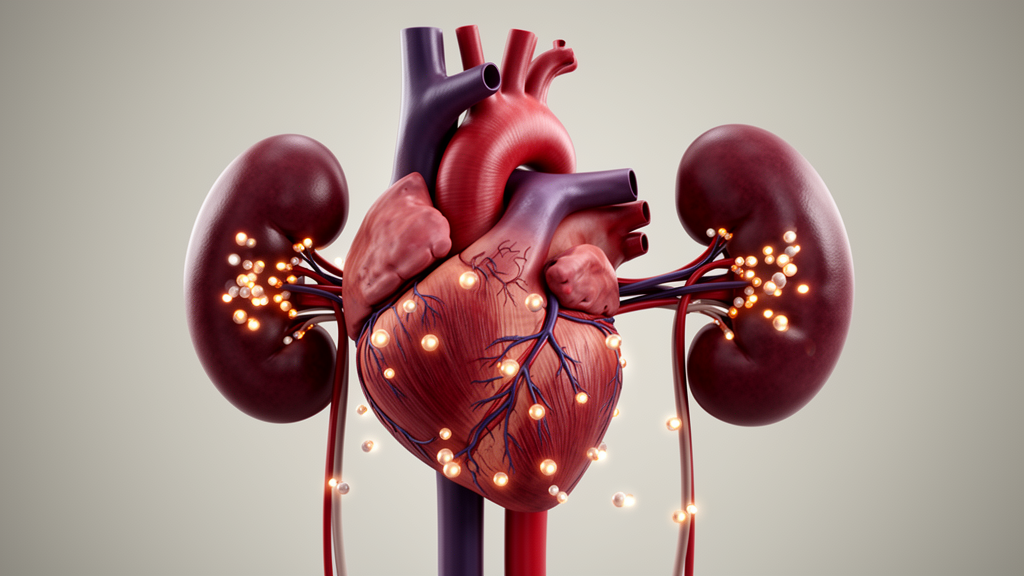
In male rats with diet-induced prediabetes, activation of the renin–angiotensin system was associated with early abnormalities in autonomic cardiovascular control, renal vascular function, and kidney structure even though the animals were not obese, hypertensive, diabetic, or showing impaired cardiac pumping. A low dose of the ACE inhibitor captopril improved several of these abnormalities without lowering blood pressure, while measurements of ACE protein in adipose tissue surrounding blood vessels and kidneys were higher in prediabetic animals than in controls. The experimental findings suggest that tissue-localized renin–angiotensin signalling may be involved before overt cardiovascular disease develops, but they do not establish a preventive treatment for people with prediabetes.
The study used an established rat model in which four- to five-week-old male Sprague Dawley rats received either normal chow or a mildly hypercaloric diet for 12 weeks. The special diet contained added fructose and hydrogenated vegetable oil, and its energy density was 4.035 kcal/g compared with 3 kcal/g for normal chow. Hypercaloric-fed rats consumed more energy and developed a higher fat-to-lean ratio, but their body weight at week 12 was comparable to that of controls. Their fasting blood glucose and glycated haemoglobin levels were also similar to those of controls, consistent with the authors’ designation of the model as prediabetic rather than diabetic. Metabolic profiling in this model has also shown hyperinsulinaemia, dyslipidaemia, and later hyperglycaemia, but the latter is not present at the 12-week endpoint used here.
Animals were assigned to six groups, with eight rats per group initially allocated: normal-chow control, normal-chow plus angiotensin II infusion, normal-chow plus captopril, hypercaloric-fed control, hypercaloric-fed plus angiotensin II infusion, and hypercaloric-fed plus captopril. Angiotensin II was delivered continuously at 0.8 mg/kg/day for the final 14 days through a subcutaneous osmotic pump. Captopril was given separately at 10 mg/kg/day during the final three weeks. The treatment groups were therefore not combined angiotensin II and captopril groups. Preliminary testing indicated that the selected doses did not produce gross haemodynamic responses in control rats during the treatment window. The design was intended to distinguish the effects of additional circulating angiotensin II from those of inhibiting ACE without producing overt hypotension.
Before the functional experiments, the researchers mapped overlaps and interactions among human protein targets associated with prediabetes, nephropathy, autonomic neuropathy, and renin–angiotensin signalling. The three disorders converged on protein targets involved in abnormal insulin signalling, while the interaction network placed ACE and angiotensin II at central positions. Significant interactions were reported at p less than 1 × 10⁻¹⁶. This computational analysis was hypothesis-generating rather than experimental confirmation of causality, but it provided a rationale for testing ACE-dependent mechanisms. Tissue measurements then supported the presence of increased local RAS machinery: ACE protein concentrations were significantly higher in perivascular adipose tissue and perirenal adipose tissue of hypercaloric-fed rats than in corresponding controls.
Despite the metabolic abnormalities, the prediabetic rats had normal systolic blood pressure, ejection fraction, and fractional shortening at week 12, and their thoracic aortas showed no significant difference in medial thickness. The absence of overt cardiovascular decompensation did not mean that cardiovascular regulation was intact. Invasive testing found an exaggerated mean arterial pressure response to the highest phenylephrine dose and blunted parasympathetic baroreceptor sensitivity, calculated from the slope relating changes in heart rate to changes in mean arterial pressure. Sympathetic responses to sodium nitroprusside, reflex tachycardia during blood-pressure reduction, and sympathetic baroreceptor sensitivity remained intact. The results therefore identified selective impairment of parasympathetic regulation rather than a generalized failure of cardiovascular reflexes.
Angiotensin II infusion affected the cardiovascular system even in rats eating normal chow. Both control and hypercaloric-fed animals receiving angiotensin II mounted an exaggerated pressor response to 2 micrograms of phenylephrine compared with untreated controls, and control animals receiving angiotensin II had significantly blunted parasympathetic baroreceptor sensitivity. In the hypercaloric-fed animals, angiotensin II infusion also raised systolic blood pressure and further reduced parasympathetic baroreceptor sensitivity relative to their untreated hypercaloric counterparts. The experiment therefore showed that additional systemic angiotensin II could compound subclinical autonomic impairment, but it also demonstrated that the infusion itself was not inert in otherwise unaffected animals.
Captopril improved the autonomic abnormality in the prediabetic group. Hypercaloric-fed rats receiving captopril had a significantly steeper parasympathetic baroreceptor-sensitivity slope than untreated hypercaloric-fed rats, with an effect size reported as η² = 0.68. This value was reported for the baroreceptor-sensitivity comparison rather than as a repeated-measures interaction effect. Captopril did not significantly change blood pressure at week 12 in either diet group, meaning that the functional improvement could not be explained simply by the drug lowering blood pressure in this experiment. The authors interpreted the result as support for a contribution from ACE-dependent, potentially local angiotensin II signalling, while acknowledging that the experiment did not identify one tissue as the sole source.
Ex vivo vascular testing showed that the metabolic model also affected cerebral and renal vessels. Middle cerebral arterioles from hypercaloric-fed rats had greater active tone than those from controls. The difference was significant at 40 and 60 mmHg in saline-infused animals and at 120 and 140 mmHg after angiotensin II infusion, with reported group-by-pressure effect sizes of ηp² = 0.15 and 0.51, respectively. Angiotensin II at the selected dose did not increase arteriolar tone in normal-chow rats or in hypercaloric-fed rats compared with their saline-infused counterparts, indicating that the cerebral-arteriole abnormality was associated with the metabolic insult rather than the pump treatment alone.
Kidney vascular function was more sensitive to the combination of metabolic stress and angiotensin II. Renal arteries from control rats dilated in response to increasing concentrations of carbachol, an endothelium-dependent agonist, while hypercaloric-fed rats had compromised vasodilation. Inhibitors of nitric oxide synthase and cyclooxygenase reduced the response in controls, confirming contributions from those pathways, whereas the inhibitors produced no meaningful distinction in hypercaloric-fed rats, consistent with loss of the measurable endothelium-dependent component. Angiotensin II infusion left only slight residual renal vasodilation in controls and was associated with an apparent total loss of the response in hypercaloric-fed animals. Captopril restored endothelium-dependent renal vasodilation in the hypercaloric group, with a reported group-by-concentration effect size of ηp² = 0.78.
Structural and inflammatory measurements completed the cardiorenal picture. Glomerular retraction, expressed as an increased ratio of Bowman’s capsule area to glomerular area, occurred in rats receiving angiotensin II and in hypercaloric-fed animals with or without angiotensin II. Tubular fibrosis was also greater in angiotensin II-infused controls and hypercaloric-fed rats than in untreated controls. Captopril reduced tubular fibrosis in hypercaloric-fed animals but did not reverse glomerular retraction, showing that short-term functional improvement did not erase every structural lesion. Brainstem inflammation, assessed by IBA-1 staining, was elevated by hypercaloric feeding, increased further by angiotensin II in that group, and reduced by captopril. Because captopril does not readily cross the blood–brain barrier, the authors considered secondary improvement in the metabolic environment a plausible explanation for that result.
Several limitations constrain how far the findings can be extended. The study involved male rats in a dietary model, not people with prediabetes, and the functional and histological analyses were based on small experimental groups, with some endpoints assessed in three to five animals per condition. The experiment could not fully separate ACE activity in adipose tissue from ACE activity in endothelial or vascular smooth muscle cells, and increased ACE protein did not directly establish the quantity or cellular source of locally generated angiotensin II. There was also no combined angiotensin II-plus-captopril group, so the study did not test whether captopril directly counteracted every consequence of the infusion. The authors proposed adipose-specific ACE knockdown and cell-culture experiments as follow-ups. The evidence supports a mechanistic role for local RAS activation in this prediabetic rat model and identifies ACE inhibition as a useful experimental probe, but it does not demonstrate a safe clinical strategy, human benefit, or reversal of established disease.
Subject of Research: Experimental evidence on adipose renin–angiotensin system activation and early cardiorenal dysfunction in prediabetic rats
Article Title: Renin–Angiotensin System Activation Drives Early Cardiorenal Dysfunction in Normotensive Prediabetes
Article References: Bakkar, N.-M. Z., Ghazi, R., Mougharbil, N., Hammoud, S. H., Sabra, R., Eid, A. H., & El‐Yazbi, A. F. (2026). Renin–Angiotensin System Activation Drives Early Cardiorenal Dysfunction in Normotensive Prediabetes. Endocrinology, Diabetes & Metabolism, 9(6), Article e70363. https://doi.org/10.1002/edm2.70363
Image Credits: AI Generated
DOI: 10.1002/edm2.70363
Keywords: prediabetes, renin–angiotensin system, angiotensin-converting enzyme, captopril, cardiorenal dysfunction, adipose tissue, baroreceptor sensitivity, renal vascular dysfunction, rat model, ACE inhibition, Renin, Angiotensin
Cite Scienmag News
Ophelia Keating. (October 22, 2026). Renin–Angiotensin System Activation Drives Early Cardiorenal Dysfunction in Normotensive Prediabetes. Scienmag. https://scienmag.com/renin-angiotensin-system-activation-drives-early-cardiorenal-dysfunction-in-normotensive-prediabetes/
Ophelia Keating. "Renin–Angiotensin System Activation Drives Early Cardiorenal Dysfunction in Normotensive Prediabetes." Scienmag, 22 October 2026, https://scienmag.com/renin-angiotensin-system-activation-drives-early-cardiorenal-dysfunction-in-normotensive-prediabetes/. Accessed 22 October 2026.
Ophelia Keating. "Renin–Angiotensin System Activation Drives Early Cardiorenal Dysfunction in Normotensive Prediabetes." Scienmag. October 22, 2026. https://scienmag.com/renin-angiotensin-system-activation-drives-early-cardiorenal-dysfunction-in-normotensive-prediabetes/


