


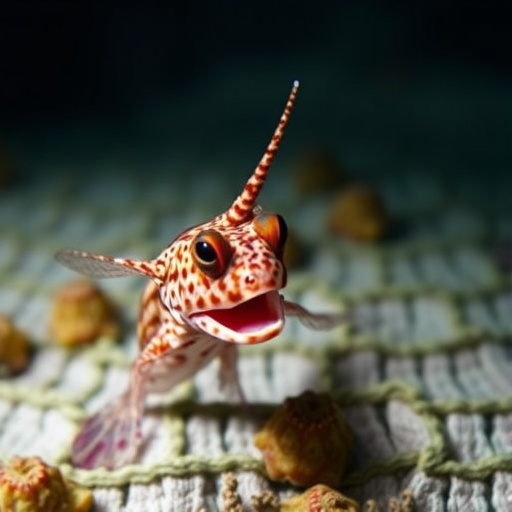
In a groundbreaking study published recently in the prestigious Journal of Zoology, researchers from the University of Lisbon have unveiled remarkable insights into the acoustic communication of the flying gurnard (Dactylopterus volitans), a striking fish species inhabiting the Adriatic Sea. This study marks a significant advancement in marine biology, confirming long-held suspicions that these vibrant fish are capable of producing sounds, a behavior hitherto poorly understood. Through meticulous observation and innovative recording techniques, the scientists have mapped out a complex acoustic repertoire that accompanies the fish’s distinctive visual displays, enriching our understanding of marine communication dynamics.
For decades, marine scientists speculated that the flying gurnard emitted sounds, but concrete evidence remained elusive. This latest research dispels uncertainty by capturing and analyzing clear sound productions characterized by two types of short, repeated grunts. These acoustic signals vary in duration, frequency, and rhythm, revealing a structured and intentional communication method within the species. Intriguingly, these sounds often coincide with the fish’s dramatic fin displays, where large pectoral fins erupt into vivid patterns speckled with blue spots. This dual sensory signaling—acoustic and visual—is suggestive of complex social or territorial behaviors.
The study’s methodology capitalized on state-of-the-art action camera technology, allowing researchers to document live interactions under natural conditions. Deploying cameras attached to divers, the team recorded these fish at Pasjača in Croatia’s Konavle region, a hotspot of marine biodiversity within the Adriatic Sea. The footage not only captured the sound production but also correlated it with the fish’s specific body movements and fin expansions. This approach circumvented previous limitations of underwater acoustics research, which often struggled with environmental noise and the elusive nature of free-swimming organisms.
The recordings indicate that sound-producing capabilities emerge early in development. Juvenile flying gurnards, measuring less than 10 centimeters, were observed emitting sounds identical to those of adults. This early onset hints that acoustic communication plays a foundational role across life stages and may influence behaviors such as predator avoidance, social hierarchy establishment, or reproductive signaling. Understanding how these capabilities develop over time provides new avenues for studying ontogeny in marine species.
Notably, the collaborative nature of this research brings together a diverse coalition of marine biologists, ecologists, and oceanographers from the University of Lisbon, the University of Zagreb, the Institute of Oceanography and Fisheries of Croatia, and the University of Venice. Such interdisciplinary efforts highlight the importance of cross-institutional partnerships in unraveling complex ecological phenomena. The research benefits from a synergy of expertise, from bioacoustics to behavioral ecology, emphasizing how modern marine science transcends borders.
The implications of discovering acoustic signaling in the flying gurnard extend well beyond the species itself. According to lead researcher Manuel Vieira, each species’ “acoustic signature” serves as a unique identifier that can be leveraged in monitoring marine ecosystems. These signatures offer non-invasive means to track species presence, reproductive cycles, and environmental disruptions, including the early detection of invasive species. For example, acoustic monitoring is already facilitating surveillance of a newly identified invasive species in Portugal’s Tagus estuary, underscoring the technique’s broad utility.
This study also illuminates the sophisticated “soundscape” of underwater environments, challenging the enduring myth that the ocean is a silent realm. Marine biologist Clara Amorim points out that, contrary to popular belief, the underwater world is vibrant with noises—ranging from the clicks and songs of cetaceans to the chatter of fish and invertebrates. These acoustic interactions form a “natural symphony” teeming with biological information. By detecting and decoding these sound patterns, scientists gain unprecedented insights into ecological interactions and biodiversity health.
Technological advances have been pivotal in pushing the boundaries of underwater acoustic research. Autonomous recorders deployed in the field can capture continuous sound data over extended periods, while artificial intelligence algorithms analyze these vast datasets to identify species-specific sounds. This marriage of technology and biology represents a paradigm shift in marine studies, offering scalable and detailed monitoring capabilities that surpass traditional visual surveys. Capturing the nuanced communication of species like the flying gurnard opens new frontiers in ecological monitoring.
The anatomical basis of sound production in Dactylopterus volitans is also a focus of enquiry. Preliminary findings suggest specialized structures within the fish’s musculature and swim bladder may facilitate the generation of these grunt-like sounds. Understanding these anatomical adaptations provides insight into the evolutionary pressures shaping communication channels in marine environments. It also sheds light on how selective forces might favor multi-modal signaling, combining acoustic and visual cues, to maximize communication efficiency.
Ecologically, the discovery enriches our grasp of species interactions within the Adriatic Sea ecosystem. Acoustic communication likely plays an integral role in territory defense, mating rituals, and social cohesion among flying gurnards. Given their conspicuous fin displays and now confirmed vocalizations, these fish participate actively in structuring the soundscape and visual landscape of their habitat. Documenting such behaviors refines ecosystem models that incorporate species’ roles beyond mere biomass, recognizing their communicative and behavioral contributions.
Moreover, this research underscores the importance of marine conservation efforts informed by behavioral science. As anthropogenic noise pollution escalates globally, understanding the acoustic ecology of marine species becomes essential. Disruptions to natural soundscapes may have profound impacts on communication, reproduction, and survival. The flying gurnard’s sensitivity to sound and visual signaling exemplifies the intricate dependencies that may be jeopardized by human activities such as shipping, construction, and resource extraction.
The study also offers educational value, demonstrating how sharing the ocean’s hidden symphonies can foster public engagement and environmental stewardship. Presenting underwater soundscapes alongside vivid visual footage ignites curiosity and emotional connections with marine life, bridging the gap between scientific discovery and societal awareness. This communicative approach heralds a more holistic appreciation of the ocean’s complexity, promoting responsible interactions with marine ecosystems.
In summary, the elucidation of acoustic signaling in the flying gurnard represents a milestone in marine science. It affirms that fish, often overshadowed by marine mammals in bioacoustic studies, contribute boldly to underwater communication networks. Through cutting-edge technologies and international collaboration, this research opens doors to deeper explorations of marine acoustic ecology, offers novel tools for environmental monitoring, and enhances our understanding of the ocean’s vibrant life. As scientists continue to decode the ocean’s symphony, we are reminded that beneath the waves lies a world rich with sound, color, and dynamic interaction still waiting to be fully heard and understood.
News Publication Date: 21-Jan-2026
Web References: http://dx.doi.org/10.1111/jzo.70101
References: Horvatić et al. (2026), Journal of Zoology
Cite Scienmag News
Violet Maxwell. (February 1, 2026). First Study Unveils the Sounds of the Flying Gurnard, Shedding Light on Its Communication. Scienmag. https://scienmag.com/first-study-unveils-the-sounds-of-the-flying-gurnard-shedding-light-on-its-communication/
Violet Maxwell. "First Study Unveils the Sounds of the Flying Gurnard, Shedding Light on Its Communication." Scienmag, 1 February 2026, https://scienmag.com/first-study-unveils-the-sounds-of-the-flying-gurnard-shedding-light-on-its-communication/. Accessed 3 September 2026.
Violet Maxwell. "First Study Unveils the Sounds of the Flying Gurnard, Shedding Light on Its Communication." Scienmag. February 1, 2026. https://scienmag.com/first-study-unveils-the-sounds-of-the-flying-gurnard-shedding-light-on-its-communication/


