


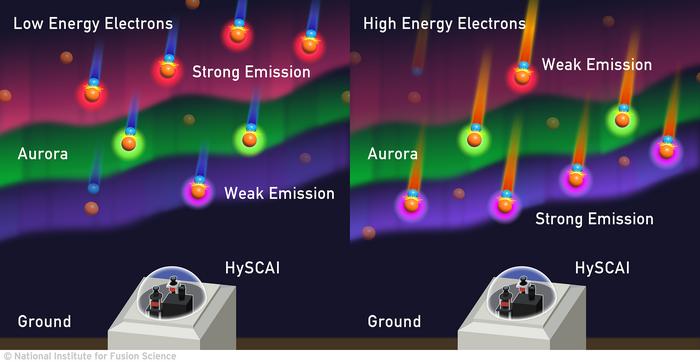
Auroras are natural luminous phenomena caused by the interaction of electrons falling from the sky and the upper atmosphere. Most of the observed light consists of emission lines of neutral or ionized nitrogen and oxygen atoms and molecular emission bands, and the color is determined by the transition energy levels, molecular vibrations and rotations. There is a variety of characteristic colors of auroras, such as green and red, but there are multiple theories about the emission process by which they appear in different types of auroras, and to understand the colors of auroras, the light must be broken down. Comprehensive (temporal and spatial) spectral observations are needed to study auroral emission processes and colors in detail.

Credit: National Institute for Fusion Science
Auroras are natural luminous phenomena caused by the interaction of electrons falling from the sky and the upper atmosphere. Most of the observed light consists of emission lines of neutral or ionized nitrogen and oxygen atoms and molecular emission bands, and the color is determined by the transition energy levels, molecular vibrations and rotations. There is a variety of characteristic colors of auroras, such as green and red, but there are multiple theories about the emission process by which they appear in different types of auroras, and to understand the colors of auroras, the light must be broken down. Comprehensive (temporal and spatial) spectral observations are needed to study auroral emission processes and colors in detail.
Complementarily, the National Institute for Fusion Science (NIFS) has been observing the emission of light from plasma in a magnetic field in the Large Helical Device (LHD). Various systems have been developed to measure the spectrum of light emitted from the plasma, and the processes of energy transport and atomic and molecular emission have been studied. By applying this technology and knowledge to auroral observations, we can contribute to the understanding of auroral luminescence and the study of the energy production process of electrons that gives rise to auroral luminescence.
Aurora observation uses optical filters to obtain images of specific colors, which has the disadvantage of a limited acquisition wavelength with low resolution. On the other hand, a hyperspectral camera has the advantage of obtaining a spatial distribution of the spectrum with high wavelength resolution. We started a plan to develop a high-sensitivity hyperspectral camera in 2018 by combining a lens spectrometer with an EMCCD camera, which had been used in the LHD, with an image-sweep optical system using galvanometer mirrors.
It took five years from the planning stage to develop a highly sensitive system capable of measuring auroras at 1kR (1 kilo-Rayleigh). In May 2023, this system was installed at KEOPS at the Swedish Space Corporation’s Esrange Space Center in Kiruna, Sweden, which is located just below the auroral belt and can observe auroras with high frequency. The system succeeded in acquiring hyperspectral images of the auroras, that is, two-dimensional images of them broken down by wavelength. Observations began in September 2023, and the data has been acquired remotely in Japan.
Auroral emission intensities and the observation positions were calibrated, based on the positions of stars obtained after installation, and the data will be made publicly available and ready to use. Using the observation data from an aurora break-up that occurred on October 20, 2023, we clarified what kind of data could be viewed using this system. In the process, we estimated the energy of electrons from the intensity ratio of light at different wavelengths, which led to the publication of this paper.
Figure 1 shows the difference in the color of the aurora when electrons arrive at low energies and speeds and when they arrive at high energies and speeds. When the electrons are slow, they emit strong red light at high altitudes. On the other hand, when the electrons are fast, they penetrate to lower altitudes and emit a strong green or purple light. Figure 2 is a two-dimensional image of auroras resolved into each color (wavelength) observed with the state-of-the-art hyperspectral camera. The different distribution by color was observed because the elements that produce the light differ according to the height at which the light is generated. Thus, we have succeeded in developing a device that can obtain two-dimensional images of the various colors produced by the aurora borealis.
From the ratio of the intensity of the red light (630nm) to the purple light (427.8nm), we can determine the energy of the incoming electrons that caused the aurora. Using the hyperspectral camera (HySCAI), which is capable of fine spectroscopy of light, the energy of the incoming electrons during the auroral explosion observed at this time was estimated to be 1600 electron volts (an energy equivalent to the voltage of about 1000 dry-cell batteries). There were no major discrepancies with previously known values, indicating that the observations were valid. The Hyperspectral Camera (HySCAI) is expected to contribute to solving important auroral issues such as the distribution of precipitating electrons, their relationship to auroral color, and the mechanism of auroral emission.
For the first time, a detailed spatial distribution of color (a two-dimensional image), a hyperspectral image of the aurora borealis, has been obtained. Many previous auroral studies have used a system in which light is selected by a filter that passes only certain wavelengths. This system compensates for the disadvantage of observing only a limited number of wavelengths. By observing detailed changes in the spectrum, it will contribute to the advancement of auroral research. On the other hand, the system will also provide insight into energy transport due to the interaction between charged particles and waves in a magnetic field, which is also attracting attention in fusion plasmas. It is expected that this interdisciplinary study will be advanced in cooperation with universities and research institutes in Japan and abroad, and will contribute to the development of worldwide aurora research.
Journal
Earth Planets and Space
Method of Research
Experimental study
Subject of Research
Not applicable
Article Title
Development of Hyperspectral Camera for Auroral Imaging
Article Publication Date
2-Aug-2024
Cite Scienmag News
Grant Pearson. (August 2, 2024). First full 2-D spectral image of aurora borealis from a hyperspectral camera. Scienmag. https://scienmag.com/first-full-2-d-spectral-image-of-aurora-borealis-from-a-hyperspectral-camera/
Grant Pearson. "First full 2-D spectral image of aurora borealis from a hyperspectral camera." Scienmag, 2 August 2024, https://scienmag.com/first-full-2-d-spectral-image-of-aurora-borealis-from-a-hyperspectral-camera/. Accessed 3 September 2026.
Grant Pearson. "First full 2-D spectral image of aurora borealis from a hyperspectral camera." Scienmag. August 2, 2024. https://scienmag.com/first-full-2-d-spectral-image-of-aurora-borealis-from-a-hyperspectral-camera/

