


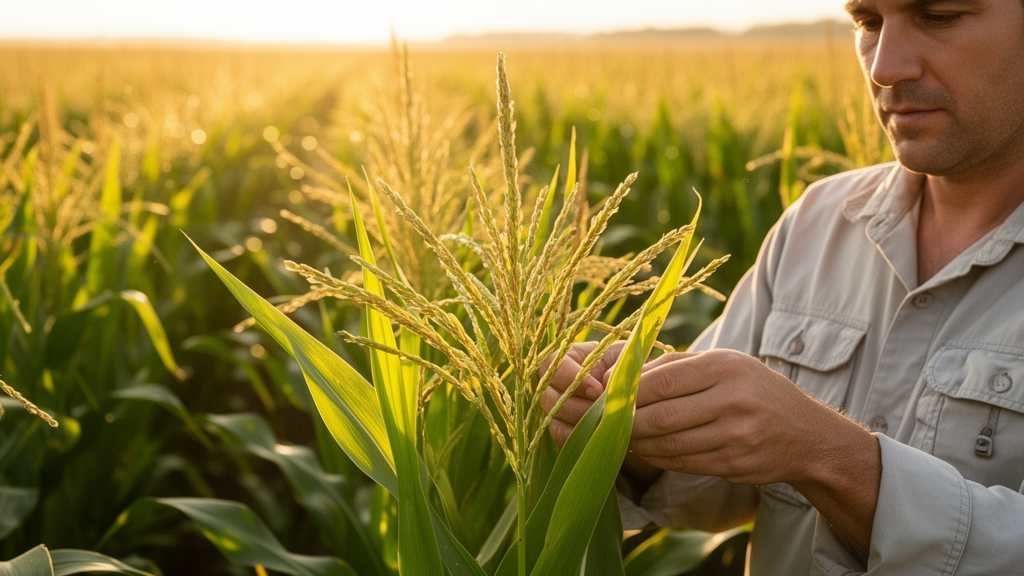
A quantitative trait locus on chromosome 3, designated qMd3, was associated with high-temperature tolerance measured by tassel desiccation in an F₂ maize population, according to the study abstract. Initial mapping consistently identified the major locus in 2015 and 2016, alongside a minor locus on chromosome 9. The two loci explained 10.72% and 5.74% of phenotypic variance, respectively.
The researchers crossed the high-temperature-tolerant inbred line PHBA6 with the high-temperature-susceptible line J63 to develop the F₂ population used for initial quantitative trait locus mapping. Tassel desiccation served as the phenotypic indicator of heat tolerance. The abstract does not provide details about the growing environments, number of plants assessed or procedures used to score desiccation, limiting assessment of environmental and replication conditions from the supplied text alone.
Fine mapping of qMd3 was subsequently conducted using advanced-generation recombinant progenies derived from the F₂ population. This work progressively narrowed the candidate interval from 59 megabases to 1.2 megabases, with the refined region bounded by the markers KASP029 and KASP032. These results identify a genomic interval associated with tassel-desiccation tolerance in the tested maize population; they do not establish qMd3 as a single-locus mechanism or identify a causal gene.
The reported variance contributions describe associations detected during the mapping experiments rather than demonstrating that qMd3 alone governs high-temperature tolerance. The abstract also does not establish effects of the locus on whole-plant survival, reproductive performance or crop yield, and it does not report performance in marker-assisted breeding programs. The narrowed interval provides a basis for subsequent identification and functional characterization of candidate genes, but the abstract does not state which genes were evaluated or whether any were confirmed to cause the associated phenotype.
Subject of Research: QTL mapping and fine mapping of high-temperature tolerance in maize tassels
Article Title: Identification of a major locus controlling high-temperature tolerance in maize tassels
Article References: Yang, J., Qin, T., Guo, Y., Abula, A., Han, D., Liang, X., Dong, Y., Lv, Y., Yang, Q., Li, M., & Zhang, X. (2026). Identification of a major locus controlling high-temperature tolerance in maize tassels. BMC Plant Biology. https://doi.org/10.1186/s12870-026-09967-9
Image Credits: AI Generated
DOI: 10.1186/s12870-026-09967-9
Keywords: maize, high-temperature stress, tassel desiccation, QTL mapping, fine mapping, chromosome 3, quantitative genetics, marker-assisted breeding, Identification, major, locus, controlling
Cite Scienmag News
Alan Morgan. (October 20, 2026). Fine mapping refines chromosome 3 QTL associated with heat tolerance in maize tassels. Scienmag. https://scienmag.com/fine-mapping-refines-chromosome-3-qtl-associated-with-heat-tolerance-in-maize-tassels/
Alan Morgan. "Fine mapping refines chromosome 3 QTL associated with heat tolerance in maize tassels." Scienmag, 20 October 2026, https://scienmag.com/fine-mapping-refines-chromosome-3-qtl-associated-with-heat-tolerance-in-maize-tassels/. Accessed 20 October 2026.
Alan Morgan. "Fine mapping refines chromosome 3 QTL associated with heat tolerance in maize tassels." Scienmag. October 20, 2026. https://scienmag.com/fine-mapping-refines-chromosome-3-qtl-associated-with-heat-tolerance-in-maize-tassels/


