


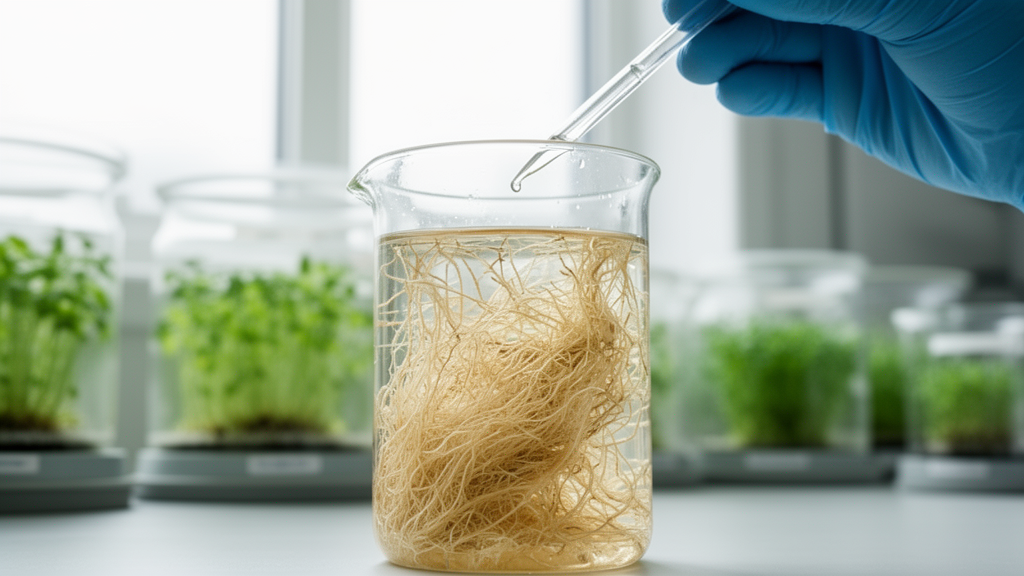
An experimental protocol study reported an optimized Agrobacterium rhizogenes-mediated hairy-root transformation system for Forsythia suspensa, a woody medicinal plant. The system achieved 95% leaf transformation efficiency when the developmental regulator FsMP was co-transformed, while supporting hairy-root induction from seedlings, stems and leaves. The abstract also reports that pairing the RUBY reporter with CRISPR/Cas9 enabled rapid and efficient gene editing in hairy roots, although it provides no comparative editing metric.
Researchers systematically assessed four key variables affecting transformation: culture medium, A. rhizogenes strain, seedling age and explant type. The selected protocol used strain K599 for infection and Hoagland-moistened vermiculite as the substrate. This combination produced successful hairy-root induction from all three explant types examined. The study did not describe the exact culture conditions, replicate numbers or statistical uncertainty in the supplied abstract, so the performance of the protocol across additional genotypes and experimental environments cannot be determined from this evidence.
Among nine developmental regulators tested, FsMP co-transformation increased leaf transformation efficiency to 95%. The abstract does not report efficiency values for the other eight regulators, meaning that 95% can be described as the reported performance of FsMP co-transformation but not as a demonstrated maximum across the full comparison. The broader objective was to reduce the low efficiency and long culture cycles associated with conventional A. tumefaciens-mediated transformation, which has hindered genomic and molecular-breeding studies in F. suspensa.
The authors characterized the resulting hairy-root system as a rapid, economical alternative to conventional tissue culture and proposed it as a platform for validating gene function and supporting molecular breeding in F. suspensa and other woody species. These are stated research conclusions rather than demonstrated field or breeding outcomes: the supplied evidence comes from an abstract and does not address genetic stability, regeneration of transformed shoots, field performance or long-term expression. The article was also identified as an early peer-reviewed version subject to further editorial changes.
Subject of Research: Optimization of hairy-root transformation and gene editing in Forsythia suspensa
Article Title: Establishment of a high-efficiency hairy root transformation system for Forsythia suspensa and enhancement of transformation efficiency by developmental regulators
Article References: Li, Q., Shao, Q., Wang, D., Zhang, N., Qiao, Y., & Song, Y. (2026). Establishment of a high-efficiency hairy root transformation system for Forsythia suspensa and enhancement of transformation efficiency by developmental regulators. BMC Plant Biology. https://doi.org/10.1186/s12870-026-09996-4
Image Credits: AI Generated
DOI: 10.1186/s12870-026-09996-4
Keywords: Forsythia suspensa, hairy-root transformation, Agrobacterium rhizogenes, FsMP, CRISPR/Cas9, RUBY reporter, leaf transformation, gene editing, woody plants, molecular breeding, Establishment, high-efficiency
Cite Scienmag News
Juliet Wilcox. (October 20, 2026). FsMP co-transformation achieves 95% leaf transformation in optimized Forsythia hairy-root protocol. Scienmag. https://scienmag.com/fsmp-co-transformation-achieves-95-leaf-transformation-in-optimized-forsythia-hairy-root-protocol/
Juliet Wilcox. "FsMP co-transformation achieves 95% leaf transformation in optimized Forsythia hairy-root protocol." Scienmag, 20 October 2026, https://scienmag.com/fsmp-co-transformation-achieves-95-leaf-transformation-in-optimized-forsythia-hairy-root-protocol/. Accessed 20 October 2026.
Juliet Wilcox. "FsMP co-transformation achieves 95% leaf transformation in optimized Forsythia hairy-root protocol." Scienmag. October 20, 2026. https://scienmag.com/fsmp-co-transformation-achieves-95-leaf-transformation-in-optimized-forsythia-hairy-root-protocol/


