


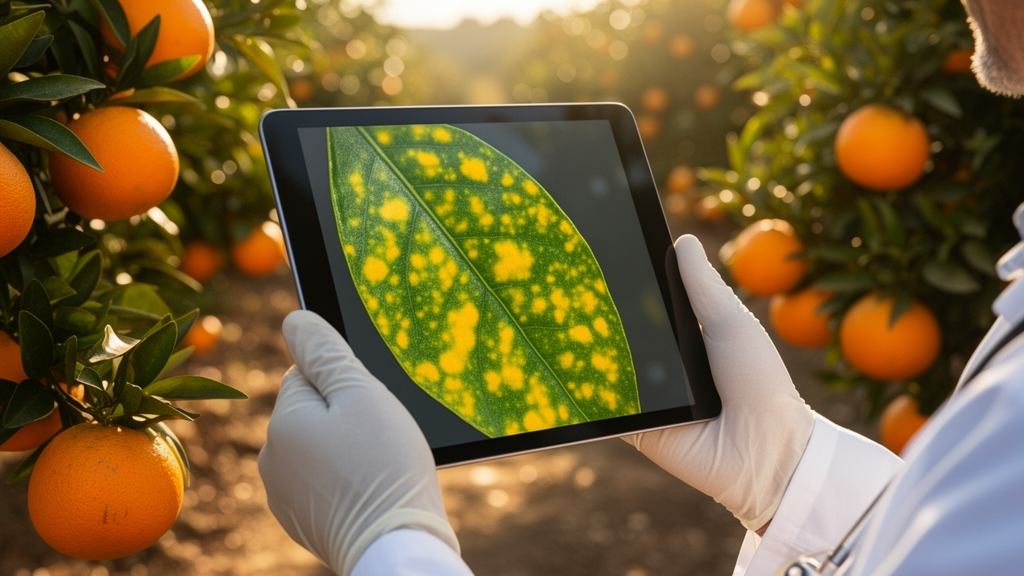
A leakage-controlled experimental study of 1,090 orange fruit images found that a Vision Transformer combined with principal component analysis and a support vector machine achieved the highest mean classification accuracy among 32 evaluated configurations. The ViT + PCA + SVM pipeline reached 99.12% ± 0.71% accuracy over 25 cross-validation partitions, outperforming the strongest CNN configuration, DenseNet201 + PCA + SVM, at 98.48% ± 0.81%.
The study used a publicly available Kaggle dataset containing images divided among four classes: Black Spot, Canker, Fresh and Greening. It evaluated eight fixed feature extractors—seven convolutional neural networks and a ViT-S/16 Vision Transformer—together with four classical classifiers: SVM, k-nearest neighbors, random forest and XGBoost. All image models were evaluated using the same dataset splits, preprocessing and metrics under 5 × 5 repeated stratified cross-validation, comprising five repeats of five folds with an 80:20 class-stratified train-test ratio in each fold.
To prevent information from held-out images entering the dimensionality-reduction stage, researchers fitted PCA separately on the training-fold features in every iteration and then applied the resulting transformation to the corresponding test fold without refitting it. The researchers used a target of retaining 98% of feature variance. A sensitivity analysis found that mean accuracy plateaued across the 95%–98% range and did not improve at 99%, supporting the selected threshold.
Across the 32 backbone-classifier combinations, SVM was consistently the strongest or nearly strongest classifier after PCA reduction. For ViT features, SVM significantly outperformed k-nearest neighbors, random forest and XGBoost, with all reported comparisons having p < 0.001. Paired tests across the 25 matched partitions also found that the ViT + PCA + SVM combination significantly outperformed DenseNet201 + PCA + SVM (p < 0.001) and EfficientNetB0 + PCA + SVM (p = 0.004).
The class-level results for the proposed ViT pipeline were not limited to the two easiest categories. Aggregated over the 25 held-out folds, F1-scores were 97.70% for Black Spot and 97.63% for Canker, compared with 99.97% for Fresh and 100.00% for Greening. The two visually similar disease classes therefore had somewhat lower, though still high, F1-scores than the other categories.
Ablation tests indicated that PCA’s main measured contribution was feature reduction rather than an increase in accuracy. For ViT, retaining 98% of variance required an average of 170 of 384 components, a reduction of about 55.7%. ViT + PCA + SVM was statistically indistinguishable from ViT features without PCA (99.01% ± 0.62%; p = 0.16) and from SVM applied to the full 384-dimensional feature space (99.12% ± 0.69%; p ≈ 1.0). The corresponding ablation for DenseNet201 produced a larger reduction, about 76.6%, while the complete pipeline did not significantly differ from unreduced DenseNet201 features (p = 0.25).
Explainability analyses used occlusion sensitivity and SHAP for the ViT configuration, while DenseNet201 was assessed with Grad-CAM and SHAP because the study states that Grad-CAM is not directly applicable to transformer attention. ViT occlusion maps showed high sensitivity in localized fruit-surface regions for Fresh and Canker, distributed sensitivity across the lower half of the fruit for Greening, and sensitivity around visible dark spots for Black Spot. SHAP summaries showed contributions distributed across multiple principal components, with both positive and negative values. These representative examples indicated reliance on fruit-surface evidence, although some ViT maps also showed sensitivity near image borders.
The computational benchmark also distinguished accuracy from model size. ViT had 21.67 million parameters and an approximate size of 82.6 MB, while DenseNet201 had 18.32 million parameters and an approximate size of 69.9 MB. The measured mean inference time was 99.07 ms for ViT and 118.66 ms for DenseNet201. EfficientNetB0 and MobileNetV2 were substantially smaller, with 4.05 million and 2.26 million parameters, respectively.
The findings are bounded by the dataset’s modest size and single public source. The 1,090 field or orchard photographs were whole intact fruit, but their repository did not provide original per-image acquisition details such as camera device, precise orchard location or controlled-versus-field capture conditions. The images also may not represent the full variation in cultivars, growing regions, lighting and sensors encountered elsewhere. The authors therefore characterized the reported accuracies as indicative rather than conclusive and identified validation on independently collected, multisource imagery as necessary future work.
Subject of Research: Experimental benchmarking of PCA and SVM classifiers with deep image features for four-class orange fruit disease classification
Article Title: A PCA-based deep feature optimization framework for explainable orange fruit disease classification
Article References: Hingmire, A., Golande, A., Bhutnal, V., Pande, S. D., & Pande, T. (2026). A PCA-based deep feature optimization framework for explainable orange fruit disease classification. BMC Plant Biology, 26(1), Article 1746. https://doi.org/10.1186/s12870-026-09984-8
Image Credits: AI Generated
DOI: 10.1186/s12870-026-09984-8
Keywords: orange diseases, image classification, Vision Transformer, principal component analysis, support vector machine, explainable AI, cross-validation, DeepNet201, computer vision, fruit disease dataset, PCA-based, deep
Cite Scienmag News
Alan Morgan. (October 20, 2026). Single-dataset orange image benchmark reports 99.12% accuracy with ViT, PCA and SVM. Scienmag. https://scienmag.com/single-dataset-orange-image-benchmark-reports-99-12-accuracy-with-vit-pca-and-svm/
Alan Morgan. "Single-dataset orange image benchmark reports 99.12% accuracy with ViT, PCA and SVM." Scienmag, 20 October 2026, https://scienmag.com/single-dataset-orange-image-benchmark-reports-99-12-accuracy-with-vit-pca-and-svm/. Accessed 20 October 2026.
Alan Morgan. "Single-dataset orange image benchmark reports 99.12% accuracy with ViT, PCA and SVM." Scienmag. October 20, 2026. https://scienmag.com/single-dataset-orange-image-benchmark-reports-99-12-accuracy-with-vit-pca-and-svm/


