

Tuesday, October 20, 2026
Science
No Result
View All Result
  • Login
  • HOME
  • SCIENCE NEWS
  • CONTACT US
  • HOME
  • SCIENCE NEWS
  • CONTACT US
No Result
View All Result
Scienmag
No Result
View All Result
Home Science News Science Education

Assessment profiles in undergraduate dental anatomy education: a five-year retrospective analysis with implications for future AI-supported question Bank Development

October 20, 2026
in Science Education
Courtney Benton
By Courtney Benton Scienmag Editorial Profile - Science and Technology Policy
Reading Time: 2 mins read
0
Five Years of Dental Anatomy Exam Data Reveal What AI Question Banks Must Overcome

Five Years of Dental Anatomy Exam Data Reveal What AI Question Banks Must Overcome

65
SHARES
587
VIEWS
Share on FacebookShare on Twitter
ADVERTISEMENT

A five-year retrospective analysis of undergraduate dental anatomy final examinations found significant year-to-year variation in assessment scores, according to the study’s abstract. The analysis included 1,216 eligible records from first- and second-year courses across the 2021–2022 through 2025–2026 academic years. Overall mean final examination performance was 63.91 ± 20.00, with a median score of 66.0. Scores differed significantly across academic years (p < 0.001), while the numerical advantage for second-year students was not statistically significant (p = 0.072).

The researchers analysed archived individual-level final examination records from first- and second-year undergraduate dental anatomy courses. They treated scores both as continuous variables and as categories assigned to predefined achievement bands. Class-level differences, variation between academic years and achievement-band distributions were evaluated through non-parametric and categorical statistical analyses. The eligible dataset comprised 666 first-year records and 550 second-year records. Artificial-intelligence-generated questions were not administered to students and did not contribute to grades, so the study did not test the performance or educational effects of an AI-assisted question bank.

The abstract reports that 2021–2022 performance was elevated relative to the other academic years in the dataset. This pattern coincided with pandemic-era online assessment conditions, but the available analysis cannot establish that the online examination format caused the higher scores. The findings therefore document longitudinal variation rather than a demonstrated causal effect of assessment format. Likewise, the absence of a statistically significant class-level difference does not establish that the two years achieved equivalent performance; it indicates that the observed numerical difference was not significant in the analysis.

Researchers described the results as a local retrospective assessment baseline that could inform future work on AI-assisted question bank development. The abstract also identifies prospective item-level psychometric validation and expert review as necessary before AI-assisted items are used in student assessment. Because the supplied evidence is limited to the study abstract, detailed information about the institution, examination content, achievement-band thresholds, statistical procedures and other methodological parameters cannot be verified from the available material. The study is a retrospective analysis of existing examination records, not a clinical trial, review, simulation or animal or cell study, and it provides no evidence that AI-generated questions improve dental students’ learning or performance.

Subject of Research: Five-year retrospective analysis of undergraduate dental anatomy examination performance and implications for AI-assisted question bank development.

Article Title: Assessment profiles in undergraduate dental anatomy education: a five-year retrospective analysis with implications for future AI-supported question Bank Development

Article References: Kiliç Şafak, N., & Karaca Bozdağ, Z. (2026). Assessment profiles in undergraduate dental anatomy education: a five-year retrospective analysis with implications for future AI-supported question Bank Development. BMC Medical Education. https://doi.org/10.1186/s12909-026-10422-4

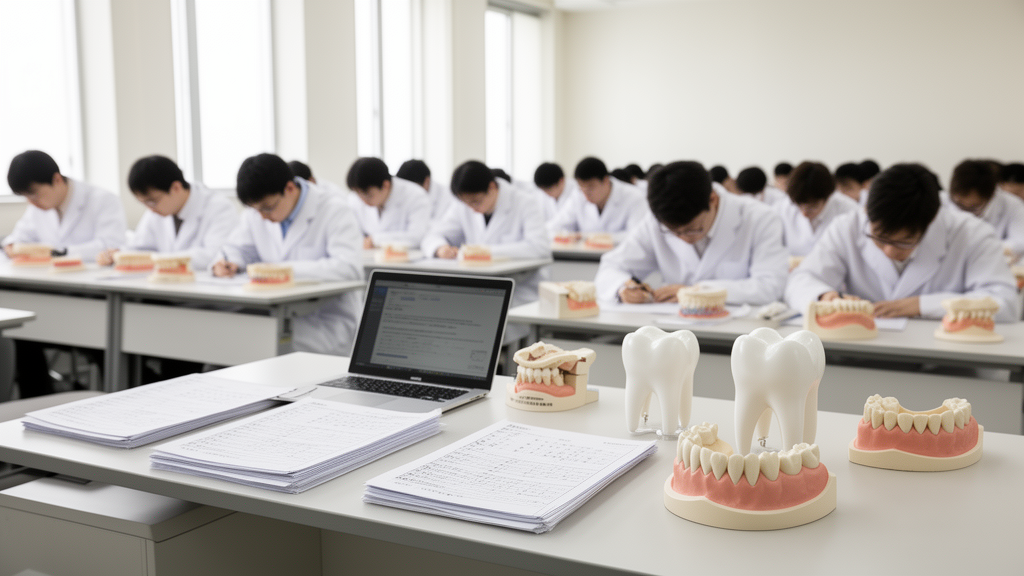
Image Credits: AI Generated

DOI: 10.1186/s12909-026-10422-4

Keywords: dental anatomy, undergraduate education, retrospective analysis, assessment profiles, examination scores, longitudinal variation, artificial intelligence, question banks, psychometric validation, Assessment, profiles, undergraduate

Cite Scienmag News

Courtney Benton. (October 20, 2026). Assessment profiles in undergraduate dental anatomy education: a five-year retrospective analysis with implications for future AI-supported question Bank Development. Scienmag. https://scienmag.com/assessment-profiles-in-undergraduate-dental-anatomy-education-a-five-year-retrospective-analysis-with-implications-for-future-ai-supported-question-bank-development/


Courtney Benton. "Assessment profiles in undergraduate dental anatomy education: a five-year retrospective analysis with implications for future AI-supported question Bank Development." Scienmag, 20 October 2026, https://scienmag.com/assessment-profiles-in-undergraduate-dental-anatomy-education-a-five-year-retrospective-analysis-with-implications-for-future-ai-supported-question-bank-development/. Accessed 20 October 2026.

Courtney Benton. "Assessment profiles in undergraduate dental anatomy education: a five-year retrospective analysis with implications for future AI-supported question Bank Development." Scienmag. October 20, 2026. https://scienmag.com/assessment-profiles-in-undergraduate-dental-anatomy-education-a-five-year-retrospective-analysis-with-implications-for-future-ai-supported-question-bank-development/

Tags: achievement band categorizationanalysis of first- and second-year dental studentsArtificial Intelligenceassessmentassessment profilesdata-driven improvements in dental curriculumdental anatomydental anatomy assessmenteducational assessment trends in dentistryexamination scoresimpact of pandemic on dental exam performanceimplications for AI-supported question bank developmentlongitudinal variationonline assessments during pandemicProfilespsychometric validationquestion banksretrospective analysisretrospective analysis of exam scoresstatistical analysis of dental exam resultsundergraduateundergraduate dental educationundergraduate educationyear-to-year variation in student performance
Share26Tweet16
Previous Post

Scoping review maps trust across firsthand and secondhand human-AI communication

Next Post

Analogical role-play for teaching the OSI model in undergraduate computing education

Related Posts

Students Act Out Networking Layers to Learn the Invisible OSI Model
Science Education

Analogical role-play for teaching the OSI model in undergraduate computing education

October 20, 2026
Accreditation and Exam Participation Make Residency Programs More Popular, Japanese Study Finds
Science Education

Accreditation, in-training exam participation and other hospital traits associated with Japanese residency popularity

October 20, 2026
Campus Crisis: Scoping Review Exposes Gaps in Tackling Gender-Based Violence at African Universities
Science Education

Scoping review finds uneven implementation of gender-based violence responses in Sub-Saharan African universities

October 20, 2026
New C-Flex Framework Aims to Fix the Flipped Classroom’s Biggest Blind Spots
Science Education

Conceptual review proposes C-Flex framework for collaborative, equitable flipped learning

October 20, 2026
Virtual OSCE Passes Its First Real Test in Emergency Medicine Training
Science Education

From paper to pixels: a pilot evaluation of the validity and reliability of virtual objective structured clinical examination in emergency medicine training

October 20, 2026
Medical School Admissions Tests Show Distinct Links to Student Awards, Study Finds
Science Education

Retrospective single-school study links selected admissions assessments with medical school awards

October 20, 2026
Next Post
Students Act Out Networking Layers to Learn the Invisible OSI Model

Analogical role-play for teaching the OSI model in undergraduate computing education

  • Mothers who receive childcare support from maternal grandparents show more optimized

    Mothers who receive childcare support from maternal grandparents show more parental warmth, finds NTU Singapore study

    27656 shares
    Share 11059 Tweet 6912
  • University of Seville Breaks 120-Year-Old Mystery, Revises a Key Einstein Concept

    1061 shares
    Share 424 Tweet 265
  • Bee body mass, pathogens and local climate influence heat tolerance

    682 shares
    Share 273 Tweet 171
  • Researchers record first-ever images and data of a shark experiencing a boat strike

    546 shares
    Share 218 Tweet 137
  • Groundbreaking Clinical Trial Reveals Lubiprostone Enhances Kidney Function

    531 shares
    Share 212 Tweet 133
Science

Embark on a thrilling journey of discovery with Scienmag.com—your ultimate source for cutting-edge breakthroughs. Immerse yourself in a world where curiosity knows no limits and tomorrow’s possibilities become today’s reality!

RECENT NEWS

  • Lab-on-chip measures C-type natriuretic peptide in patient blood, saliva and urine
  • 2022 US survey links cancer, immunosuppression and care access to influenza vaccination
  • Mahabad Dam modeling study reports 80% lower mean absolute error for total nitrogen predictions
  • Analogical role-play for teaching the OSI model in undergraduate computing education

Categories

  • Agriculture
  • Anthropology
  • Archaeology
  • Athmospheric
  • Biology
  • Biotechnology
  • Blog
  • Bussines
  • Cancer
  • Chemistry
  • Climate
  • Earth Science
  • Editorial Policy
  • Marine
  • Mathematics
  • Medicine
  • Pediatry
  • Policy
  • Psychology & Psychiatry
  • Science Education
  • Science News
  • Social Science
  • Space
  • Technology and Engineering

Subscribe to Blog via Email

Enter your email address to subscribe to this blog and receive notifications of new posts by email.

Join 5,150 other subscribers

© 2025 Scienmag - Science Magazine

Welcome Back!

Login to your account below

Forgotten Password?

Retrieve your password

Please enter your username or email address to reset your password.

Log In
No Result
View All Result
  • HOME
  • SCIENCE NEWS
  • CONTACT US

© 2025 Scienmag - Science Magazine

Discover more from Science

Subscribe now to keep reading and get access to the full archive.

Continue reading