


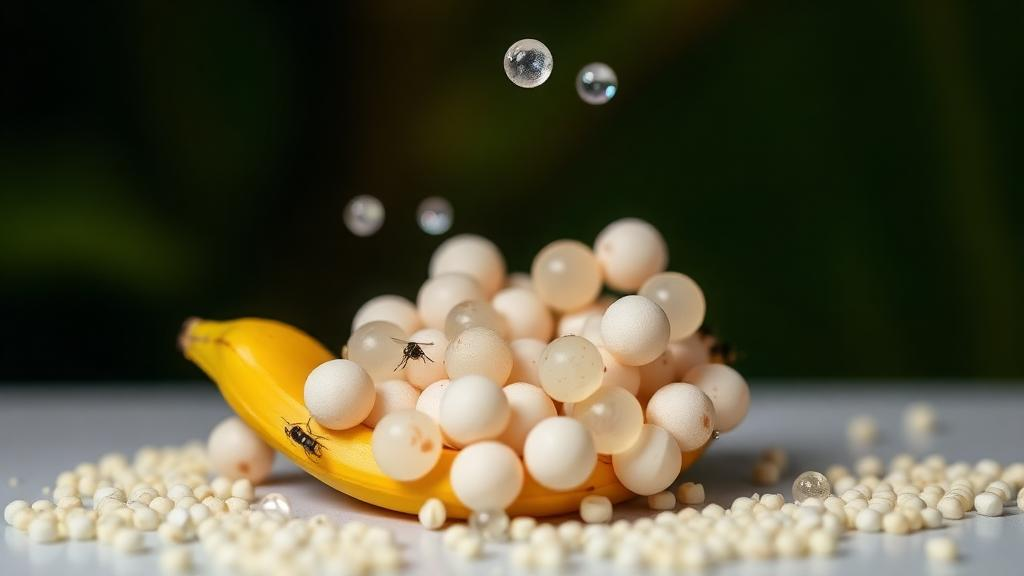
In a finding that could reshape how growers monitor one of the world’s most familiar insects, researchers in Thailand have transformed discarded banana peels and other fruit waste into a powerful, eco-friendly attractant for the vinegar fly Drosophila melanogaster. The study, published in Frontiers in Insect Science, shows that simply letting fruit waste ferment for seven days dramatically increases its appeal to the flies—and that encapsulating the fermented juice in biodegradable sodium alginate beads boosts attraction under greenhouse conditions to nearly 83 percent. The work offers a rare triple win: it valorizes food waste, reduces reliance on synthetic pesticides, and provides an affordable tool for sustainable pest management aligned with several United Nations Sustainable Development Goals.
Drosophila melanogaster, commonly known as the vinegar fly or common fruit fly, is best celebrated as the workhorse of genetics laboratories. But beyond the lab bench, it is a cosmopolitan, fruit-associated insect that thrives on ripe, overripe, damaged, and fermenting fruits. Adults are strongly drawn to fermentation odors—volatile compounds produced by microbial activity—which serve as critical cues for locating feeding and reproductive substrates. Under favorable summer conditions, the flies can complete development in roughly seven to eight days, and females may lay several hundred eggs over their lifespan, allowing populations to explode wherever fermenting organic material is continuously available. In vineyards and fruit markets, this translates into contamination, postharvest deterioration, and involvement in disease complexes such as grape sour rot, where the flies facilitate microbial transmission.
It is important to distinguish the pest status of D. melanogaster from that of its notorious relative Drosophila suzukii, the spotted wing drosophila. While D. suzukii females possess a serrated ovipositor that lets them pierce the skin of intact, ripening soft-skinned fruit and deposit eggs beneath the surface—directly damaging marketable produce—D. melanogaster primarily exploits fruit that has already undergone ripening, physical damage, fermentation, or microbial deterioration. Its agricultural importance lies more in damaged and fermenting fruit, postharvest losses, contamination, and interactions with fruit-spoilage microorganisms. Still, monitoring and managing vinegar fly populations remains essential for reducing contamination and spoilage in susceptible production systems, and the new attractant could serve as a low-cost monitoring and mass-trapping tool.
Conventional management of vinegar flies relies on sanitation, removal of overripe fruit, exclusion, trapping, and, when necessary, insecticide applications. But repeated dependence on chemical insecticides raises well-documented concerns: resistance development, environmental contamination, residues, and harm to beneficial and non-target organisms. Chemical control may also prove insufficient where abundant fermenting substrates continuously provide feeding and breeding resources. These limitations have fueled interest in attractant-based strategies that exploit the natural olfactory behavior of fruit flies. Olfaction is central to the ecology of D. melanogaster—adults use volatile organic compounds (VOCs) to locate food, substrates, and oviposition sites, and fermentation-associated odors are particularly powerful because microbial fermentation generates complex mixtures of alcohols, esters, acids, aldehydes, and ketones.
The research team, led by Kannan Swathy, Perumal Vivekanandhan, and Patcharin Krutmuang at Chiang Mai University, collected fruit waste from banana, pineapple, mango, guava, and papaya at a local market in Chiang Mai, Thailand. The wastes were homogenized with sterile deionized water at a 1:1 ratio, filtered to obtain clarified extracts, and subjected to spontaneous fermentation by indigenous microorganisms for 0, 1, 3, 5, and 7 days. Multiple-choice bioassays in screened cages then evaluated the attraction of adult D. melanogaster to each fermented juice against a sterile water control. Across all fruit substrates, fermentation duration significantly enhanced attraction, with fermented treatments generally outperforming fresh juices. Banana juice fermented for seven days elicited the highest attraction rate of 34.07 percent—a statistically robust result (F(5,12) = 121.331; p < 0.001)—followed by pineapple at 26.30 percent, mango at 22.22 percent, guava at 20.37 percent, and papaya at 18.15 percent.
To understand why fermented banana juice performed so well, the researchers isolated and identified the microorganisms driving the fermentation. Using morphological characterization and molecular barcoding—the internal transcribed spacer (ITS) region for yeast and the 16S rRNA gene for bacteria—they identified three key players: the yeast Saccharomyces cerevisiae, the lactic acid bacterium Lactiplantibacillus plantarum, and the acetic acid bacterium Acetobacter aceti. Phylogenetic analysis with 1,000 bootstrap replicates confirmed the taxonomic placement of all three isolates, and BLASTn searches showed 100 percent sequence similarity with reference strains in the NCBI GenBank database. These microorganisms are classic fermenters: S. cerevisiae drives alcoholic fermentation and produces ethanol plus numerous volatile metabolites, while lactic and acetic acid bacteria modify organic acid concentrations and other physicochemical properties of the substrate.
Gas chromatography–mass spectrometry (GC–MS) profiling revealed that fermentation substantially diversified the volatile and semi-volatile chemical profile of banana waste juice. The fresh juice yielded 23 tentatively identified compounds, dominated by phytosterols such as γ-sitosterol and fatty acids like n-hexadecanoic acid. The seven-day fermented juice yielded 27 compounds, including elevated levels of D-limonene, phenol, ethyl 2,3-epoxybutyrate, and 2-propenoic acid, 6-methylheptyl ester, along with phenolic derivatives, esters, and organic acids. The researchers emphasize that detection of a compound by GC–MS does not establish its function as an attractant—behavioral assays are required to evaluate biological relevance. Nevertheless, the correlation between the enriched VOC profile and the increased fly attraction suggests that fermentation-associated biochemical changes enhanced the production and release of olfactory cues.
The most promising fermented banana juice was then encapsulated in biodegradable sodium alginate–carboxymethyl cellulose (CMC) hydrogel beads for controlled release. Sodium alginate forms hydrogels through calcium-mediated ionic crosslinking, while CMC acts as a viscosity-modifying and structural stabilizing agent to improve bead integrity and regulate compound diffusion. The polymer blend was extruded dropwise into a calcium chloride solution to induce ionic crosslinking and form spherical hydrogel beads, which were cured, washed, air-dried, and stored at 4 °C. Under greenhouse conditions maintained at 30 ± 2 °C with 65–75 percent relative humidity, beads loaded with seven-day fermented banana juice achieved a remarkable attraction rate of 82.96 percent (F(2,6) = 358.183; p < 0.001), substantially outperforming beads loaded with fresh juice and the distilled water control. The results confirm that the fermented attractant retained its behavioral activity after encapsulation and that the bead-based delivery system may effectively release fermentation-associated volatile compounds.
To probe the molecular basis of attraction, the team performed molecular docking analysis against the odorant-binding protein dmelOBP28a of D. melanogaster (PDB ID: 6QQ4), a soluble protein within the sensillar lymph that binds and transports hydrophobic odorant molecules to olfactory receptors. Docking simulations using the CB-Dock2 web server with the AutoDock Vina algorithm identified five candidate binding pockets on the protein. The branched fatty acid ester 2-propenoic acid, 6-methylheptyl ester exhibited the strongest predicted binding affinity, with a Vina score of −6.7 kcal/mol, followed by D-limonene at −6.5 kcal/mol and ethyl 2,3-epoxybutyrate at −5.0 kcal/mol. The most favorable binding energy converged with the largest cavity volume (1468 ų), a deep, elongated hydrophobic cavity lined predominantly by aliphatic residues—Leu7, Leu10, Met31, Met50, Ile55, Leu62, Ala66, Ala71, Tyr74, Ala85, Leu86, Ile88, Phe112, Ala116, Leu121, and Leu122—capable of accommodating long-chain lipophilic molecules, with polar and charged residues at the pocket entrance likely engaging the acrylate carbonyl head group.
The authors caution that docking scores represent computational predictions rather than experimentally measured binding affinities or biological activity, and that the behavioral assays evaluated complex fruit-juice formulations rather than purified compounds—so the findings cannot establish that D-limonene or any individual ester directly caused the observed attraction. Instead, these compounds should be considered candidate attractant constituents for further investigation. The study also did not directly evaluate reductions in fruit infestation or postharvest fruit losses, and the optimized formulation was tested only under controlled greenhouse conditions; performance may differ under field conditions due to variations in temperature, humidity, airflow, and competing environmental odors. Future research should focus on electrophysiological and behavioral validation of candidate VOCs using electroantennography and olfactometer assays, optimization of VOC combinations and bead formulations to improve release characteristics and attractant longevity, and multi-site field trials to evaluate efficacy, environmental stability, and practical applicability within integrated pest management programs. Nevertheless, by combining microbial fermentation, chemical ecology, computational docking, and controlled-release formulation, the study demonstrates that fermented fruit waste—particularly banana waste—can be developed into an affordable and environmentally friendly fruit fly attractant, advancing waste-valorization approaches for sustainable insect pest management.
Subject of Research: Development of fermented fruit waste attractants and controlled-release beads for sustainable Drosophila melanogaster management
Article Title: Fermented fruit waste extract-loaded sodium alginate beads for the sustainable management of Drosophila melanogaster (Diptera: Drosophilidae)
Article References: Swathy, K., Vivekanandhan, P., & Krutmuang, P. (2026). Fermented fruit waste extract-loaded sodium alginate beads for the sustainable management of Drosophila melanogaster (Diptera: Drosophilidae). Frontiers in Insect Science, 6, Article 1933666. https://doi.org/10.3389/finsc.2026.1933666
Image Credits: AI Generated
DOI: 10.3389/finsc.2026.1933666
Keywords: Drosophila melanogaster, fermented fruit waste, banana waste, sodium alginate beads, volatile organic compounds, Saccharomyces cerevisiae, Lactiplantibacillus plantarum, Acetobacter aceti, molecular docking, dmelOBP28a, controlled-release formulation, sustainable pest management
Cite Scienmag News
Morgan Morrow. (October 15, 2026). Fermented Banana Waste Turned Into Biodegradable Beads That Lure Fruit Flies. Scienmag. https://scienmag.com/fermented-banana-waste-turned-into-biodegradable-beads-that-lure-fruit-flies/
Morgan Morrow. "Fermented Banana Waste Turned Into Biodegradable Beads That Lure Fruit Flies." Scienmag, 15 October 2026, https://scienmag.com/fermented-banana-waste-turned-into-biodegradable-beads-that-lure-fruit-flies/. Accessed 15 October 2026.
Morgan Morrow. "Fermented Banana Waste Turned Into Biodegradable Beads That Lure Fruit Flies." Scienmag. October 15, 2026. https://scienmag.com/fermented-banana-waste-turned-into-biodegradable-beads-that-lure-fruit-flies/


