


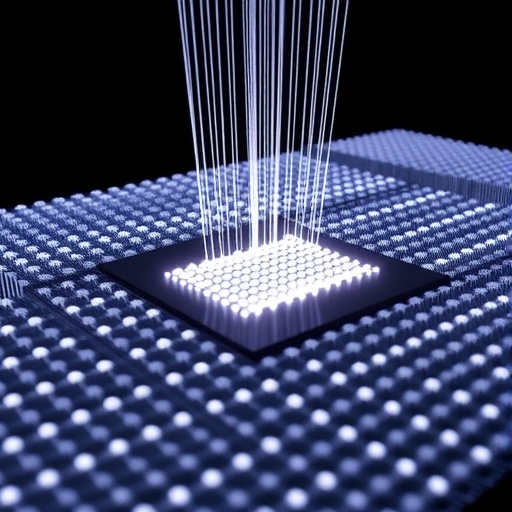
Researchers have unveiled a groundbreaking advancement in the field of single-photon detection technology, introducing a novel dielectric grating design that harnesses Fano resonance to dramatically enhance the performance of superconducting nanowire single-photon detectors (SNSPDs). This transformative approach presents an ultralow-filling-factor detector that achieves unprecedented sensitivity and efficiency compared to conventional designs. Positioned at the forefront of quantum sensing and photonics research, the innovation promises sweeping impacts across quantum computing, secure communications, and fundamental physics research relying on photon detection.
SNSPDs have been critical instruments in detecting single photons with near-ideal timing resolution and low dark counts. However, their performance is inherently limited by the trade-offs in filling factor—the ratio of the active superconducting area to the total device area. Traditional nanowire designs with higher filling factors tend to maximize photon absorption but increase kinetic inductance and limit speed. Conversely, low-filling-factor designs, which offer faster recovery time and reduced device noise, often sacrifice detection efficiency due to diminished absorption cross-section.
In this pioneering study, the research team led by Zheng, Wei, Huang, and colleagues has engineered a dielectric grating structure capable of elevating photon absorption through carefully tailored Fano resonance effects. Fano resonance arises from the interference between a broad spectral continuum and a discrete resonance state, producing asymmetric and sharply peaked spectral features. By designing the grating to induce such resonance near the operational wavelength of the SNSPD, the device achieves enhanced electromagnetic field confinement and increased photon interaction with the superconducting nanowire.
The key to this enhancement lies in the subwavelength periodic patterning of the dielectric layer atop the superconducting nanowires. This grating serves as an optical antenna that channels incident photons into highly resonant modes, significantly concentrating the optical field intensity where it couples effectively to the sensor. As a result, even an ultralow filling factor, far below that used in traditional SNSPD geometries, can deliver detection efficiencies that rival or surpass current state-of-the-art devices.
From a materials science perspective, the researchers employed high-index dielectric materials with exceptionally low optical losses, ensuring minimal dissipation of resonant modes. This novel integration of dielectric gratings with superconducting films required meticulous fabrication techniques capable of producing uniform nanoscale features. The interplay between the dielectric environment and superconducting nanowire morphology was optimized through iterative electromagnetic simulations, including finite-difference time-domain (FDTD) methods, to maximize the resonance effect precisely at the targeted operational wavelengths.
The experimental validation of these devices showcases dramatically improved quantum efficiency, even at extremely low filling factors—below 20%—which is seldom achieved in commercial SNSPDs. This performance gain translates into faster detector reset times due to reduced kinetic inductance, enabling higher count rates without sacrificing sensitivity. Additionally, the refined optical design reduces polarization dependence, improving reliability in systems where photon polarization states fluctuate or remain uncontrolled.
Beyond efficiency improvements, the Fano-resonance-enhanced dielectric grating offers enhanced tunability across different wavelength regimes by adjusting the grating period and dielectric thickness. This opens pathways for customizing SNSPDs to meet the demands of emerging applications in telecommunications, where detection in the near-infrared regime is crucial, as well as in the visible spectrum for biomedical imaging and quantum optics experiments.
The implications for quantum technologies are profound. High-performance SNSPDs underpin many quantum key distribution (QKD) systems, and the ability to engineer ultralow-filling-factor detectors with enhanced absorption can significantly improve the fidelity and scalability of secure quantum communication networks. Moreover, the combination of faster operation speeds and enhanced efficiency aligns with the increasing requirements for temporal resolution and low noise in quantum computing hardware reliant on photonic qubits.
In addition to advancing photon detection, the underlying principles demonstrated by Fano resonance engineering in dielectric gratings could inspire broader innovations in photonic device design. Such resonant structures may be adapted for sensor applications where enhanced light-matter interaction is pivotal, including biosensing, nonlinear optics, and laser cavity engineering. The cross-disciplinary impact stems from achieving precise optical control using relatively simple and scalable fabrication methods.
Crucially, this research highlights the importance of synergizing optical physics concepts with materials science and nanofabrication expertise to solve pressing challenges in photodetection. By moving beyond incremental improvements to embrace fundamentally new resonance mechanisms, the study sets a new benchmark for SNSPD performance metrics, challenging the community to rethink how nanostructured elements can shape device functionalities.
Looking ahead, further optimizations could explore integrating these dielectric gratings with emerging high-temperature superconducting materials or novel two-dimensional superconductors, broadening operational regimes and simplifying cooling requirements. Additionally, combining this approach with multiplexed SNSPD arrays could revolutionize photon-counting capabilities in large-scale quantum sensor networks.
From a practical standpoint, the compatibility of these dielectric gratings with existing photonic integrated circuit platforms suggests potential for seamless incorporation into complex optical systems. This alignment accelerates the translation of laboratory breakthroughs into deployable technologies for real-world quantum instrumentation, telecommunication, and even space-based sensing where minimal detector footprint and efficiency are paramount.
The study’s comprehensive methodology, incorporating both theoretical simulations and experimental verification, provides a robust framework for future device engineering. The precise control over Fano resonance exemplified here serves as a new design paradigm, balancing light absorption and superconducting active area to unlock detector performance hitherto considered unattainable with traditional approaches.
In summary, the inventive design of Fano-resonance-enhanced dielectric gratings for ultralow-filling-factor superconducting nanowire single-photon detectors addresses a critical bottleneck in quantum photonic detection. By leveraging the subtle interference effects responsible for Fano resonance, the team achieves an elegant solution that preserves high detection efficiency while enabling faster response times and reduced detector noise. This leap forward opens exciting new avenues in photonic quantum technologies and beyond, heralding a new era of advanced optical sensing capabilities.
Cite Scienmag News
Katie Riggs. (June 20, 2026). Fano-Enhanced Dielectric Grating Boosts Nanowire Detectors. Scienmag. https://scienmag.com/fano-enhanced-dielectric-grating-boosts-nanowire-detectors/
Katie Riggs. "Fano-Enhanced Dielectric Grating Boosts Nanowire Detectors." Scienmag, 20 June 2026, https://scienmag.com/fano-enhanced-dielectric-grating-boosts-nanowire-detectors/. Accessed 3 September 2026.
Katie Riggs. "Fano-Enhanced Dielectric Grating Boosts Nanowire Detectors." Scienmag. June 20, 2026. https://scienmag.com/fano-enhanced-dielectric-grating-boosts-nanowire-detectors/


