


From ancient texts we know that – for their times – the ancient Egyptians were exceptionally skilled at medicine. For example, they could identify, describe, and treat diseases and traumatic injuries, build protheses, and put in dental fillings. Other conditions, like cancer, they couldn’t treat – but they might have tried.

Credit: Tondini, Isidro, Camarós, 2024.
From ancient texts we know that – for their times – the ancient Egyptians were exceptionally skilled at medicine. For example, they could identify, describe, and treat diseases and traumatic injuries, build protheses, and put in dental fillings. Other conditions, like cancer, they couldn’t treat – but they might have tried.
Examining the limits of traumatological and oncological treatments in ancient Egypt, an international team of researchers has now studied two human skulls, each thousands of years old.
“We see that although ancient Egyptians were able to deal with complex cranial fractures, cancer was still a medical knowledge frontier,” said Tatiana Tondini, a researcher at the University of Tübingen and first author of the study published in Frontiers in Medicine.
“This finding is unique evidence of how ancient Egyptian medicine would have tried to deal with or explore cancer more than 4,000 years ago,” added the study’s lead author, Prof Edgard Camarós, a paleopathologist at the University of Santiago de Compostela. “This is an extraordinary new perspective in our understanding of the history of medicine.”
Cutting away cancer
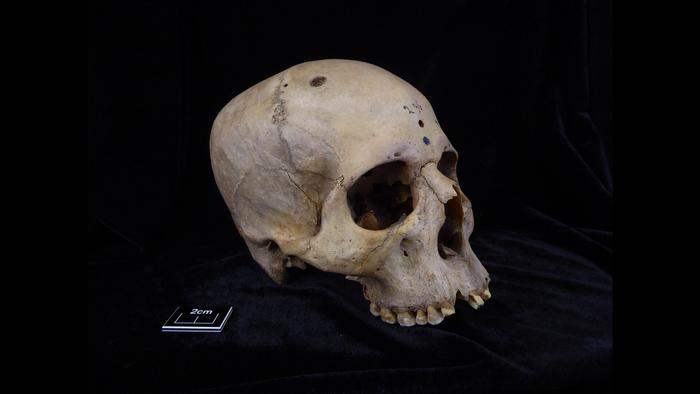
“We wanted to learn about the role of cancer in the past, how prevalent this disease was in antiquity, and how ancient societies interacted with this pathology,” explained Tondini. To do so, the researchers examined two skulls held at the University of Cambridge’s Duckworth Collection. Skull and mandible 236, dating from between 2687 and 2345 BCE, belonged to a male individual aged 30 to 35. Skull E270, dating from between 663 and 343 BCE, belonged to a female individual who was older than 50 years.
On skull 236, microscopic observation showed a big-sized lesion consistent with excessive tissue destruction, a condition known as neoplasm. In addition, there are 30 or so small and round metastasized lesions scattered across the skull.
What stunned the researchers was the discovery of cutmarks around these lesions, which probably were made with a sharp object such as a metal instrument. “When we first observed the cutmarks under the microscope, we could not believe what was in front of us,” said Tondini.
“It seems ancient Egyptians performed some kind of surgical intervention related to the presence of cancerous cells, proving that ancient Egyptian medicine was also conducting experimental treatments or medical explorations in relation to cancer,” explained co-author Prof Albert Isidro, a surgical oncologist at the University Hospital Sagrat Cor, who specializes in Egyptology.
Cancer in antiquity
Skull E270, too, shows a big lesion consistent with a cancerous tumor that led to bone destruction. This may indicate that although today’s lifestyle, people getting older, and cancer-causing substances in the environment increase cancer risk, cancer was also a common pathology in the past.
On skull E270, there are also two healed lesions from traumatic injuries. One of them seems to have originated from a close-range violent event using a sharp weapon. These healed lesions could mean that the individual potentially received some kind of treatment, and as a result, survived.
Seeing such a wound on a female individual, however, is uncommon, and most violence-related injuries are found on males. “Was this female individual involved in any kind of warfare activities?” asked Tondini. “If so, we must rethink the role of women in the past and how they took active part in conflicts during antiquity.”
The researchers, however, also said that studying skeletal remains comes with certain challenges that make definitive statements difficult, especially since remains often are incomplete and there is no known clinical history. “In archaeology we work with a fragmented portion of the past, complicating an accurate approach,” Isidro pointed out.
“This study contributes to a changing of perspective and sets an encouraging base for future research on the field of paleo-oncology, but more studies will be needed to untangle how ancient societies dealt with cancer,” concluded Camarós.
Journal
Frontiers in Medicine
Method of Research
Case study
Subject of Research
Not applicable
Article Title
Boundaries of oncological and traumatological medical care in ancient Egypt: New palaeopathological insights from two human skulls
Article Publication Date
29-May-2024
COI Statement
The authors declare that the research was conducted in the absence of any commercial or financial relationships that could be construed as a potential conflict of interest.
Cite Scienmag News
Nathaniel Bowman. (May 29, 2024). ‘Extraordinary’ 4,000-year-old Egyptian skull may show signs of attempts to treat cancer. Scienmag. https://scienmag.com/extraordinary-4000-year-old-egyptian-skull-may-show-signs-of-attempts-to-treat-cancer/
Nathaniel Bowman. "‘Extraordinary’ 4,000-year-old Egyptian skull may show signs of attempts to treat cancer." Scienmag, 29 May 2024, https://scienmag.com/extraordinary-4000-year-old-egyptian-skull-may-show-signs-of-attempts-to-treat-cancer/. Accessed 4 September 2026.
Nathaniel Bowman. "‘Extraordinary’ 4,000-year-old Egyptian skull may show signs of attempts to treat cancer." Scienmag. May 29, 2024. https://scienmag.com/extraordinary-4000-year-old-egyptian-skull-may-show-signs-of-attempts-to-treat-cancer/

