


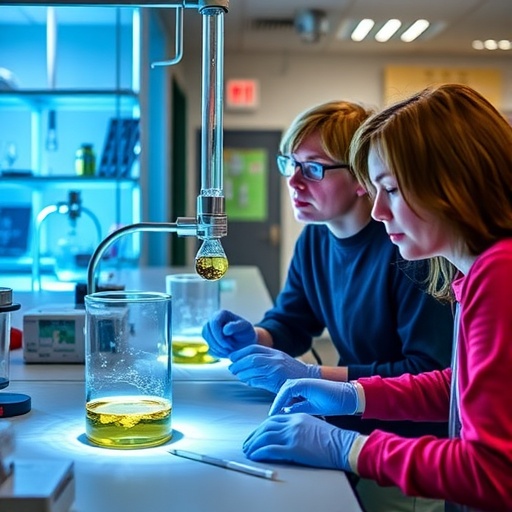
A groundbreaking imaging facility at Tufts University is transforming how scientists study materials by enabling comprehensive analysis of samples from the macroscale down to the nanoscale—all within a single session. Known as the Center for Optical Characterization of Organic and Natural Materials (COCOON), this innovative lab integrates multiple microscopy techniques, allowing researchers to correlate observations across different scales without moving the sample.
At the heart of COCOON is a state-of-the-art scanning electron microscope capable of resolving surface features as small as 0.8 nanometers, roughly the size of a glucose molecule. This powerful tool is complemented by Raman spectroscopy for molecular mapping and energy dispersive X-ray (EDX) spectroscopy for elemental analysis. The combined data provide a multidimensional picture detailing not only surface topography but also chemical composition at precise locations.
Beyond electron microscopy, COCOON incorporates confocal laser scanning microscopy, akin to CT scanning, to visualize internal structures at varying depths, as well as atomic force microscopy, enabling near-atomic resolution surface profiling. These instruments share spatial data, ensuring seamless navigation from a whole-sample view down to nanometer details without losing positional context.
COCOON addresses a persistent challenge in biological material imaging—preserving natural conditions during high-resolution microscopy. Conventional electron microscopy requires vacuum environments, risking dehydration and structural distortion of tissues. To overcome this, the facility employs cryogenic preservation, rapidly freezing samples to maintain biological integrity, water content, and functionality. Crucially, these frozen states are kept consistent throughout multi-instrument imaging sessions, minimizing sample damage and extending data acquisition windows.
The multidisciplinary platform serves diverse fields, from understanding the thermal regulation in butterfly wings and drug release mechanisms in capsules to characterizing polymers, microchips, batteries, catalysts, and even forensic materials. The integrated workflow and collaborative service model developed at COCOON enable both academic and industrial researchers to design tailored experiments with expert support in sample preparation, imaging strategy, and data interpretation.
This comprehensive approach not only advances material science research but also promises to unlock new insights by directly linking molecular, elemental, and structural information across scales. As COCOON director Giulia Guidetti explains, this facility offers more than advanced tools—it introduces a paradigm shift in how researchers think about and investigate complex materials.
Tufts University invites researchers operating at the nexus of biology, material science, and optics to explore the capabilities of COCOON. With flexible hourly access or full consulting services, this next-generation imaging suite stands poised to accelerate discovery and innovation in diverse scientific and industrial arenas.
News Publication Date: Not specified
Web References: https://silklab.engineering.tufts.edu/cocoon.html
Keywords
Materials engineering, scanning electron microscopy, confocal microscopy, cryo electron microscopy, optical microscopy, surface microscopy, Raman spectroscopy, infrared spectroscopy
Cite Scienmag News
Denise Maddox. (July 9, 2026). Exploring Nanoscale Materials in the COCOON Laboratory. Scienmag. https://scienmag.com/exploring-nanoscale-materials-in-the-cocoon-laboratory/
Denise Maddox. "Exploring Nanoscale Materials in the COCOON Laboratory." Scienmag, 9 July 2026, https://scienmag.com/exploring-nanoscale-materials-in-the-cocoon-laboratory/. Accessed 4 September 2026.
Denise Maddox. "Exploring Nanoscale Materials in the COCOON Laboratory." Scienmag. July 9, 2026. https://scienmag.com/exploring-nanoscale-materials-in-the-cocoon-laboratory/


