


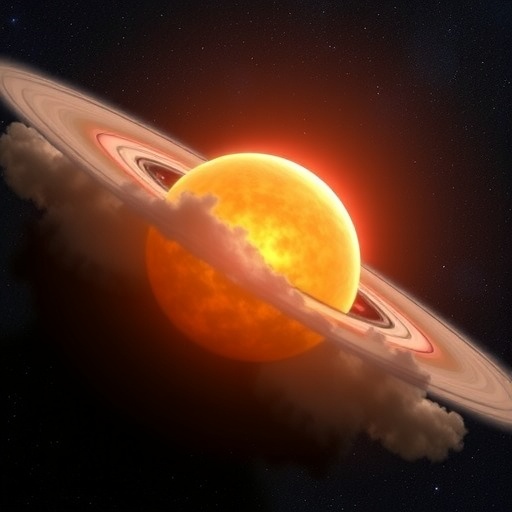
Sub-Neptune planets, the most common class of exoplanets in our galaxy, remain enigmatic despite their abundance. Larger than Earth but smaller than Neptune, their true nature has eluded scientists seeking to understand their internal makeup. Are these worlds rocky cores swathed in thick hydrogen atmospheres, or are they composed predominantly of volatile substances like water or carbon compounds? The James Webb Space Telescope (JWST), with its unprecedented capability to probe exoplanetary atmospheres, offers hope for answers—but interpreting its data poses significant challenges.
A recent study led by astrophysicists at Arizona State University sheds new light on how atmospheric clouds on sub-Neptunes impact our understanding of their interiors. Published in The Astrophysical Journal Letters, the research reveals a compelling feedback between atmospheric phenomena and the thermal state of the planet’s deep interior. Rather than merely obscuring atmospheric chemistry from observation, these clouds actively reshape the temperature at the critical interface where the planet’s atmosphere meets its mantle.
Using sophisticated computer models, the team showed that clouds composed of vaporized rocky materials and salts can form deep within the atmospheres of sub-Neptunes. These clouds act as a thermal blanket, trapping heat escaping from below and raising the temperature at the atmosphere-interior boundary by as much as 1,400 to 2,600 degrees Celsius. This elevated temperature can push the rocky interface beyond its melting point, creating molten magma oceans beneath the atmosphere on planets such as GJ 1214 b and TOI-1231 b—features that would otherwise remain solid without cloud-driven heating.
The presence of magma oceans is profound. It implies dynamic geological activity where the molten surface exchanges gases with the overlying atmosphere. The study found that this interaction alters atmospheric chemical composition considerably: gases like oxygen and silicon compounds increase, while methane, water vapor, and ammonia tend to dissolve into the magma. Consequently, JWST’s spectral data can become “polluted” by these deep geological processes, complicating efforts to use atmospheric signatures as direct proxies for planetary composition.
This discovery challenges the conventional view that clouds merely obscure atmospheric signals. Instead, they are an integral part of a planet’s thermal and chemical environment, influencing how sub-Neptunes cool and contract over billions of years. Understanding this relationship is essential not only for characterizing these worlds but also for assessing their potential habitability. The interaction between clouds, interior heat, and atmospheric chemistry fundamentally affects the observable properties astronomers rely on.
Co-author Luis Welbanks underscores the significance of this work: interpreting JWST’s observations requires untangling the complex coupling between a sub-Neptune’s atmosphere and its interior. The research marks a crucial advance toward that goal, revealing that atmospheric clouds do more than blur data—they rewrite the thermal and chemical narrative of distant planets.
As JWST continues to revolutionize exoplanet science, studies like this highlight the necessity of integrated models accounting for atmospheric, geological, and thermal processes. Unlocking the mysteries of sub-Neptunes demands a nuanced approach that sees clouds not as obstacles but as key players in unveiling the true nature of these fascinating alien worlds.
News Publication Date:
8-Jul-2026
Web References:
http://dx.doi.org/10.3847/2041-8213/ae7432
Keywords
Sub-Neptunes, Exoplanets, James Webb Space Telescope, Atmosphere, Interior, Clouds, Magma Ocean, Planetary Composition, Thermal Modeling
Cite Scienmag News
Grant Pearson. (July 9, 2026). ASU Astronomers Uncover Cloud Effects on Common Exoplanet Interiors. Scienmag. https://scienmag.com/asu-astronomers-uncover-cloud-effects-on-common-exoplanet-interiors/
Grant Pearson. "ASU Astronomers Uncover Cloud Effects on Common Exoplanet Interiors." Scienmag, 9 July 2026, https://scienmag.com/asu-astronomers-uncover-cloud-effects-on-common-exoplanet-interiors/. Accessed 3 September 2026.
Grant Pearson. "ASU Astronomers Uncover Cloud Effects on Common Exoplanet Interiors." Scienmag. July 9, 2026. https://scienmag.com/asu-astronomers-uncover-cloud-effects-on-common-exoplanet-interiors/


