


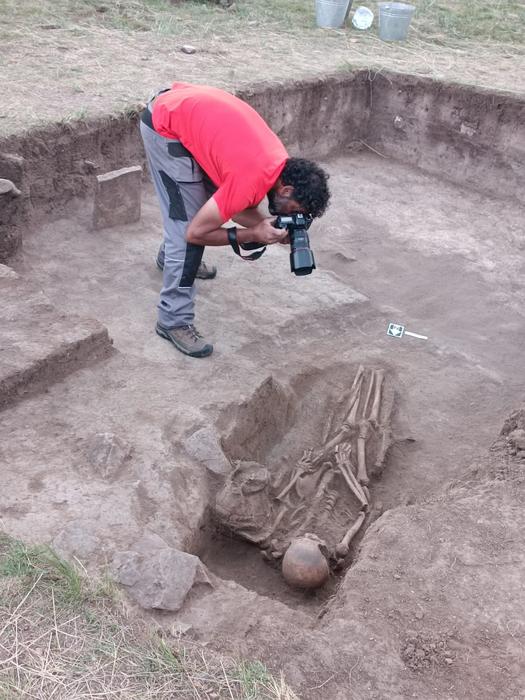
In the vast and often enigmatic landscapes of Mongolia, a groundbreaking archaeological investigation has shed remarkable new light on the complexity of medieval frontier life. Led by Professor Gideon Shelach-Lavi of the Department of Asian Studies at the Hebrew University of Jerusalem, this latest research challenges long-held assumptions about the nature and purpose of the sprawling Medieval Wall System across eastern Mongolia. Far from mere military defenses, these monumental structures reveal evidence of diverse social, economic, and cultural interactions that reframe our understanding of medieval Eurasian frontier dynamics.
The focus of these investigations is a relatively unknown segment of the Medieval Wall System, specifically a feature known as the Mongolian Arc, which stretches through Mongolia’s Sukhbaatar and Dornod provinces. Unlike the iconic Great Wall of China, this frontier zone comprises a combination of earthen trenches, modest linear embankments, and fortified enclosures that collectively extend over several hundred kilometers. The recent excavations concentrated on an enclosure designated MA03, dated by radiocarbon methods to the Jin dynasty period, between the twelfth and thirteenth centuries.
Contrary to the prevailing view that these ancient walls primarily functioned as formidable defensive barriers, researchers discovered only a shallow trench along the MA03 section without an accompanying tall linear wall. This trench, running over 300 kilometers, likely operated less as a barrier to hostile forces and more as a sophisticated territorial demarcation and administrative control mechanism. The absence of a standing wall in this sector suggests that the function of the Medieval Wall System was multifaceted, encompassing management of nomadic movements, regulation of trade activities, disturbance control, and symbolic assertions of imperial presence.
Within the confines of the MA03 enclosure, the archaeological team uncovered extensive evidence of permanent habitation. The remains of complex stone architecture and an advanced hypocaust-style heating system bear witness to substantial settlement activities, contradicting the stereotype of Mongolia’s frontier as an exclusively nomadic domain. Artifacts such as iron tools—including a broken plough—animal bones, and ceramic vessels further illustrate a community engaged in a mixed subsistence economy encompassing herding, hunting, and agriculture.
The presence of the heating system is particularly noteworthy from a technological perspective. Similar to systems documented previously in medieval China and Korea, this subterranean heating innovation reflects cultural transmission and adaptation to Mongolia’s harsh winter climate. Such findings underscore the dynamic nature of frontier societies as active participants in broader Eurasian exchange networks, integrating diverse cultural elements into their material culture.
Adding a poignant layer to the narrative, the team unearthed a grave dating to the mid-fifteenth century, which was interred long after the enclosure had been abandoned. The burial included exquisitely preserved textiles, wooden implements, and metal objects. Remarkably, the grave was inserted into the remains of the collapsed enclosure wall, implying that the site maintained symbolic significance well beyond its original functional lifetime. This enduring legacy points to the ways in which these frontier structures continued to shape regional identity and memory across centuries.
The findings illuminate how the Medieval Wall System served not only as a physical frontier but as a multifaceted landscape of social negotiation and imperial projection. By controlling movement and facilitating regulation rather than waging outright military defense, these constructions helped manage the complex interactions between sedentary agriculturalists and nomadic pastoralists. This challenges conventional narratives that often polarize these communities and elevates the frontier as a zone of cultural and economic synthesis.
Moreover, this research contributes to a growing paradigm shift in archaeology that emphasizes the symbolic and administrative roles of monumental architecture in frontier zones. Similar patterns have been observed across Eurasia, where boundaries often delineated jurisdictional authority and mediated cross-cultural engagement rather than functioning solely as fortifications. The scattered presence of walled forts along the trench line further strengthens this interpretation of an intricate system of regional governance and interaction.
By investigating life along the edges of imperial power, Professor Shelach-Lavi and colleagues urge scholars to rethink simplistic dichotomies between the center and periphery. The frontier emerges not as a void or a mere buffer but as a vibrant space where diverse populations lived, worked, and negotiated their identities. This integrative lens reveals the importance of studying peripheral regions to fully appreciate the complexity of medieval Eurasian political and social landscapes.
The research was facilitated by the project “The Wall: People and Ecology in Medieval Mongolia and China,” an international collaborative endeavor headquartered at the Hebrew University of Jerusalem and funded by the European Research Council. Since 2018, the project has employed cutting-edge archaeological survey, excavation, and environmental analysis techniques to map these little-known frontier systems and unravel their ecological and cultural contexts.
Synthesizing archaeological data, radiocarbon chronology, and material culture analysis, the team’s work articulates a nuanced vision of frontier life that balances mobility with permanence, local governance with imperial ambitions, and material innovation with cultural continuity. This comprehensive approach not only enriches our historical understanding but also provides a valuable reference for contemporary studies of borderlands and cross-cultural interactions worldwide.
Ultimately, this investigation reveals that the medieval Mongolian frontier was a mosaic of human experience encompassing more than just military confrontation. The walls and trenches formed part of a broader system for managing movement, trade, and social relations, reminding us that human societies have always been adept at creating complex infrastructures that extend far beyond mere survival or warfare.
Such insights invite future research aimed at exploring the ecological dimensions of these frontier settlements, their role in shaping regional climate resilience, and their place within the transcontinental networks of the Eurasian steppe. With each excavation, scholars unearth new chapters in the story of borders—not as lines of division but as spaces of connection and transformation.
Cite Scienmag News
Courtney Benton. (May 29, 2025). Exploring Life on the Medieval Mongolian Frontier: New Discoveries from the Borders and Beyond. Scienmag. https://scienmag.com/exploring-life-on-the-medieval-mongolian-frontier-new-discoveries-from-the-borders-and-beyond/
Courtney Benton. "Exploring Life on the Medieval Mongolian Frontier: New Discoveries from the Borders and Beyond." Scienmag, 29 May 2025, https://scienmag.com/exploring-life-on-the-medieval-mongolian-frontier-new-discoveries-from-the-borders-and-beyond/. Accessed 6 September 2026.
Courtney Benton. "Exploring Life on the Medieval Mongolian Frontier: New Discoveries from the Borders and Beyond." Scienmag. May 29, 2025. https://scienmag.com/exploring-life-on-the-medieval-mongolian-frontier-new-discoveries-from-the-borders-and-beyond/


