


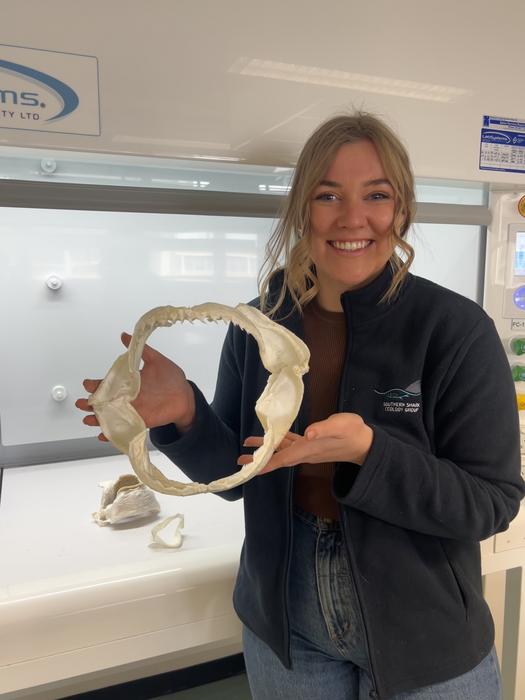
In a groundbreaking revelation for the field of marine biology, researchers from Flinders University have shed light on the potential of preserved shark jaws as an invaluable resource for studying the diets of various shark species. This innovative study addresses a significant barrier in shark research—the challenge of obtaining samples from rare or protected species—which has often hindered scientists’ understanding of shark ecology.
Shark teeth have long been acknowledged for their role in revealing dietary habits through biochemical analysis. However, the difficulty of acquiring samples from living sharks made relying solely on contemporary specimens inadequate for holistic dietary studies. With the advent of this new research, the potential to utilize preserved specimens from museums and private collections opens a door previously thought closed. These preserved jaws are now recognized as treasure troves of information, capable of providing insights into the feeding habits and habitats of sharks long after their collection.
Biochemical techniques, notably stable isotope analysis, serve as the backbone of this groundbreaking work. By examining specific isotopes present within shark teeth, researchers can glean essential information regarding their diet and geographic range. Traditionally, concerns over chemical treatments used to preserve these jaws have raised questions regarding their reliability as research samples. The findings from this recent study, however, offer a significant level of reassurance. The researchers demonstrated that preservation chemicals, such as ethanol, bleach, and hydrogen peroxide, do not alter the isotopic signatures of the shark teeth, rendering them suitable for ecological studies.
Lead author Laura Holmes from the Southern Shark Ecology Group emphasizes that the isotopes found in shark teeth can narrate a complex story of their dietary preferences and feeding locations. For instance, isotopic evidence could tell scientists if a shark dined on sea lions off the coast of South Australia or targeted tuna in the waters off New South Wales. Such insights are pivotal in understanding how these apex predators interact with their environment and the numerous threats they face, particularly in the context of rapid environmental change influenced by human activities.
The research, carried out in collaboration with the Isotope Ratio Mass Spectrometry Laboratory at the University of Tasmania, examined jaws from three distinct species of elasmobranchs—cownose rays, gummy sharks, and broadnose sevengill sharks. Remarkably, across the various species, researchers observed consistent results: the different tooth structures showed no alteration due to the chemicals employed during preservation processes. This finding encourages the broader use of museum collections in research, paving the way for exploratory studies that utilize jaws preserved for decades.
Dr. Lauren Meyer, a research associate at Flinders University, underscores the importance of understanding how chemical treatments impact the isotopes in shark teeth. This understanding allows scientists to confidently use historical collections and helps to demystify the impacts of anthropogenic pressures on these species. For rare or threatened sharks—such as the iconic white shark, the formidable tiger shark, and the sleek mako—this research offers a profound opportunity to investigate diets from periods when these creatures thrived undisturbed by modern human influence.
The implications of this study extend beyond sharks alone, providing a methodology that could apply to other marine predators. For instance, teeth from species such as killer whales, sperm whales, and fur seals, which are similarly represented in museum collections, could also be analyzed through the stable isotope lens. This convergence of historical data with modern analytical techniques yields a powerful tool for unraveling complex predator-prey interactions and provides context for current concerns regarding the health and sustainability of marine ecosystems.
Furthermore, the potential for retrospective analysis of historic jaws from the 1970s and 1980s introduces an unprecedented viewpoint into the diets of species that currently face numerous threats due to climate change and human activity. By examining these archived specimens, researchers can draw parallels between historical feeding behaviors and modern predatory patterns, thus gaining insight into how shifting ecological dynamics influence shark populations over time.
As acknowledged in the recently published study in Marine Environmental Research, the significance of these findings cannot be overstated. The research represents not just a study of shark diets, but a broader commentary on the value of historical biological samples. It is a testament to the scientific community’s commitment to harnessing all available resources, especially in an era where biodiversity is increasingly under threat.
With this newly acquired knowledge, scientists hope to foster a deeper understanding of sharks’ roles in marine ecosystems and the ramifications of ecological shifts. The call to action for leveraging historical collections aligns seamlessly with global conservation efforts, supporting the notion that even outdated resources can hold the keys to present and future sustainability endeavors.
In conclusion, the ability to utilize preserved jaws for isotopic analysis constitutes a significant advancement in marine science. By tapping into the treasure troves of information locked within these specimens, researchers can begin to untangle the complexities of predator dynamics and historical shark diets. This study not only opens new avenues for academic inquiry but also reinforces the necessity of conservation efforts aimed at protecting marine biodiversity for generations to come.
Cite Scienmag News
Daisy Hatcher. (March 24, 2025). Exploring Diet History Through Preserved Shark Jaws: A Window into the Past. Scienmag. https://scienmag.com/exploring-diet-history-through-preserved-shark-jaws-a-window-into-the-past/
Daisy Hatcher. "Exploring Diet History Through Preserved Shark Jaws: A Window into the Past." Scienmag, 24 March 2025, https://scienmag.com/exploring-diet-history-through-preserved-shark-jaws-a-window-into-the-past/. Accessed 3 September 2026.
Daisy Hatcher. "Exploring Diet History Through Preserved Shark Jaws: A Window into the Past." Scienmag. March 24, 2025. https://scienmag.com/exploring-diet-history-through-preserved-shark-jaws-a-window-into-the-past/


