


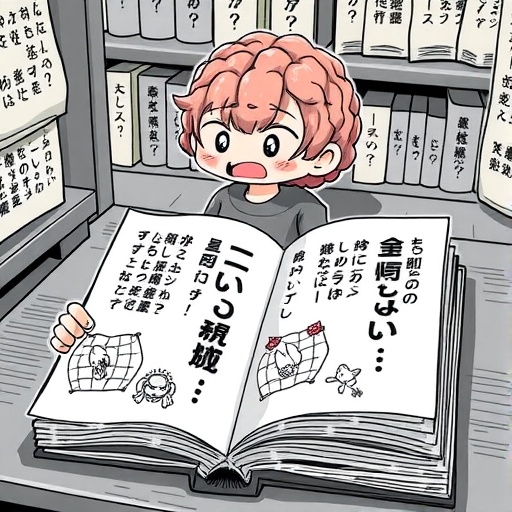
Japanese manga has captured the imaginations of readers worldwide, blending intricate narratives with dynamic visual storytelling. However, a groundbreaking new study from Japan now reveals that the medium on which manga is consumed—paper versus digital screens—significantly influences both comprehension and the neurological processes involved during reading. This research, recently published in PLOS One, sheds light on how traditional paper manga may facilitate more efficient brain integration compared to digital reading, with sweeping implications for our understanding of reading cognition in the digital age.
The study embarked on a detailed examination of neural activation during manga reading on paper compared to digital devices such as tablets and e-readers. Using functional magnetic resonance imaging (fMRI), researchers observed key differences in brain activity patterns, particularly in areas associated with language processing and information integration. They identified enhanced activation in the language-related regions of the brain when subjects read manga on paper, suggesting that tactile and sensory cues inherent to the physical medium may bolster cognitive engagement.
Central to the findings is the notion of “energy-saving brain activation,” referring to more efficient neural processing during paper-based reading. The yellow-highlighted areas in the language regions of the brain in the fMRI images demonstrate this phenomenon, showing less scattered and more unified activation patterns. This contrasts sharply with the more diffuse brain activation recorded during digital reading sessions, which might indicate heightened cognitive load or less seamless integration of visual and textual information.
The researchers propose that paper’s tactile feedback, combined with the unique spatial layout of manga pages, strengthens the coordination between core and supportive brain integration processes. Specifically, the core integration networks encompass regions responsible for combining linguistic content with narrative context, while supportive networks assist by integrating visual cues and managing attention. Paper reading appears to harmonize these processes, facilitating more fluid comprehension and retention.
One of the compelling insights from the study connects these neural findings with behavioral measures. Participants exhibited improved understanding and memory recall of manga narratives when reading on paper. This superior performance aligns with the more focused brain activation patterns and suggests that the medium influences both the mechanics of brain function and the experiential aspects of comprehension.
Technological interface challenges also arise from this research. Digital screens, while convenient and increasingly prevalent, may impose subtle cognitive barriers related to screen glare, scrolling mechanisms, and screen refresh rates, all of which could disrupt the natural flow of reading and result in fragmented neural activation. Furthermore, the static yet tactile nature of paper affords readers a physical map of narrative progress, enhancing spatial memory and sequencing, critical for understanding complex storylines.
This investigation holds particular relevance in our current era, where digital consumption dominates cultural and educational content dissemination. As manga’s global audience increasingly shifts towards online platforms and digital archives, understanding the cognitive trade-offs of screen reading versus traditional media becomes paramount. This study’s demonstration that paper facilitates better integrative brain processing calls for a reevaluation of digital literacy tools and digital content delivery methods.
Beyond manga, the implications extend to other domains where multimedia and textual integrations are crucial, including education, professional reading, and even therapeutic storytelling. The brain’s differential response to media formats could influence curricular designs, recommending strategic use of paper for deeper learning and digital formats for rapid access or convenience.
Funding for the study was provided by COAMIX INC, a prominent entity in the manga publishing industry, alongside governmental support from Japan’s Ministry of Education, Culture, Sports, Science, and Technology. Importantly, the research team maintained strict adherence to scientific objectivity, asserting no conflicts of interest that could unfairly bias the results despite the corporate sponsorship.
The article “Manga reading on paper vs. digital devices: Prospective effects on core and supportive integration processes in the brain” was published on June 3, 2026, in PLOS One, a reputable open-access journal known for rigorous peer review. This publication date situates the study at the forefront of contemporary neurocognitive research into the interplay between media technologies and brain functions.
In summary, this landmark study challenges prevailing assumptions that digital devices unequivocally offer the superior or equal reading experience. Instead, it underscores the enduring value of traditional reading on paper, revealing nuanced neurophysiological differences with meaningful cognitive outcomes. As digital reading technologies evolve, integrating insights from this research could inform the development of next-generation devices replicating the cognitive advantages of paper.
Future investigations might explore how these findings generalize across different genres and languages, or how individual differences in reading habits and neurological makeup modulate the observed effects. In addition, expanding research to educational settings will clarify how to harness these insights for optimal learning outcomes in the digital era.
For manga enthusiasts, educators, cognitive scientists, and technology designers alike, this study offers a fresh perspective on an age-old question: does the medium matter? The answer, according to this research, is a resounding yes. The physicality of paper reading more than a nostalgic artifact, it remains a potent ally in the complex dance of brain networks that make reading a rich, immersive cognitive experience.
Cite Scienmag News
Cassandra Pierce. (June 3, 2026). Experiment Reveals Japanese Manga Stories Are Better Understood on Paper, Showing Distinct Brain Activation Patterns Compared to Digital Reading. Scienmag. https://scienmag.com/experiment-reveals-japanese-manga-stories-are-better-understood-on-paper-showing-distinct-brain-activation-patterns-compared-to-digital-reading/
Cassandra Pierce. "Experiment Reveals Japanese Manga Stories Are Better Understood on Paper, Showing Distinct Brain Activation Patterns Compared to Digital Reading." Scienmag, 3 June 2026, https://scienmag.com/experiment-reveals-japanese-manga-stories-are-better-understood-on-paper-showing-distinct-brain-activation-patterns-compared-to-digital-reading/. Accessed 3 September 2026.
Cassandra Pierce. "Experiment Reveals Japanese Manga Stories Are Better Understood on Paper, Showing Distinct Brain Activation Patterns Compared to Digital Reading." Scienmag. June 3, 2026. https://scienmag.com/experiment-reveals-japanese-manga-stories-are-better-understood-on-paper-showing-distinct-brain-activation-patterns-compared-to-digital-reading/


