Cluster-based farming in Ethiopia offers real gains in productivity, market access and farmer collaboration, but its expansion is being held back by farmer resistance, weak institutional coordination and political instability, according to a systematic review of 23 empirical studies published in the journal Agriculture & Food Security. The review, conducted by Endris Mamo Mulate and Muluken Gezahegn Wordofa, synthesizes research published mainly between 2015 and 2026 to map both the promise and the pitfalls of one of Ethiopia’s flagship agricultural policy interventions.
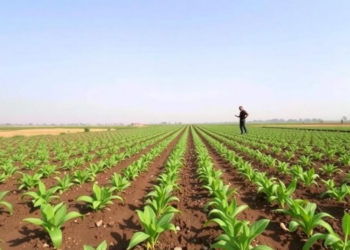
Cluster farming asks neighboring smallholder farmers to voluntarily pool portions of their adjacent plots and grow the same commodity together, while keeping individual land ownership intact. Participants are expected to apply recommended fertilizers, improved seed varieties, pesticides, herbicides and proper tillage, harvesting and threshing techniques, all of which can boost productivity. The approach was introduced in Ethiopia in 2014 by the Agricultural Transformation Agency, now the Agricultural Transformation Institute, with the explicit goal of shifting subsistence-oriented production toward a commercial, market-oriented system. Priority crops include teff, wheat, maize, tomato and onion, with barley also featured in later initiatives.
The review is careful to distinguish cluster farming from models it is often confused with. Under Ethiopia’s former socialist regime, cooperative farming involved mandatory joint ownership and collective land management, which produced inefficiency and resistance. Cluster-based farming, by contrast, rests on voluntary participation and preserves private landholding while encouraging coordinated production.
The stakes are considerable. Agriculture contributes about 37.57 percent of Ethiopia’s GDP and 66.6 percent of employment, and the country’s roughly 120 million people remain predominantly rural, with 78 percent living outside cities. Yet recent agricultural growth has not efficiently addressed persistent food insecurity, malnutrition and rural poverty among smallholders. Smallholder farmers continue to face limited bargaining power, poor farming practices, environmental degradation, insufficient credit, infrastructure gaps, market failures driven by information asymmetry, high transaction costs and restricted access to modern inputs and technologies.
On the opportunity side, the review identifies benefits across five dimensions. Socially, cluster farming fosters farmer-to-farmer knowledge exchange and collaboration, allowing members to observe, experiment with and adapt practices through peer influence. It also enables groups to jointly purchase large machinery such as tractors and combine harvesters that would be difficult for individuals to acquire. Economically, farmers in clusters can achieve economies of scale, share training costs and risks, negotiate better prices by marketing collectively, and gain better access to finance by approaching lenders as cluster members rather than isolated individuals.
Ecologically, the review finds that clusters can pool resources for soil conservation, water conservation and agroforestry in collaboration with the Ministry of Agriculture, and can serve as a platform for adopting climate-smart agriculture practices, including improved seeds, organic manure and integrated weed management. These practices may improve resilience to climate shocks, stabilize productivity and reduce environmental degradation. Institutionally, clusters strengthen partnerships and coordination among farmers, government agencies, research institutes and development organizations, and make it easier for governments and NGOs to deliver inputs, extension advice and mechanization services efficiently. Politically, government promotion through the Agricultural Transformation Institute and the Climate Resilient Green Economy strategy provides policy support and aligns farming with national development goals.
The constraints, however, are equally multidimensional. Socially, the review documents farmers’ resistance to the collective concept, competition for irrigation water, low working capital, weak cooperative ownership, lack of trust among farmers in the same group and along the agricultural value chain, and opportunistic behavior within clusters. Ethiopia’s land tenure arrangements, in which the state owns the land, add further complexity. Adoption is sometimes limited by fragmented extension services and uneven participation, which can weaken social cohesion within clusters.
Economically, the cited studies list unexpected price failures on selected crops, low market promotion, dependency on project support, lack of economies of scale among smallholders, an inefficient rural financial system, high prices of basic seed, lack of access to land and credit, and poorly functioning extension services as major barriers. Ecologically, unfavorable agro-ecological conditions, climate change, water scarcity, erratic rainfall, land scarcity and excessive pesticide use threaten soil quality and water resources. Environmental risks such as frost, ice rain and moisture stress can damage entire cluster farms at once, and the emergence of new rust diseases and pests may cause crop failure, leaving farmers without alternative plots or income sources exposed to serious food insecurity and economic hardship.
Institutionally, the review identifies weak implementation capacity, inadequate physical and social infrastructure, insufficient financial resources, distorted incentives, poor coordination and missing legal frameworks such as certificates for seed distribution. Limited functionality of Farmers’ Training Centers and gaps in monitoring and evaluation compound the problem, with the authors noting that expansion alone is insufficient if operational effectiveness is neglected. Politically, poor administration linked to corruption, export restrictions on agricultural commodities and political instability can disrupt market systems, weaken coordination and reduce the long-term effectiveness of clusters.
The authors conclude that cluster-based farming has genuine potential to transform smallholder agriculture in Ethiopia by improving productivity, commercialization and rural livelihoods, but that success depends on addressing the social, economic, ecological, institutional and political constraints the review documents. Their recommendations include prioritizing rural infrastructure to connect cluster farms with markets, expanding agricultural research, strengthening farmer training, securing financial support for cooperatives, promoting pro-poor agricultural strategies, extending extension services and establishing continuous government monitoring and evaluation of cluster performance in productivity, market participation and livelihood outcomes. The review is based on 23 studies identified through digital libraries, web sources, Ethiopian public university repositories and the ATA government website, and the authors note that future work with larger samples and additional databases could capture further constraints and opportunities.
Subject of Research: Constraints and opportunities of cluster-based farming among Ethiopian smallholder farmers
Article Title: Constraints and opportunities in cluster-based farming in Ethiopia
Article References: Mulate, E. M., & Wordofa, M. G. (2026). Constraints and opportunities in cluster-based farming in Ethiopia. Agriculture & Food Security, 15(1), Article 45. https://doi.org/10.1186/s40066-026-00634-8
Image Credits: AI Generated
DOI: 10.1186/s40066-026-00634-8
Keywords: cluster farming, Ethiopia, smallholder farmers, systematic review, agricultural transformation, food security, market access, climate-smart agriculture, economies of scale, institutional coordination, rural livelihoods, Agricultural Transformation Agency
Cite Scienmag News
Alan Morgan. (October 28, 2026). Ethiopia’s Cluster Farming Reviewed: Five Forces Shaping Smallholder Transformation. Scienmag. https://scienmag.com/ethiopias-cluster-farming-reviewed-five-forces-shaping-smallholder-transformation/
Alan Morgan. "Ethiopia’s Cluster Farming Reviewed: Five Forces Shaping Smallholder Transformation." Scienmag, 28 October 2026, https://scienmag.com/ethiopias-cluster-farming-reviewed-five-forces-shaping-smallholder-transformation/. Accessed 28 October 2026.
Alan Morgan. "Ethiopia’s Cluster Farming Reviewed: Five Forces Shaping Smallholder Transformation." Scienmag. October 28, 2026. https://scienmag.com/ethiopias-cluster-farming-reviewed-five-forces-shaping-smallholder-transformation/