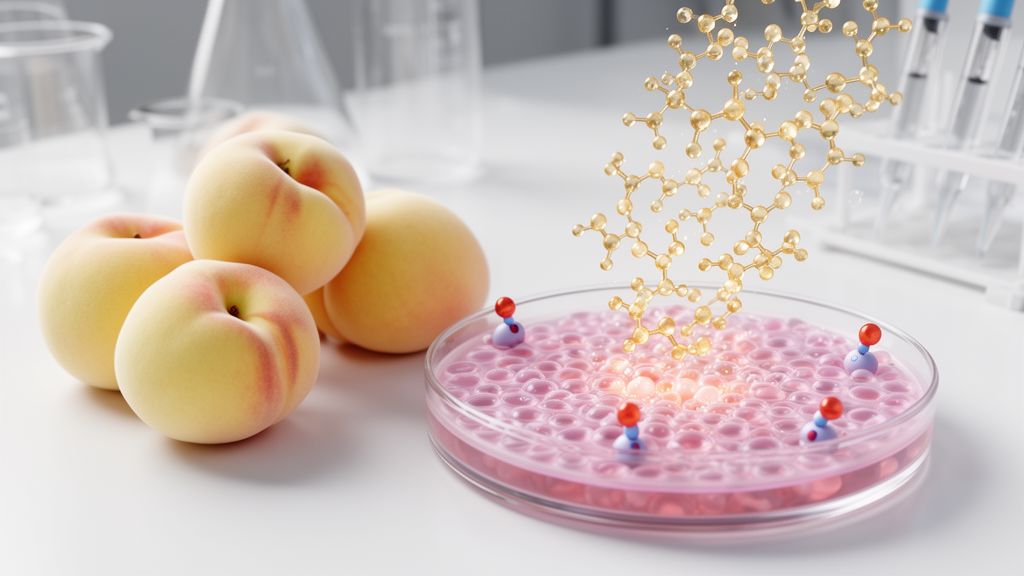
Every year, Chinese orchards discard roughly 1.25 million tons of thinned peaches — the immature fruit removed so that remaining peaches can grow larger and sweeter. Most of this fruit rots in the field, a waste stream that growers accept as the price of quality but that researchers increasingly view as an untapped reservoir of bioactive compounds.
The research team, working with thinned fruit of the Hujingmilu peach cultivar collected in Fenghua, Ningbo, in Zhejiang Province before the stone-hardening stage, first extracted crude polysaccharides from the dried, crushed fruit. After stripping polyphenols with 70% ethanol, they extracted sugars in water at 110 °C and pH 5.0 for 40 minutes, then precipitated the carbohydrates with ethanol and freeze-dried the crude material, which they call CPPS. That crude powder was the starting point for a purification cascade designed to find exactly which molecules carry the hypoglycemic activity hinted at in the team’s earlier work.
Purification proceeded in two stages. First, CPPS was passed over a DEAE Fast Flow anion-exchange column and eluted stepwise with pure water and sodium chloride solutions of 0.1, 0.2 and 0.5 mol/L, yielding five fractions. When each fraction was tested against α-glucosidase using the standard PNPG colorimetric assay with acarbose as the positive control, the water-eluted fraction stood out: it inhibited the enzyme more strongly than the crude polysaccharides and all salt-eluted fractions, with a half-maximal inhibitory concentration (IC50) of 1.41 mg/mL. Because the water fraction performed best, it alone was carried forward and re-chromatographed under gentler conditions, producing two subfractions named W1 and W2.
Those subfractions were then split by molecular size using 3 kDa ultrafiltration centrifuge tubes. The material that passed through the membrane — the low-molecular-weight fraction — became W1-2 from W1 and W2-2 from W2, and these two filtrates turned out to be the stars of the study. Their IC50 values against α-glucosidase were 0.57 and 0.37 mg/mL respectively, both significantly lower than that of the crude starting material, meaning far less material was needed to halve enzyme activity. At the assay concentrations, W1-2 achieved an inhibition rate of 47.01% and W2-2 reached 57.64%. High-performance gel permeation chromatography showed each fraction eluting as a single, symmetrical peak, a sign of compositional homogeneity — although, as the authors later discovered, that apparent purity concealed a mixture of very similar oligosaccharides.
With the active fractions in hand, the team built a cellular model of insulin resistance. HepG2 cells, a human hepatocyte-derived line widely used to model liver glucose handling, were treated with glucosamine at doses from 1.5 to 18 mmol/L. Glucose consumption of the culture medium, measured with a commercial glucose assay kit, fell at every dose, but the largest and most significant drop occurred at 12 mmol/L, so that concentration was chosen. Testing induction times of 16, 20 and 24 hours showed the greatest difference from untreated controls at 16 hours, which also avoided problems of over-confluent cultures, so 12 mmol/L glucosamine for 16 hours became the standard insulin-resistance protocol. In this model, glucose consumption collapsed from 7.91 mmol/L in normal cells to 3.86 mmol/L in the model group — a reduction large enough to confirm the resistant state had been established.
Before testing activity, the researchers checked toxicity with MTT assays. For W1-2, viability of HepG2 cells stayed above 90% at concentrations up to 2.0 mg/mL and only dropped significantly above that, so doses of 0.25, 0.5, 1.0 and 2.0 mg/mL were taken forward. W2-2 was somewhat less tolerated: viability remained above 90% below 1.0 mg/mL but fell significantly beyond it, so the working range was 0.125 to 1.000 mg/mL. Within those safe windows, both fractions dramatically revived glucose uptake. Compared with the insulin-resistant model cells, W1-2 at 0.5, 1.0 and 2.0 mg/mL raised glucose consumption by factors of 1.47, 2.29 and 2.46 respectively, while W2-2 at 0.25, 0.5 and 1.0 mg/mL raised it by 1.60, 2.19 and 2.16 times.
The fractions also restored two downstream markers of hepatic glucose handling. Glycogen content, which falls when insulin signaling is impaired because glycogen synthase kinase-3 suppresses glycogen synthase, rose significantly only at the top doses: W1-2 at 2.0 mg/mL lifted glycogen to 1.35 times the model level, and W2-2 at 0.5 and 1.0 mg/mL reached 1.23 and 1.35 times. Enzyme activities told a similar story. Hexokinase, which phosphorylates glucose at the entry point of glycolysis, was depressed to 279.92 U/10⁴ cells in the model group; W1-2 at 2.0 mg/mL raised it to 332.38 U/10⁴ cells, an 18.74% increase, while W2-2 at 0.5 and 1.0 mg/mL produced increases of 17.31% and 43.87%, the latter reaching 402.72 U/10⁴ cells. Pyruvate kinase, the rate-limiting enzyme of the final glycolytic step, was even more responsive: from a model baseline of 20.12 U/10⁴ cells, W1-2 at 1.0 and 2.0 mg/mL drove increases of 54.13% and 51.54%, and W2-2 at 0.5 and 1.0 mg/mL delivered gains of 43.74% and 72.71%.
The structural chemistry behind these effects was probed with liquid chromatography–mass spectrometry, monosaccharide analysis and methylation. LC-MS detected oligosaccharides of 313 and 679 Da in W1-2 — consistent with a disaccharide of one hexose plus one pentose and a pentasaccharide of five pentoses — and species of 343 and 679 Da in W2-2, matching a two-hexose disaccharide and the same pentasaccharide. Monosaccharide profiling showed W1-2 is a complex mixture dominated by glucose (29.74%), arabinose (23.47%), glucosamine (18.43%), galactose (11.1%), fructose (7.91%), mannose (6.82%) and galactosamine (2.54%), whereas W2-2 is overwhelmingly glucose at 86.95%, with arabinose at 7.39%, galactose at 3.53%, mannose at 1.28% and fructose at 0.85%. Methylation analysis of W1-2 identified seven residue types including terminal arabinofuranose, 1,5- and 1,3,5-linked arabinofuranose, terminal glucose and galactose, and 1,4-linked glucose and galactose, with 1→4 bonds accounting for 42.57% of all linkages. For W2-2, terminal glucose residues made up a striking 76.95% of sugar residues.
That terminal-glucose dominance led the authors to a reasoned structural inference: if two glucose units are joined α-(1→1), the product is trehalose. The authors propose that W2-2 may contain trehalose-like disaccharides composed of glucose units, which they suggest endows this fraction with hypoglycemic activity. As supporting context from earlier work, trehalose isolated from bitter melon seeds and the fruiting bodies of Polyporus frondosus showed a 42% inhibition rate against α-glucosidase at 2 × 10⁻³ mol/L; this was a finding for isolated trehalose, not a measured property of W2-2 itself. The team therefore proposes that W2-2 contains trehalose-like disaccharides, while its pentasaccharides are arabinose-rich chains built from terminal, 1,5-linked and 1,3,5-linked arabinofuranose residues, the same branching pattern seen in W1-2. The authors also point to the arabinose residues in W1-2 and W2-2, such as terminal, 1,5-linked and 1,3,5-linked arabinofuranose, as a possible contributor to activity. They note that L-arabinose is reported to inhibit intestinal mucosal α-glucosidase non-competitively with good selectivity for sucrase, and that in prior work type 2 diabetic mice given 20 and 60 mg/kg per day showed reduced blood glucose, alleviated hepatic steatosis and improved dyslipidemia. These are findings from separate studies of L-arabinose, not direct evidence that the arabinofuranose motifs in W1-2 and W2-2 produce the same effects. The authors also concede an analytical gap: the diverse minor monosaccharides and linkage types do not fully match the two LC-MS species, and follow-up separation with pulsed amperometric detection revealed two trace-level constituents beyond the major disaccharide and pentasaccharide peaks.
The study’s scope deserves clear framing. All of the hypoglycemic evidence comes from a glucosamine-induced insulin-resistance model in a single liver-derived cell line, with enzyme assays run in vitro; the reported effects on glucose consumption, glycogen and glycolytic enzymes are cellular measurements, not demonstrations of blood-sugar control in people. The authors note only that their own preliminary experiments found hypoglycemic effects of the crude polysaccharides in diabetic mice, and no clinical data exist for the purified oligosaccharides. Still, the work delivers a concrete, quantified case that agricultural waste can yield chemically defined, enzyme-inhibiting carbohydrates with measurable activity in liver cells — and it maps which structural features, from 1→4-linked disaccharides to terminal arabinose pentamers, deserve attention as candidates for functional-food development.
Subject of Research: Hypoglycemic oligosaccharides isolated from thinned peach waste and their effects in insulin-resistant HepG2 cells
Article Title: α-Glucosidase inhibitory oligosaccharides derived from thinned peach fruit: preparation, identification, and effects on IR-HepG2 cells
Article References: Huang, Y., Ye, J., Wei, Y., Jiang, S., Chen, Y., & Shao, X. (2026). α-Glucosidase inhibitory oligosaccharides derived from thinned peach fruit: preparation, identification, and effects on IR-HepG2 cells. Agricultural Products Processing and Storage, 2(1), Article 43. https://doi.org/10.1007/s44462-026-00077-1
Image Credits: AI Generated
DOI: 10.1007/s44462-026-00077-1
Keywords: thinned peaches, oligosaccharides, alpha-glucosidase inhibition, insulin resistance, HepG2 cells, crude polysaccharides, trehalose-like disaccharides, arabinose, glycogen synthesis, hexokinase, pyruvate kinase, agricultural waste
Cite Scienmag News
Daisy Hatcher. (October 28, 2026). Oligosaccharides from Thinned Peaches Inhibit α-Glucosidase and Improve Glucose Metabolism in Insulin-Resistant Liver Cells. Scienmag. https://scienmag.com/oligosaccharides-from-thinned-peaches-inhibit-%ce%b1-glucosidase-and-improve-glucose-metabolism-in-insulin-resistant-liver-cells/
Daisy Hatcher. "Oligosaccharides from Thinned Peaches Inhibit α-Glucosidase and Improve Glucose Metabolism in Insulin-Resistant Liver Cells." Scienmag, 28 October 2026, https://scienmag.com/oligosaccharides-from-thinned-peaches-inhibit-%ce%b1-glucosidase-and-improve-glucose-metabolism-in-insulin-resistant-liver-cells/. Accessed 28 October 2026.
Daisy Hatcher. "Oligosaccharides from Thinned Peaches Inhibit α-Glucosidase and Improve Glucose Metabolism in Insulin-Resistant Liver Cells." Scienmag. October 28, 2026. https://scienmag.com/oligosaccharides-from-thinned-peaches-inhibit-%ce%b1-glucosidase-and-improve-glucose-metabolism-in-insulin-resistant-liver-cells/