


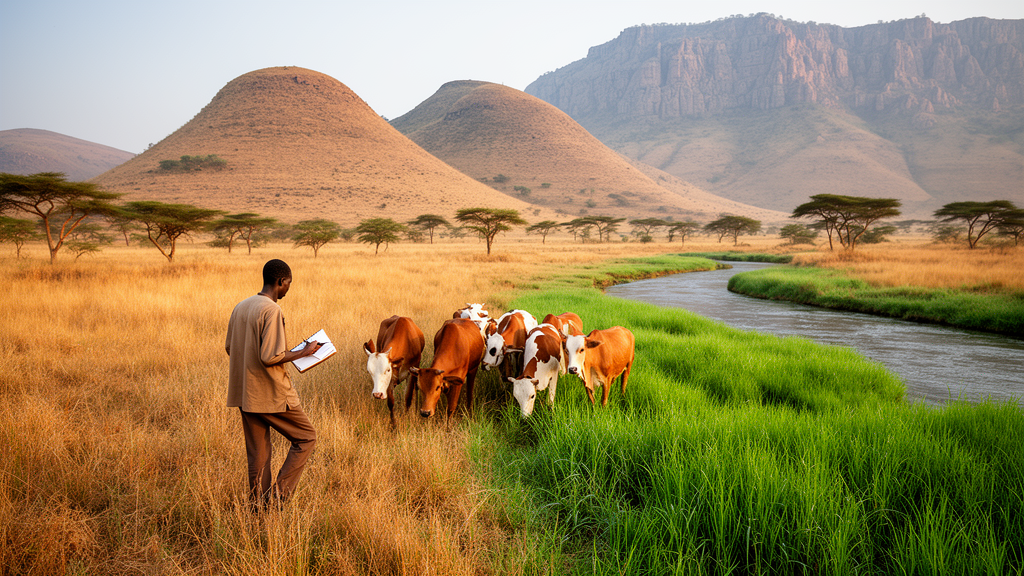
A field study in southern Ethiopia has identified a complementary native feed system for cattle, with perennial grasses supplying most of the biomass while protein-rich legumes, shrubs and fodder trees remain available when pasture quality deteriorates. Researchers surveyed 371 households and evaluated 20 indigenous forage species across pastoral, agro-pastoral and mixed crop–livestock communities in the Omo–Woito River Basin. Laboratory analysis found that seasonal changes in crude protein, fibre and in vitro digestibility were most pronounced in grasses, while woody browse offered comparatively high nutritional value during feed-scarce periods.
The study combined household questionnaires, interviews with herders and community elders, focus groups, field observations, biomass sampling and laboratory measurements. The survey covered 12 kebeles in four districts: Dasenech, Nyangatom, Salamago and Kolume. Twenty plant species were selected from communal rangelands and riverine grazing areas, comprising six grasses, four legumes, four shrubs and six fodder trees. Herbaceous biomass was assessed in 260 one-square-metre quadrats across wet and dry seasons, while edible leaf and tender-twig biomass was estimated for woody plants using allometric measurements.
Among the grasses, Para grass, Brachiaria mutica, produced the highest mean dry-matter yield at 11.2 ± 0.7 tonnes per hectare. Buffel grass, Cenchrus ciliaris, followed at 10.7 ± 0.6 tonnes per hectare, and switchgrass, Panicum virgatum, reached 9.7 ± 0.5 tonnes per hectare. Among legumes, sweet white clover, Melilotus albus, yielded 9.6 ± 0.5 tonnes per hectare. Woody species produced less edible biomass: Grewia bicolor recorded 3.6 ± 0.3 tonnes per hectare, sycamore fig, Ficus sycomorus, 3.4 ± 0.3, and Moringa stenopetala 2.2 ± 0.2 tonnes per hectare.
Nutrition changed sharply as the seasons turned. In C. ciliaris, crude protein fell from 10.3% of dry matter in the wet season to 7.5% in the dry season, while neutral detergent fibre rose from 60.2% to 67.6% and acid detergent fibre rose from 34.4% to 40.8%. Its in vitro dry-matter digestibility consequently declined from 63.6% to 56.5%, and in vitro organic-matter digestibility from 61.8% to 52.4%. Similar declines occurred in Sporobolus indicus, whose in vitro dry-matter digestibility dropped from 63.5% in the wet season to 54.4% in the dry season. The study associated this pattern with seasonal maturity, moisture stress and greater accumulation of structural fibre.
Legumes and selected trees had markedly higher protein concentrations and lower fibre levels. In the wet season, Indigofera spicata contained 21.2% crude protein, wild cowpea, Vigna luteola, contained 20.6%, and Moringa stenopetala reached 23.5% during its dry-season sample. Moringa also had the highest measured in vitro dry-matter digestibility, 77.7%, and organic-matter digestibility, 74.5%. Its neutral detergent fibre was 39.2%, acid detergent fibre 25.6% and ash 11.8%. Other dry-season browse included Ficus sycomorus, with 16.9% crude protein and 71.5% in vitro dry-matter digestibility, and Grewia bicolor, with 19.9% protein and 69.1% digestibility.
Field observations and local knowledge indicated a predictable seasonal handover among forage groups. Annual grasses such as Sporobolus indicus and Eragrostis superba were rated highly available in the wet season but only low in the dry season, on a scale running from 1 for very low to 5 for very high. Perennial grasses were more persistent: C. ciliaris, P. virgatum and Chloris gayana each retained a moderate dry-season availability score of 3, and Brachiaria mutica fell to 2. Most legumes also declined sharply, although I. spicata retained a score of 3.
Woody plants occupied the opposite end of the seasonal pattern. Celtis ehrenbergiana, Grewia bicolor, Cadaba farinosa, Acalypha fruticosa, Triadica sebifera, Moringa stenopetala, Vachellia tortilis and Ficus sycomorus were generally rated low or moderate in the wet season but high or very high in the dry season. Moringa stenopetala was recorded as retaining green foliage year-round. These results support a functional interpretation of the local feed base: grasses provide the largest quantity of dry matter, legumes enrich the wet-season diet with protein, and browse plants act as a reserve of edible leaves, pods and twigs when herbaceous feeds become scarce.
Across the 20 species, chemical composition was closely associated with laboratory digestibility. Spearman correlations showed that crude protein was positively related to in vitro dry-matter digestibility, with r = 0.81, and to in vitro organic-matter digestibility, with r = 0.83; both relationships were significant at p < 0.001. Neutral detergent fibre was negatively associated with the two digestibility measures at r = −0.79 and −0.80, while acid detergent fibre had coefficients of −0.71 and −0.73. Ash was positively associated with digestibility, and the two digestibility indices themselves were extremely strongly correlated at r = 0.98. These are associations among measured variables, rather than direct evidence that supplementation with any one species will improve animal growth, milk yield or health.
The findings offer a location-specific guide to managing cattle feed through a pronounced seasonal transition, but the researchers also identify important boundaries. The work did not measure soil characteristics or grazing intensity, both of which may influence biomass, species composition and nutritive value. Seasonal availability scores partly relied on local knowledge, focus groups and field observations, making them less precise than long-term quantitative monitoring. The study also covered selected districts during one study period rather than multiple years, so it cannot establish how the observed patterns respond to interannual rainfall variability. Finally, anti-nutritional compounds and secondary metabolites, including tannins, saponins and alkaloids, were not assessed, despite their potential effects on palatability, intake and nutrient utilization. The laboratory results therefore describe composition and in vitro digestibility, not direct animal performance or the health effects of feeding these plants.
Subject of Research: Seasonal nutritional value and in vitro digestibility of 20 indigenous cattle forages in Ethiopia’s Omo–Woito River Basin
Article Title: Diversity, seasonal availability, and nutritional value of indigenous cattle forages in pastoral and agro-pastoral systems of the Omo–Woito River Basin, southern Ethiopia
Article References: Edjem, T., Kechero, Y., & Guja, A. (2026). Diversity, seasonal availability, and nutritional value of indigenous cattle forages in pastoral and agro-pastoral systems of the Omo–Woito River Basin, southern Ethiopia. Pastoralism: Research, Policy and Practice, 16, Article 16541. https://doi.org/10.3389/past.2026.16541
Image Credits: AI Generated
Keywords: cattle nutrition, indigenous forages, seasonal forage, in vitro digestibility, crude protein, rangeland biodiversity, Omo–Woito River Basin, pastoralism, fodder trees, southern Ethiopia, Diversity, seasonal
Cite Scienmag News
William Thompson. (October 21, 2026). Ethiopian river-basin study maps seasonal forage value for cattle. Scienmag. https://scienmag.com/ethiopian-river-basin-study-maps-seasonal-forage-value-for-cattle/
William Thompson. "Ethiopian river-basin study maps seasonal forage value for cattle." Scienmag, 21 October 2026, https://scienmag.com/ethiopian-river-basin-study-maps-seasonal-forage-value-for-cattle/. Accessed 21 October 2026.
William Thompson. "Ethiopian river-basin study maps seasonal forage value for cattle." Scienmag. October 21, 2026. https://scienmag.com/ethiopian-river-basin-study-maps-seasonal-forage-value-for-cattle/


