


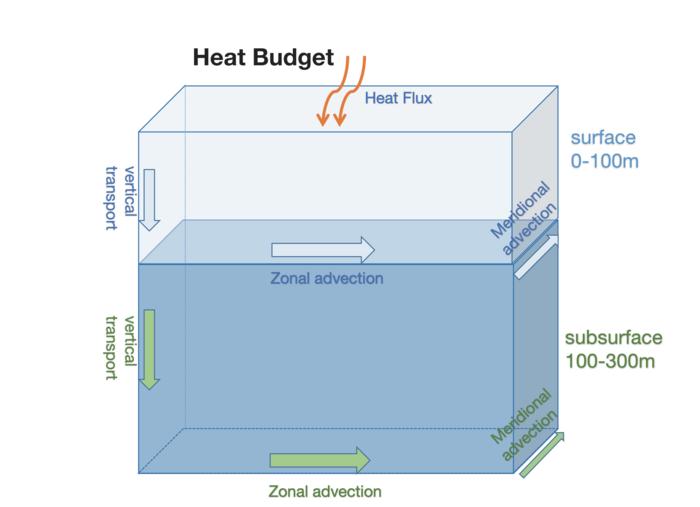
The “Blob”, a significant marine heatwave in the Northeast Pacific Ocean from 2013 to 2016, had profound effects on climate and marine ecosystems. Predicting such events is challenging due to the complexity of ocean–atmosphere interactions and the need for accurate initial conditions in models.

Credit: Tang Tiantian
The “Blob”, a significant marine heatwave in the Northeast Pacific Ocean from 2013 to 2016, had profound effects on climate and marine ecosystems. Predicting such events is challenging due to the complexity of ocean–atmosphere interactions and the need for accurate initial conditions in models.
Researchers at the Nanjing University of Information Science and Technology have made strides in predicting marine heatwaves by employing an advanced ocean data assimilation scheme. Their approach, using the deterministic ensemble Kalman filter (EnKF) technique, significantly improves forecasting for subsurface temperature anomalies, which are crucial for understanding and predicting the development of events like the Blob. The new findings have recently been published in Atmospheric and Oceanic Science Letters.
The study leveraged two assimilation schemes within the global climate forecast system developed by Nanjing University of Information Science and Technology. While the SST nudging scheme focuses solely on sea surface temperatures, the EnKF assimilates a broader range of oceanic observations, from the surface to the deep ocean. This comprehensive approach has been shown to enhance the accuracy of subsurface temperature predictions, particularly in the critical 100–300 m depth layer.
The researchers found that the EnKF scheme outperformed the SST nudging scheme in predicting both the horizontal and vertical heat transport in the lower ocean layer. This improvement is attributed to the assimilation of subsurface observational data, which are pivotal for forecasting upper-ocean conditions.
“By assimilating more ocean data, particularly subsurface temperatures, we can better predict the progression and impacts of marine heatwaves like the Blob,” says corresponding author Jingjia Luo. “Our findings underscore the importance of incorporating detailed oceanic observations into climate models.”
The research team plan to further refine their models and continue investigating the mechanisms behind marine heatwaves. Their work not only enhances our ability to predict these extreme events but also contributes to a deeper understanding of the intricate dynamics within our oceans. They provide strong support for improving future prediction models. This work is crucial for enhancing the monitoring of, and issuing warnings for, extreme climate events, and holds promise for providing a scientific basis for relevant decision-making.
Journal
Atmospheric and Oceanic Science Letters
Cite Scienmag News
Violet Maxwell. (May 14, 2024). Enhancing marine heatwave predictions with advanced ocean data assimilation. Scienmag. https://scienmag.com/enhancing-marine-heatwave-predictions-with-advanced-ocean-data-assimilation/
Violet Maxwell. "Enhancing marine heatwave predictions with advanced ocean data assimilation." Scienmag, 14 May 2024, https://scienmag.com/enhancing-marine-heatwave-predictions-with-advanced-ocean-data-assimilation/. Accessed 3 September 2026.
Violet Maxwell. "Enhancing marine heatwave predictions with advanced ocean data assimilation." Scienmag. May 14, 2024. https://scienmag.com/enhancing-marine-heatwave-predictions-with-advanced-ocean-data-assimilation/

