


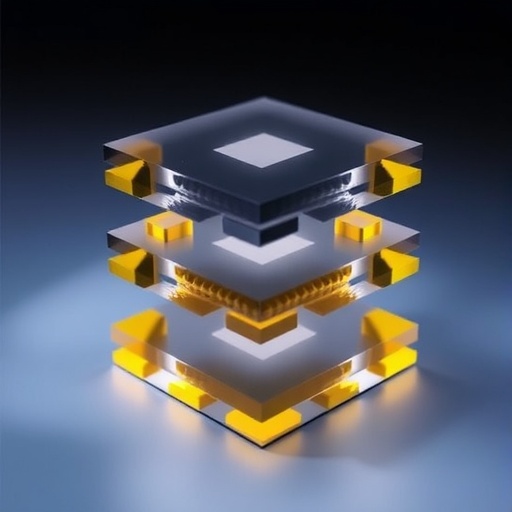

- A pyramid-interface-structured Bi2Se3 layer was electrochemically constructed on flexible carbon paper, exhibiting excellent hydrophobicity with a contact angle of 143.7°.
- Dual-mode decoupling of temperature and pressure without cross-interference was achieved using a single material in both air and underwater environments.
- The sensor maintains stable signal output under prolonged underwater operation, mechanical bending, electromagnetic interference exposure, and even direct flame contact, demonstrating exceptional environmental resilience.
view more
Credit: Yan Xu, Xuefei Zhang, Size Lou, Zhe Tang, Dongmei Xie, Chuanrui Zhang, Mengran Chen, Heng Liu*, Chuan Sun, Yixiang Ou, Peng-an Zong*.
As marine resource exploration and underwater environmental monitoring expand rapidly, conventional underwater sensors face a critical bottleneck: they typically rely on combinations of multiple functional materials to detect temperature and pressure simultaneously, requiring additional waterproof encapsulation that complicates system integration and compromises reliability. Now, researchers from Nanjing Tech University, Tsinghua University, and Tohoku University, led by Professor Peng-an Zong and Professor Heng Liu, have presented a breakthrough single-material dual-mode sensor that operates natively in both air and underwater environments.
The Pyramid Interface Advantage
Traditional dual-mode sensors often employ heterogeneous composites—such as PDMS/carbon nanotube sponges or laser-induced porous carbon films—that suffer from interfacial delamination and baseline drift upon water infiltration. Hydrophobic coatings (e.g., PDMS, polyimide) are commonly applied, but these organic layers involve complex processing, exhibit poor corrosion resistance, and attenuate signal transmission. The novel pyramid-interface-structured Bi2Se3 layer overcomes these limitations by combining intrinsic hydrophobicity, high thermoelectric performance, and piezoresistive sensitivity within a single electrochemically deposited architecture—eliminating the need for external waterproof encapsulation.
Innovative Design and Mechanism
The material is synthesized through pulsed electrochemical deposition of Bi2Se3 onto flexible carbon paper (CP), followed by thermal annealing at 300°C. DFT calculations and finite-element modeling reveal that the pyramid microstructure originates from optimized ion aggregation and nucleation kinetics at −0.02 V deposition potential. The pyramid geometry achieves a stable Cassie–Baxter state with a water contact angle of 143.7°, minimizing solid–liquid contact and promoting droplet roll-off. Simultaneously, the sloped facets induce a stress-concentration effect, causing the interlayer contact area to vary nonlinearly with pressure—enabling high sensitivity across a broad detection range. The stacked Bi2Se3/CP/Bi2Se3 multilayer assembly leverages the Seebeck effect for temperature detection (voltage signal) and piezoresistive interlayer contact modulation for pressure detection (resistance signal), with fully decoupled signal origins.
Outstanding Performance
The optimized Bi2Se3/CP film delivers a power factor of 106.0 μW m-1 K-2—nine times that of bare carbon paper—with an electrical conductivity of 779.3 S cm-1 and a Seebeck coefficient of −36.9 μV K-1. The stacked sensor achieves a rapid temperature response time of 0.9 s and a pressure sensitivity of 0.94% kPa-1, with a minimum detectable pressure of 0.1 kPa and an upper limit of 100 kPa. Notably, the sensor maintains complete signal decoupling: pressure variations show no effect on temperature sensitivity, and temperature changes do not alter pressure response—verified in both air and underwater environments. The device also exhibits exceptional environmental resilience: >62 dB electromagnetic interference shielding effectiveness across the X-band (>99.9% attenuation), stable operation after 1000 bending cycles, 100 immersion cycles, direct flame exposure for 200 s without ignition, and sustained performance in 5 wt% NaCl solution at 60°C for 100 h.
Applications and Future Outlook
When integrated into a smart mask, the sensor tracks respiratory rate in real time, distinguishing between sitting (17.09 bpm), standing (18.75 bpm), and squatting (26.67 bpm) states. A 3×3 underwater sensor array enables touch-encoded word recognition (“age,” “bed,” “hic”) and simultaneous spatiotemporal mapping of thermal and mechanical stimuli—demonstrating potential for underwater human–machine interaction. The sensor precisely monitors human joint motions (finger bending, wrist rotation, elbow flexion) and captures subtle facial expressions on moist skin, supporting underwater communication and emotion-aware diving assistants. Mounted on a robotic fish, it tracks tail-flapping propulsion for 200 s with stable periodic signal output. This work establishes a new paradigm for amphibious wearable sensing, opening promising avenues for marine exploration, environmental monitoring, and next-generation underwater robotics.
Stay tuned for more groundbreaking research from this collaborative team at Nanjing Tech University, Tsinghua University, and Tohoku University!
Journal
Nano-Micro Letters
Method of Research
News article
Article Title
Stack of Bi2Se3/Carbon Films with Pyramid Interface for Dual‑Mode Temperature–Pressure Sensing in Aquatic Environments
Article Publication Date
22-Jun-2026
Bowen Li
Shanghai Jiao Tong University Journal Center
qkzx@sjtu.edu.cn
Office: 021-62800059
Journal
Nano-Micro Letters
Method of Research
News article
Article Title
Stack of Bi2Se3/Carbon Films with Pyramid Interface for Dual‑Mode Temperature–Pressure Sensing in Aquatic Environments
Article Publication Date
22-Jun-2026
Tags
Cite Scienmag News
Violet Maxwell. (July 30, 2026). Stack of Bi2Se3/carbon films with pyramid interface for dual‑mode temperature–pressure sensing in aquatic environments. Scienmag. https://scienmag.com/stack-of-bi2se3-carbon-films-with-pyramid-interface-for-dual-mode-temperature-pressure-sensing-in-aquatic-environments/
Violet Maxwell. "Stack of Bi2Se3/carbon films with pyramid interface for dual‑mode temperature–pressure sensing in aquatic environments." Scienmag, 30 July 2026, https://scienmag.com/stack-of-bi2se3-carbon-films-with-pyramid-interface-for-dual-mode-temperature-pressure-sensing-in-aquatic-environments/. Accessed 5 September 2026.
Violet Maxwell. "Stack of Bi2Se3/carbon films with pyramid interface for dual‑mode temperature–pressure sensing in aquatic environments." Scienmag. July 30, 2026. https://scienmag.com/stack-of-bi2se3-carbon-films-with-pyramid-interface-for-dual-mode-temperature-pressure-sensing-in-aquatic-environments/

