


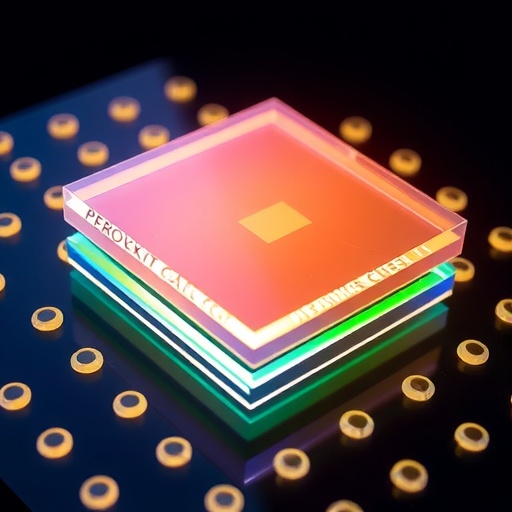
In a significant advancement in the field of solar energy, researchers from the Qingdao Institute of Bioenergy and Bioprocess Technology (QIBEBT) of the Chinese Academy of Sciences, along with their international collaborators, have successfully engineered a novel thin two-dimensional (2D) perovskite phase located at the buried interface of three-dimensional (3D) perovskite solar cells (PSCs). This breakthrough aims not only to heighten the performance of these solar cells but also to enhance their operational stability, addressing two of the most pressing challenges in photovoltaic technology today.
The methodology behind this innovative approach, as documented in the esteemed journal Nature Energy, involves a sophisticated process that significantly improves the crystallization quality of perovskite films. It also drastically reduces the concentrations of defects at the buried interfaces of these films by over 90 percent—a remarkable tenfold reduction. Such enhancements are crucial in refining the efficiency and longevity of PSCs, which are gaining traction due to their potential to revolutionize solar energy generation.
Defects present on the surfaces of perovskite solar cells represent a primary bottleneck that hinders their photovoltaic performance and operational stability. These defects can lead to increased recombination losses, reducing the efficiency of light-to-energy conversion. Traditionally, incorporating long-chain ammonium salts into the bulk perovskite has been a method to form 2D perovskite phases. However, the challenge has been to fabricate these 2D structures exclusively at buried interfaces without affecting the overall integrity of the perovskite layer.
To tackle this intricate problem, the researchers employed a pioneering strategy that involved the sequential grafting of thioglycolic acid (TGA) and oleylamine (OAm) onto the surfaces of tin dioxide (SnO2) nanoparticles. This cutting-edge material modification resulted in the formation of SnO2-TGA-OAm. The chemical bonding established between TGA and OAm is strong enough to ensure that cation exchange with formamidinium iodide (FAI) occurs specifically during the thermal annealing phase of perovskite film preparation. This controlled process enables the spontaneous development of a 2D/3D perovskite heterostructure exclusively at the film’s bottom interface.
This novel SnO2-TGA-OAm nanoparticles play a crucial role as a multifunctional electron-transporting layer within the solar cells. The resultant PSCs fabricated using this innovative component achieved remarkable power conversion efficiencies (PCEs) of up to 26.19% for smaller devices with a surface area of 0.09 cm2. This efficiency is amongst the highest levels recorded for small-sized PSCs. Furthermore, larger modules also exhibited impressive performance, achieving PCEs of 23.44% for those with an aperture area of 21.54 cm2 and a certified value of 22.68%, while larger modules with an aperture area of 64.80 cm2 recorded efficiencies of 22.22%. Such performance metrics place this research firmly at the forefront of perovskite solar technology.
The implications of these findings are monumental. As highlighted by Dr. Zhao Qiangqiang, the first author of the study, these efficiency values rank among the highest reported for small-sized PSCs and larger modules that are based on 2D/3D perovskite heterojunctions. Such advancements indicate a trajectory towards enhanced commercialization potential for perovskite photovoltaic technology.
Moreover, the researchers are optimistic about the scalability of this in situ solid-state ligand-exchange strategy. They assert that this innovative method is easily adaptable from laboratory-scale production to industrial manufacturing settings. According to Prof. Pang Shuping, a corresponding author of the study, the enhancements in operational stability are pivotal in bringing the long-anticipated commercialization of PSCs closer to reality.
This work not only enriches the scientific knowledge surrounding perovskite photovoltaic technology but also sets a standard for future research in the field. It opens new avenues for the development of 2D/3D heterojunctions at the buried interfaces of perovskite absorber layers, promising to accelerate the transition of perovskite photovoltaic technology into practical applications.
The potential for perovskite solar cells to become a leading player in the renewable energy landscape cannot be understated. As the world increasingly turns toward sustainable energy solutions, advancements like these serve to underline the importance of ongoing research and innovation in the solar energy sector. By enhancing the efficiency and reliability of solar cells, researchers are not just improving technology; they are paving the way for a cleaner, more sustainable future.
Moving forward, it will be crucial to monitor how these findings influence the design and production of future solar cells. The landscape of renewable energy is rapidly evolving, and innovations in materials science, such as those presented here, are integral in shaping the future of energy production.
As researchers continue to explore the potential of perovskites and implement novel strategies to address existing challenges, the role of collaborative international research efforts remains vital. The crossing of boundaries in scientific inquiry fosters innovation that can lead to significant technological advancements. Judging by the outstanding results shared by the QIBEBT team and their collaborators, the future of perovskite solar cells is indeed poised for promising developments.
Furthermore, as this technology moves towards commercialization, stakeholders such as policymakers, investors, and industry leaders will need to engage closely with scientific communities. Coordinated efforts will be necessary to integrate these advancements into broader energy frameworks and set the stage for a future dominated by renewable sources.
In conclusion, the engineering of a 2D perovskite phase at the buried interfaces of solar cells signifies a transformative step in the evolution of photovoltaic technology. As the world grapples with energy supply challenges and the urgent need for climate action, breakthroughs of this nature hold the key to unlocking the full potential of solar power as a viable and sustainable energy source.
Keywords
Cite Scienmag News
Denise Maddox. (February 6, 2026). Enhanced Performance of Perovskite Solar Cells Achieved Through Interface Engineering. Scienmag. https://scienmag.com/enhanced-performance-of-perovskite-solar-cells-achieved-through-interface-engineering/
Denise Maddox. "Enhanced Performance of Perovskite Solar Cells Achieved Through Interface Engineering." Scienmag, 6 February 2026, https://scienmag.com/enhanced-performance-of-perovskite-solar-cells-achieved-through-interface-engineering/. Accessed 5 September 2026.
Denise Maddox. "Enhanced Performance of Perovskite Solar Cells Achieved Through Interface Engineering." Scienmag. February 6, 2026. https://scienmag.com/enhanced-performance-of-perovskite-solar-cells-achieved-through-interface-engineering/


